

Your brain is not an empty bucket waiting to be filled. It’s a bustling construction site, where new information is actively shaped and integrated alongside what you already know. This core idea is the foundation of constructivist learning theory.
Constructivism emphasizes the role of learners in building their own knowledge through their experiences and interactions with the world.
As John Dewey notes, “We do not learn from experience, we learn from reflecting on experience”. This active approach empowers us to continually build and refine our understanding of the world around us.
In this article, we’ll dive into the core ideas of Constructivism, explore how it empowers learners, and discover the benefits it can bring to your classrooms and training programmes.
Ready to construct a deeper understanding? Then let’s get started!
What is Constructivist Learning Theory?
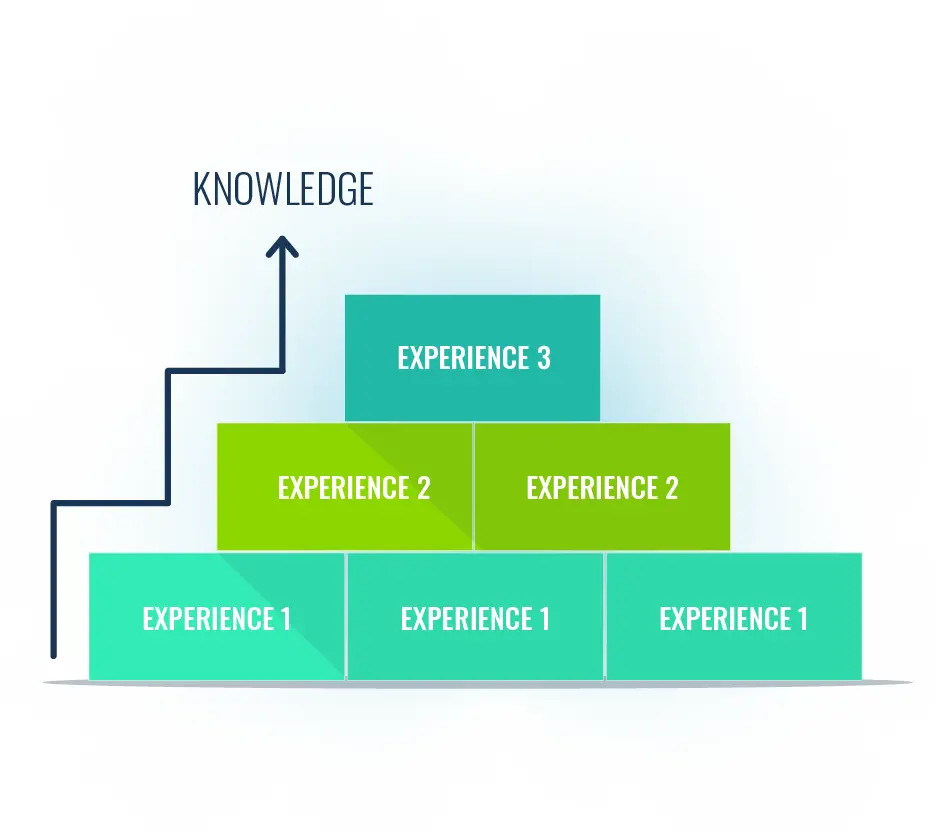
Constructivist learning theory is a powerful approach to education that emphasises the active role of learners in constructing their own knowledge. This contrasts with traditional instructional approaches, where teachers simply impart information.
With this approach, learners build their knowledge by interacting with the world and reflecting on their experiences. Here are the key ideas of constructivism:
- Active Engagement: With a constructivist approach, knowledge is not passively received. Learners actively construct their understanding by integrating new information alongside existing knowledge.
- Experience: Learning happens best through hands-on activities, exploration, and grappling with new information. John Dewey and David Kolb would approve.
- Social Interaction: Constructivists (in large part) agree that collaboration and dialogue with others can significantly enhance learning outcomes.
- Knowledge in Flux: As we encounter new experiences, our understanding of the world is continuously refined and updated.
This approach differs from cognitivism, which acknowledges the role of our internal mental processes, but downplays the active role of learners in constructing their own knowledge.
Likewise, whilst behaviourism focuses on observable actions and responses, constructivism goes deeper, by emphasizing the importance of what students are thinking and the role of their previous experiences.
It’s easy to understand why a learner-centric model like constructivism has gained such traction. After all, by encouraging active engagement and cultivating critical thinking skills, you’ll drive towards deeper understanding and improved knowledge retention.
Types of Constructivist Learning Theory
The origins of constructivist learning theory can be traced back to the work of several key figures, with two main strands emerging:
1. Cognitive Constructivism
This strand focuses on how individuals build knowledge through their own experiences and interactions with their environment. It can be traced back to Jean Piaget’s work in the early 20th century. He suggested that through processes of assimilation and accommodation, humans build their own knowledge.
- Assimilation: When we assimilate new information, we integrate it within our existing framework, or our current understanding of the world, without adapting the framework.
- Accommodation: When we accommodate new information, we use it to update our existing frameworks, or our understanding of the world around us.
For example, a young child might initially call all four-wheeled vehicles ‘cars’, assimilating them into an existing category (or schema) within their mind. However, after further experience, they may come to accommodate new categories such as ‘van’ or ‘truck’.
In other words, new information is integrated with whatever knowledge they already hold. Our previous experiences, skills and knowledge act as the scaffolding from which we can expand our understanding.
Knowledge can’t simply emerge from sensory experience alone. As a result of our previous experiences, we have a standardised way of responding to the world. What we call behaviour patterns, or reflexes, Piaget would call ‘schemas’.
These mental frameworks help us to organise and structure our thoughts. We assimilate new information by fitting it into these existing schemas.
For example, a child might have a schema about dinosaurs based on watching Jurassic Park. As a result, they might believe that all dinosaurs were scaly creatures. However, through further research, they might discover that many dinosaurs actually had feathers.
This new information can then be used to update their dinosaur schema, creating a more nuanced understanding.
2. Social Constructivism
This strand of constructivism emphasises the role of social interaction and collaboration in learning. It finds its roots in the work of Lev Vygotsky, a Russian psychologist whose ideas, although developed contemporaneously with Piaget’s, remained largely unknown in the West until the 1970s.
Vygotsky proposed the concept of the ‘Zone of Proximal Development‘ (ZPD). This is the gap between what a learner can do independently and what they can achieve with guidance and support from more knowledgeable others.
This support comes in the form of ‘scaffolding’, which refers to the temporary structures and guidance offered by our teachers, instructors and mentors. This scaffolding should help us to reach our Zone of Proximal Development.
As the learner gains competence and confidence, the scaffolding can be gradually removed, allowing them to tackle challenges independently.
Today, constructivism is seen as a broad framework encompassing both cognitive and social aspects of learning.
What About Now?
The question of how learning happens and knowledge forms remains. Multiple studies have taken place since Piaget’s heyday. For example, researchers conducted an experiment in 2004 on third-grade students.
Three learning approaches were used: a traditional approach, an instruction only approach, and an approach with constructivist motivation techniques like hands-on activities. This is called CORI (Concept-Oriented Reading Instruction). The constructivist approach was shown to be the most effective and resulted in improved reading comprehension, cognitive strategies, and motivation.
A recent 2023 study examined the impact of using constructivist learning approaches (including smart classroom environments, peer engagement, cooperativity, etc.) on learning outcomes. The study found that it had a positive impact on critical thinking, creativity and academic performance.

Constructivist Learning Theory in Practice
How does constructivism impact your training programme and classroom setups? Let’s take a look!
1. Focus on the Learner

According to constructivist learning theory, each learner constructs their knowledge based on prior information and experiences. As such, you should take care to treat every learner as an individual.
Learners will naturally make their own deductions based on their background or culture. This means learner-led experiences, personalisation, and open access to training content are the order of the day. After all, the expectation for learners to take ownership of their learning is greater.
However, as we’ve seen from social constructivist theory, this individualism should not prevent you from adopting a social learning strategy. Each individual learner can still construct their knowledge through interactions with others.
2. Shift the role of the Instructor

Despite the focus on the individual, instructors still play an important role. After all, to help encourage learners to construct their own interpretations, you’ll need to create a supportive learning environment. The right instructor can help to make this happen.
With a constructivist approach, instructors need to become adept at facilitating learning rather than delivering it. Instead of telling learners about concepts, ask them so they can draw their own conclusions.
Consequently, the learning process becomes much more active and your learners will be much more engaged. According to Gallup, engaged learners are 2.5x more likely to report good test results.
Characteristics of Constructivism
Let’s take a look at some of the key characteristics of a constructivist learning or teaching approach:
- Learning is a never-ending experience. Our understanding of the world is constantly expanding.
- In this sense, learning could be seen as a search for meaning.
- We should make sure that we understand concepts as a whole, rather than just in parts.
- Curricula should be customised for different students.
- Collaborative and conversational learning can be remarkably effective.
- And regular assessments and assignments are useful to check understanding.
Now let’s take a look at a few of the ways constructivist learning theory can help with your online learning initiatives.
Online Learning and Constructivist Learning Theory
Increased Collaboration

Social constructivist models make it clear that collaboration between learners is essential.
As such, making use of collaborative tools on an online learning platform, such as a learning management system or learning app, is really beneficial.
On Growth Engineering LMS, there are features that help to facilitate this. For example, learners are able to post to various social feeds across the platform. These feeds provide learners with a comprehensive view of discussions and enable them to join in on the action.
As a facilitator rather than a teacher, you should aim to promote discussion and interaction by asking questions and challenging your learners.
This can help to drive real business impact. Did you know that collaborative tools are able to increase workplace productivity by 30%? That’s the power of social!
Increased Communication

With any training initiative, communication with your learners is vital. A survey of 400 companies found that those with poor communication reported an average loss of $62.4 million per year. Ouch!
Thankfully, there are other social features you can use to bolster communication between you and your learners, helping to improve knowledge retention. This includes:
1. Expert Area: In this area, subject matter experts (SMEs) are available to engage with your learners and answer any questions they may have. What’s more, all questions and answers are made available for everyone to view in the FAQs section.
2. Live Chat: This puts the power of instant messaging in the hands of your learners. As a result, your audience can easily discuss topics with each other in a free-flowing environment.
3. Clubs: On Growth Engineering LMS, you have the ability to create Clubs. These social Clubs can be based on any topic that you choose.
Learners are then able to join Clubs relating to a topic they want to learn about. As learners add their own contributions to the discussion, Clubs become a library of user-generated content.
4. Push Notifications: With constructivist learning approaches, your role becomes more of a facilitator than instructor. Therefore, you should also make use of push notifications.
On Growth Engineering Learning App, you can send learners custom notifications. This way you’ll be able to direct them to new content, or exciting discussions taking place.
Increased Motivation

Constructivist learning theory is also great for boosting the motivation of your learners. After all, you’re empowering your audience to take more control and ownership over their learning journey.
In a recent study, empowered employees scored engagement levels in the 79th percentile. On the other hand, disempowered workers scored engagement levels in the 24th percentile.
As such, it’s clear you need to make your learners feel competent and intrinsically motivated. You can do this with Epic Meaning.
Epic Meaning is that sense of purpose that fuels a learner’s passion for progress. Gamification, the use of game mechanics in a non-gaming environment, is great for generating purpose.
On many modern learning platforms, as learners progress through their content they ‘level up’. Additionally, you can give them rewards for completing modules or assessments. These include experience points and badges, alongside movement on platform leaderboards.
Criticisms of Constructivist Learning Theory
As with many other learning theories or models of learning, constructivist learning theory has been subject to its fair share of critique.
For instance, some critics suggest that it encourages an unguided learning style with a lack of structure. This can cause issues for learners who need more support and direction in their learning journey.
Other critics note that the theory focuses on cognitive elements at the expense of considering environmental or even technological factors. This is something that connectivism learning theory would later try to address.
Lastly, a common criticism suggests that some students may find it difficult to link new knowledge with their past experiences. After all, many traditional learning environments fail to explicitly develop the metacognitive skills necessary to bridge this gap.
And there’s one criticism in particular that you need to be mindful of. Keep reading!
Something to Be Mindful Of

One small note. Moving from teacher or instructor to facilitator and mentor can be difficult. You need to consider how you give your students free reign.
Letting students take control of their own learning can result in disorganisation. In a recent study, results showed that it was important for students to set their own goals. By doing this, they can tailor their learning to their own requirements.
However, many of the participants were worried that their goals wouldn’t meet external requirements or expectations. These concerns stemmed from not knowing what was needed for their roles and their lack of familiarity with the learning content.
To address this concern, you should clearly outline the responsibilities associated with each role. This way learners will understand which content is relevant and worthwhile. Additionally, encouraging collaboration and providing advice and feedback is helpful.
Final Words
We’ve covered a lot. And we did it bit by bit, building our knowledge as we went!
The key takeaway is that constructivist learning theory empowers learners to actively build their knowledge. After all, we all process information in different ways, based on previous experiences. We’re all different people.
However, it’s still important that you set clear parameters, provide guidance where necessary, and assess your learners’ progress. That way your learners are sure to construct something great!
Thank you for reading. Download our guidebook ‘The Learning Theories & Models You Need to Know’ now to find out how to add structure, shape and form to your training initiative! Alternatively, click the links below to explore the individual theories:
- Behavioral Learning Theory
- Cognitive Learning Theory
- Humanistic Learning Theory
- Connectivism Learning Theory