
We read a dozen guides to UK learning management systems before writing this one. They list the same platforms every time: Docebo, Cornerstone, TalentLMS, Absorb. All good systems. But not one of them is headquartered in Britain.
This list is different. Every company on it runs from the UK, which matters more than it sounds: it changes who picks up the phone at four o’clock, whose working week matches yours, and who already knows what the CQC or FCA is going to ask you for.
We haven’t ranked them. A number one would have to be best for everyone, and none of these is: the platform that suits a care home chasing certificate renewals is the wrong buy for an investment bank evidencing FCA compliance. Each entry covers what it costs, who owns it, and where it falls short.
If you’re after the best of British, start here.
The 12 UK LMS Platforms Compared
Twelve platforms, listed alphabetically. Use the “best for” column to find the two or three worth your time and then dig into the details below. Where the type says LMS / LXP, the platform does both.
Price bands are indicative annual cost for around 500 users (including licensing but not implementation or content).
| Platform | Best for | Type | HQ | Price | B Corp |
|---|---|---|---|---|---|
| Access Learning | HR and learning in one suite | LMS | Loughborough | ££ | No |
| Confirm (was Learning Pool) | Large enterprise, public sector | LMS + LXP suite | Derry | ££ | Yes |
| Fuse Universal | Frontline and deskless teams | LMS / LXP | Kent | £££ | No |
| Growth Engineering | Behaviour change, not just completion | LMS | London | ££ | Yes |
| Kallidus | Mid-market, public sector, compliance | LMS | Altrincham | £ | Yes |
| Learn Amp | Mid-market people teams | LMS | London | £££ | Yes |
| myAko | Health and social care, CQC | LMS | Dorset | ££ | No |
| Nimble Elearning | Small business | LMS + authoring | Gloucestershire | £ | Yes |
| Open eLMS | Apprenticeships and qualifications | LMS | Maidenhead | £ | No |
| Skillcast | Financial services, legal, insurance | Compliance platform | London | ££ | No |
| Thrive | Replacing several tools with one | LMS / LXP | Nottingham | £££ | No |
| Totara | Open source at enterprise scale | LMS | London | ££ | No |
£ under £15k · ££ £15k to £50k · £££ £50k+
Our LMS pricing guide explains how vendor pricing usually works.
What Counts as a UK LMS?
We set one clear rule: the company’s operating headquarters must be in the UK.
That’s a narrower test than it sounds. Almost every learning platform on earth is “available in the UK”, which is why the usual lists are interchangeable. But being run from here is different. It determines:
- Support hours
- Contract terms
- Regulations and restrictions
So Docebo (Toronto), Cornerstone (Santa Monica), TalentLMS (Athens), 360Learning (Paris), and LearnUpon (Dublin) are all out. Not because they’re weak, but because they aren’t what this list is for. We’ll cover them separately.
LMS vs LXP: Which Platform Do You Need?
In basic terms, a learning management system (or LMS) assigns learning and keeps the records. A learning experience platform (or LXP) recommends learning and gets out of the way. A training management system runs the logistics (think trainers, rooms, cohorts, etc.).
Those lines have blurred, though. Plenty of vendors describe themselves as both, because it widens their audience. Most modern LMSs now ship with recommendation engines, social feeds, and curated content. These are the things that defined an LXP five years ago.
So the label is the wrong thing to shop on. Instead, decide what you need the platform to do:
- If anyone will ever ask you to prove training happened (such as a regulator, an auditor, an insurer, or a client), then you need an LMS. That isn’t a preference, it’s the platform’s whole job.
- If the problem is that nobody touches the training you already have, engagement features will help. So will better content. You’re best off starting with a full audit of your approach.
- If the problem is running courses rather than delivering them (booking trainers, filling cohorts, chasing invoices), then you want a training management system.
We’ve labelled each platform in the table above. The longer explanation, including where an LCMS fits, is in LMS vs LCMS vs LXP: what’s the difference?
The 12 UK LMS Providers in Detail
1. Growth Engineering
Best for: organisations who need training to change behaviour, not just be completed
- HQ: London
- Ownership: Independent, owned by its founder
- Hosting: UK, US, and APAC
- B Corp: Yes
- Price: ££
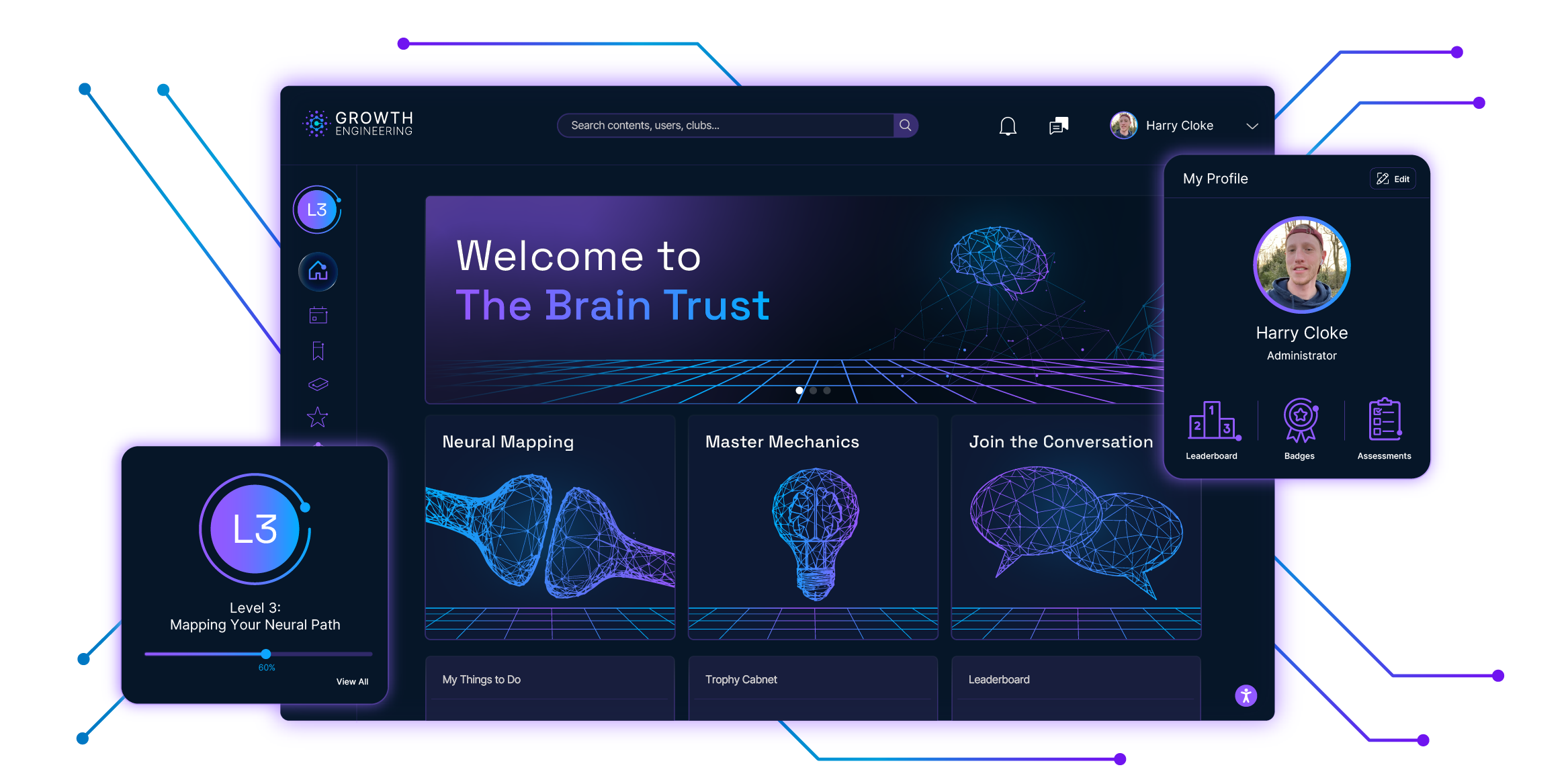
We build the Impact Suite, which includes Growth Engineering LMS, Learning App, Authoring Tool, and Zavmo, our AI learning companion. We have 120+ industry awards. Customers include L’Oréal, Hewlett-Packard, EE and Caffè Nero.
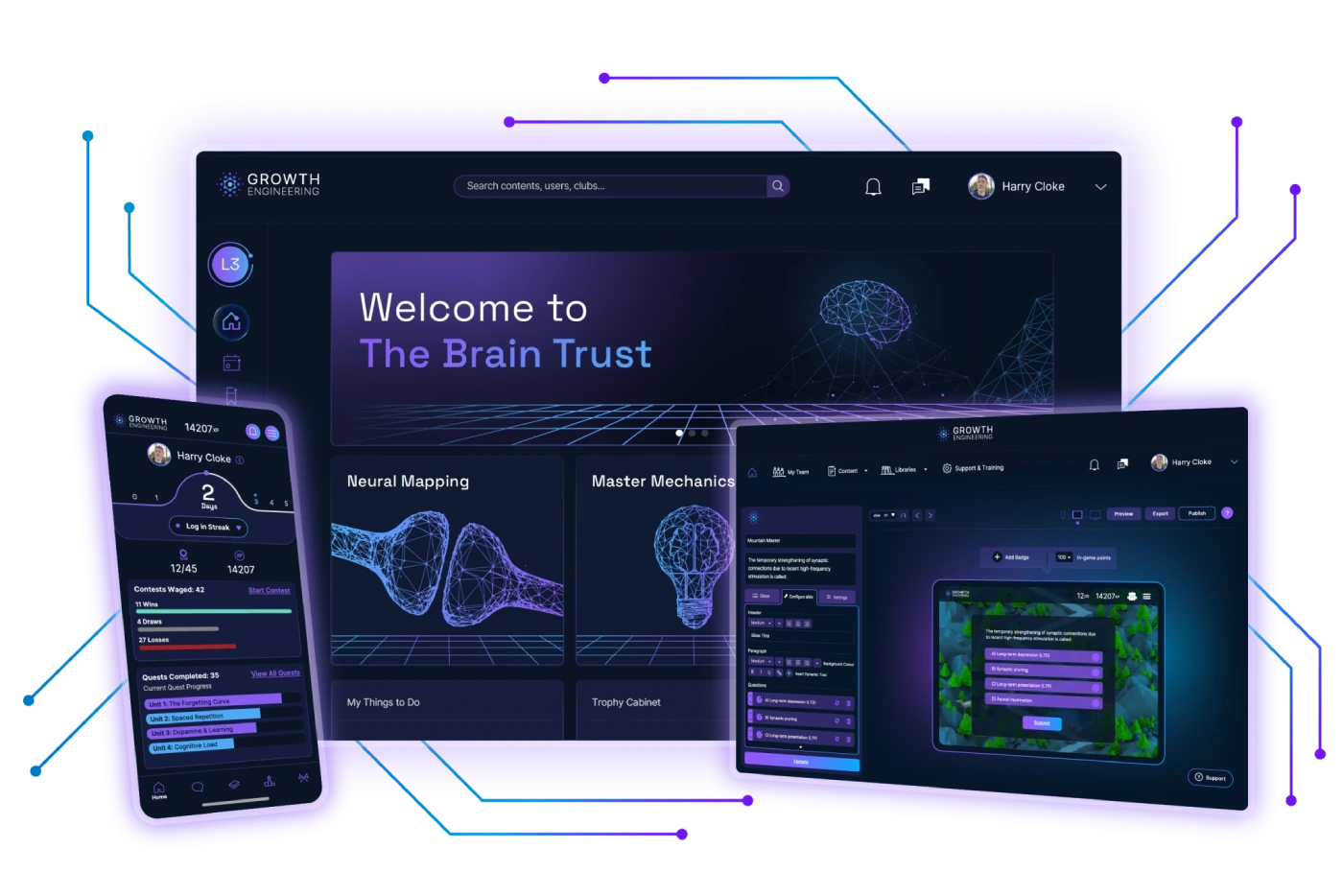
The platform is built around Neurogogy, our term for designing learning systems against what is actually known about memory, attention, and transfer, rather than what has become conventional in L&D. The Impact Suite respects cognitive load rather than testing how much of it people will tolerate.
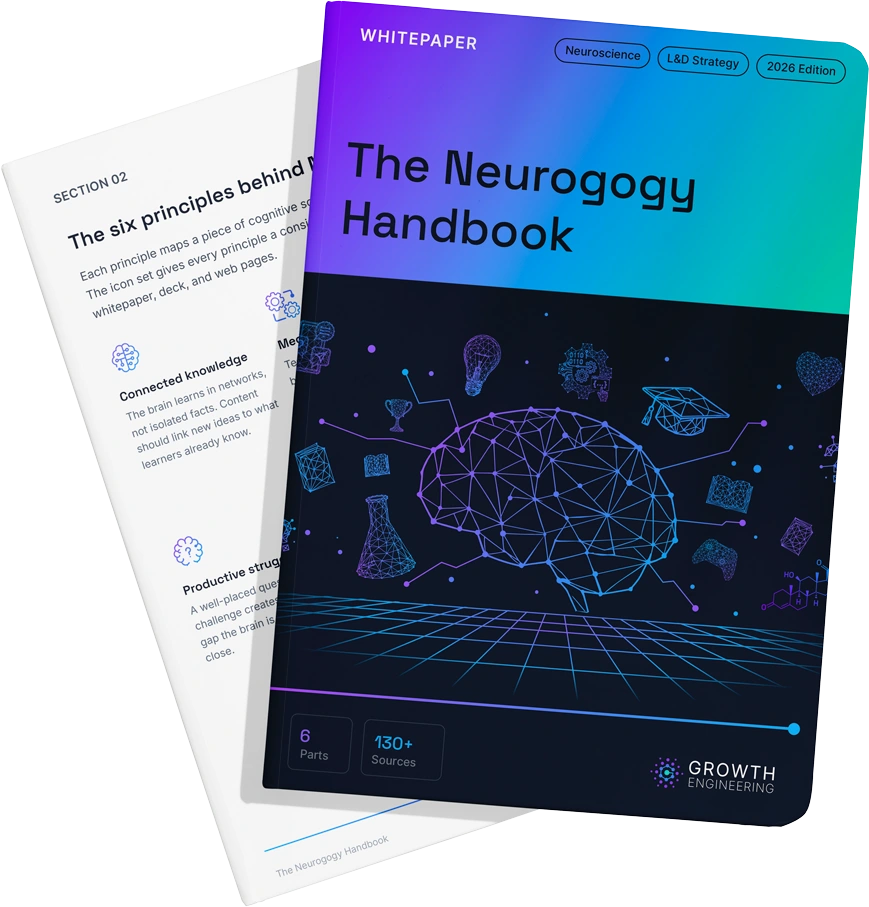
The Neurogogy Handbook sets out the 130+ primary sources behind it, including several widely cited figures that did not survive the checking.
We provide platforms rather than training content. If you are starting from nothing we can introduce you to the content partners we work with, but the library is not bundled in the way it is with several vendors on this list.
The honest limitation is one of fit. If all you need is a record that mandatory training was completed, this is more platform than the job requires, and several here will do it for less. We are built for organisations that want their training to work.
Want to see more? Head here.
2. Access Learning
Best for: enterprise and public sector buyers consolidating suppliers
- HQ: Loughborough
- Ownership: Private equity
- Hosting: United Kingdom
- B Corp: No
- Price: ££
Access Learning is the learning arm of The Access Group, one of the largest business software companies in the UK. If you already run Access for HR, finance or payroll, the learning module plugs into the same workspace and the same user records, which removes most of the integration work that often sinks LMS projects.
The learning capability was bought, not built. Access acquired Unicorn Training, a Bournemouth compliance training specialist with roots going back to the early 1990s, in April 2019. That business became the core of what Access now sells as Access Learning.
That history is also the limitation. You are buying into an ecosystem rather than a product, and Access has acquired more than a hundred companies in a decade. Integration depth between any two of them varies, so ask specifically about the modules you actually intend to use.

3. Confirm
Best for: organisations that want one supplier for learning and performance
- HQ: Derry, Northern Ireland
- Ownership: US private equity
- Hosting: UK and US
- B Corp: Yes
- Price: ££
Confirm is the platform most UK L&D teams still know as Learning Pool. Founded in Derry in 2006 and rebranded to Confirm in August 2026, it has one of the longest track records in UK public sector learning, and the portfolio now runs as Engage, Learn:Up, and Perform.
The suite genuinely spans LMS and LXP behaviour rather than bolting a recommendation engine onto a course catalogue, which matters if you are trying to serve mandatory training and self-directed development from the same place.
The limitation is that this British learning platform is no longer British-owned. Marlin Equity Partners, a US private equity firm, acquired Learning Pool in 2021. The team, the Derry base, and the track record are all still there, but the strategic direction now sits in Los Angeles.
4. Fuse Universal
Best for: social and peer-led learning in distributed workforces
- HQ: Kent
- Ownership: Venture-backed
- Hosting: Not published
- B Corp: No
- Price: £££
Fuse was founded in 2008 as Fusion Universal and built its reputation on knowledge sharing rather than course delivery. The model assumes your best content already exists inside the organisation, in the heads of the people doing the work. The platform’s job is to surface and circulate it.
For field teams, retail networks, and frontline operations, that is a more honest description of how learning actually happens than a course catalogue is.
The limitation is the standards footprint, and for an enterprise buyer in 2026, it is a serious one. Fuse supports SCORM 1.2 with single-SCO packages only, and has no xAPI support at all. If you have any interest in learning analytics that go beyond completion records, then check compatibility before you shortlist rather than after.
5. Kallidus
Best for: mid-market buyers who want learning and talent management together
- HQ: Cheshire
- Ownership: Private equity
- Hosting: United Kingdom
- B Corp: Yes
- Price: £
Kallidus has been trading longer than almost anyone on this list. The company was incorporated in April 2000 as e2train and took the Kallidus name in 2011, after its own LMS product had become better known than the company selling it.
It has grown by acquisition since: Intraventure in 2011, Engage in Learning in 2020, and Sapling in 2021, which took it into full human capital management. The platform has a strong focus on talent management, compliance reporting, and business impact.
The limitation is that three acquisitions in a decade means three product lineages. Learning, talent, and recruitment came from different places, and the seams show. Ask to see the specific combination of modules you want, working together, rather than a demo of each in isolation.

6. Learn Amp
Best for: mid-market people teams, 200 employees and up
- HQ: London
- Ownership: Private equity
- Hosting: United Kingdom
- B Corp: Yes
- Price: £££
Founded in 2016 by Duncan Cheatle, Joe Hill-Wilson, and Matt Jeffries, Learn Amp has the strongest standards support of any platform on this list: SCORM 1.2, SCORM 2004, xAPI, AICC, and CMI5.
If you have years of existing content, or you want learning data that goes beyond completion records, this is the shortest path to getting it in and getting it out. It has been a certified B Corp since November 2021.
The limitation is timing. Cezanne HR acquired Learn Amp in June 2026. A recent acquisition means the roadmap you are shown today may not be the one you get in eighteen months. Ask what has been committed in writing.
7. myAko
Best for: compliance-led training in care, education, and logistics
- HQ: Dorset
- Ownership: Independent, owned by its founder
- Hosting: United Kingdom
- B Corp: No
- Price: ££
myAko takes its name from ako, the Māori concept in which teacher and learner are the same person. Founder and chief executive Kevin Ashley built it after years reselling somebody else’s LMS.
The design reflects a specific frustration with that experience: certificate expiry, renewal scheduling, and audit reporting are core behaviours here, not configurations you bolt on afterwards.
The limitation is scale. myAko is a genuinely small business, with three employees on its most recent filings. That brings real advantages, including direct access to the person who built the product, but it also means a thinner bench if things go sideways.
8. Nimble Elearning
Best for: small businesses that need to build their own courses
- HQ: Gloucestershire
- Ownership: Independent
- Hosting: Not published
- B Corp: Yes
- Price: £
Nimble was incorporated in 2009 as eLearning247 and took its current name in 2017. It pairs an authoring tool with a straightforward LMS, and the pitch is genuine simplicity: a subject matter expert can easily use the platform to build and publish a course without a learning technologist standing behind them.
Nimble became a certified B Corp in May 2025, and offers a 15% discount for charities.
The limitation is depth. The assignment and enrolment functionality is the lightest of any platform here. If you need complex learning paths, conditional routing by role, or anything resembling a curriculum that adapts to who is taking it, you will hit the ceiling quickly.
9. Open eLMS
Best for: apprenticeships and qualification providers
- HQ: Maidenhead
- Ownership: Independent, founder-controlled
- Hosting: United Kingdom
- B Corp: No
- Price: £
Founded in 2003 as eLearning WMB and renamed in April 2022, Open eLMS bundles authoring and delivery rather than selling them separately. Its AI course generation will draft a module from a policy document or a set of slides, which is a great time saver.
The LMS underneath is fuller than their pricing suggests. Certificate expiry and renewal tracking are built in, and most standard learning system functionality is covered.
The limitation is that bundled authoring trades flexibility for speed. The templates get you to a finished course quickly, but they look like templates. If your brand team has opinions about how learning should look, budget for that conversation.

10. Skillcast
Best for: regulated sectors that need to evidence compliance
- HQ: London
- Ownership: Independent, AIM-listed
- Hosting: United Kingdom
- B Corp: No
- Price: ££
Skillcast listed on AIM in December 2021, which makes it the only platform on this list whose accounts, governance, and financial position you can read before you buy. For a compliance-focused platform, this is more than just a curiosity.
Beyond all the compliance functionality, Skillcast also offers a comprehensive library of 600+ expert-backed courses. Topics include cybersecurity, risk management, and data protection (GDPR).
The limitation is the platform’s focus. If you want a system that also handles onboarding, skills development, and career pathways, this is not it. The compliance-shaped assumptions run deep enough that bending it into a general-purpose LMS will be a fight.

11. Thrive
Best for: enterprises replacing several tools with one
- HQ: Nottingham
- Ownership: Independent, founder-controlled
- Hosting: UK, US, and UAE
- B Corp: No
- Price: £££
Thrive is a genuine LMS and LXP hybrid rather than one wearing the other’s label. Compliance assignment and content discovery sit side by side, which solves a real problem: most organisations need both and end up buying two systems that don’t talk to each other.
It is also one of very few platforms here to have scaled without outside money. Founder Sean Reddington retains control, and the company reached a reported £150m valuation with no external funding, which is close to unheard of in learning technology.
The limitation is how fast it has grown by acquisition, and how recently. Thrive bought Guider, a mentoring and coaching platform, in July 2025, and Huler, a smart intranet, weeks later in August. Both are young integrations. If what appeals to you is the combined proposition, rather than the core platform, ask to see the joins.

12. Totara
Best for: large or heavily regulated organisations that want to own their configuration
- HQ: London
- Ownership: Private equity
- Hosting: Partner-dependent
- B Corp: No
- Price: ££
Totara began in New Zealand and now operates from London. Ownership moved from Five V Capital to Tenzing in August 2024.
It is built on an open architecture and distributed through a partner network rather than sold direct. That model suits organisations with genuinely unusual requirements. This could include complex hierarchies, multi-tenancy, or workflows no configuration screen can cater for.
That partner model is also the limitation. You’re not really buying from Totara, you’re buying from whichever partner implements it, and the quality of that relationship will determine almost everything about your experience. Choose your partner at least as carefully as you choose your platform.
How to Narrow This List Down
Twelve is a longlist, not a shortlist. The fastest way to get to your platform of choice is to start ruling systems out. The following questions will help you to get there:
- Is it a learning platform or learning module? Access, Kallidus and Confirm sell learning as part of a bigger suite. Decide whether you want one supplier or the best platform available, because either answer removes half this list.
- Who owns it, and since when? Learn Amp was acquired in June 2026, Totara changed hands in 2024, Confirm rebranded last month (at the time of writing). A new owner has not yet made the decisions that will shape your roadmap.
- What is it built on? Most platforms are designed around a feature list. A few are designed around evidence of how adults actually acquire and retain knowledge. Ask which, then ask them to show you the research.
- What happens to your content? Standards support decides what survives migration and what gets rebuilt. Learn Amp supports everything. Fuse supports SCORM 1.2. It’s much cheaper to discover this now than in month three.
- What does it cost at your headcount? Most learning management systems require a three-year contract, with a one-off setup fee and monthly or annual licensing fees. Our LMS pricing guide explains how the banding works.
We would argue Growth Engineering belongs in your top three. It’s independent rather than private equity owned, built as one system rather than assembled through acquisition, and designed around cognitive science rather than feature count.
Test that claim against the entries above rather than taking our word for it, and read the LMS buyer’s guide for the full process.
Final Words
So, there we have it. The best of British.
Every “best UK LMS” list we found before writing this one was populated by companies headquartered in Milan, Boston, or Sydney. Twelve entries later, the more interesting finding is how much genuine British learning technology exists, and how little of it shows up in these lists.
It’s also moving quickly. Three of these twelve changed hands or changed names in the last two years, and most comparison articles you will read will not have caught up. Check the date on anything you read about this market, including this.
If you want to see what a platform designed around how the brain actually learns looks like in practice, then book a demo of the Impact Suite. And if we have a detail wrong about your platform, tell us and we will correct it.
None of these twelve is the best LMS in the UK. But one of them is the best LMS for you. We hope this list helps you find it.