
Almost every gamification LMS on the market will show you points, badges, and a leaderboard. That’s the easy part. The hard part is using game mechanics to help people remember more and come back without being chased.
Points for logging in only teach people to log in. Conversely, points for recalling a product detail under pressure, or for beating a colleague in a contest, change what they know and what they can do. Gamification only improves learning if it’s strategically applied.
Unfortunately, several well-known platforms stop at points, badges, and leaderboards. That’s why they didn’t make our list. The 10 below go further, with competitions, real rewards, unlockable content, and even challenges that adapt to what each person knows.
They aren’t ranked. Instead, each one is labelled by who it suits, because the right choice depends on what you want your people to do differently. Game on.
What a Gamification LMS Actually Has to Do
A gamification LMS is a learning management system that uses game mechanics to change how people learn, not just how often they log in. We held every platform below to three clear tests:
- Is It a Real LMS? It must assign training, track completion, and report on it. Quiz apps and standalone gamification engines don’t count.
- Does It Go Beyond Badges? Points, badges, and leaderboards are table stakes. Each platform needed at least one advanced game mechanic.
- Can You Set the Rules? Admins must decide what earns points, so rewards follow the behaviour you want rather than the vendor’s defaults.
Once a platform clears those criteria, these questions show where it stands out:
- What Does It Reward? Points for recalling information build memory. Points for opening the app build habits, but not always useful ones.
- Can People Compete and Collaborate? Head-to-head contests sharpen recall, while team challenges help to bring quieter learners along.
- Are the Rewards Worth Having? Vouchers, perks, and prizes add pull for people who don’t care a jot about leaderboard rankings.
- Does the Challenge Adapt? Spaced repetition brings topics back just before people forget, and adaptive questions get harder as they improve.
- Can You Keep It Fresh? Novelty fades fast. Look for platforms that let you run new contests, reset scores by season, and retheme games to match your campaigns.
- Can You See What It Changed? Reporting should show knowledge and behaviour, not just how many badges your people have collected.
The Big Names That Didn’t Make It
Several familiar platforms fell short. This list includes Adobe Learning Manager, iSpring Learn, LearnUpon, Litmos, Schoox, TalentLMS, and 360Learning. All these systems offer some mix of points, badges, and leaderboards, but they don’t go much further than that.
This matters, because design decides the result. Gamification works when it taps into how the brain handles reward and memory, and it backfires when it doesn’t. Our guide to the neuroscience of gamification explains the difference.
The 10 platforms below do more than keep score.
The 10 Gamification LMS Platforms Compared
Here’s each platform at a glance: who it suits, what it offers beyond badges, where it’s hosted, and roughly what it costs. Growth Engineering makes the Impact Suite, which is why we come first. Everyone else is in alphabetical order.
At a Glance
| Platform | Best for | Beyond badges | Hosting | Price |
|---|---|---|---|---|
| Growth Engineering | Gamification that builds lasting knowledge | Knowledge and Squad Contests, Reward Centre, streaks | AWS: UK, US, APAC | ££ |
| Absorb LMS | Adding competition to an established corporate LMS | Time-limited team competitions (Engage add-on) | AWS: US, Canada, EU, Australia | ££ |
| Axonify | Daily reinforcement with real prizes | Arcade games, prize auctions, raffles, spin-to-win | Google Cloud: US, EU, APAC | £££ |
| Beedeez | Store teams competing on their phones | Quiz battles and store-vs-store competitions | Scaleway: France | ££ |
| CYPHER Learning | Games tied to skills and competencies | Course games, team games, periodic levelling | AWS: US, EU, Australia | ££ |
| Docebo | Enterprises running contests and rewards at scale | Contests and a rewards shop | AWS: US, Canada, EU, UK, APAC | £££ |
| Mitti | Operations teams wanting game templates and spaced repetition | 80+ game templates and spaced repetition | AWS: US, EU, Australia | £££ |
| OttoLearn | Reinforcing knowledge alongside your existing LMS | Adaptive mastery, contests, rewards store | AWS: Canada | £ |
| Paradiso LMS | Teams wanting detailed point rules on a budget | Cross-team challenges and bonus-point rules | AWS: US, EU | £ |
| Thrive | Rewards learners can actually spend | In-app rewards store (gift cards, air miles) | AWS: UK | ££ |
£ under £25k · ££ £25k to £45k · £££ £45k+
Bands are a rough guide to annual licence costs for around 1,000 learners, before implementation, add-ons, and content. Use them to compare the field, then get a quote. Our LMS pricing guide explains what moves these numbers.
The 10 Gamification LMS Platforms in Detail
Each profile covers the key facts, the game mechanics that earned the platform its place, and one limitation to weigh up before you buy.
1. Growth Engineering
Best for: gamification that builds lasting knowledge
- HQ: London, UK
- Ownership: Independent, owned by its founder
- Hosting: AWS: UK, US, APAC
- Price: ££
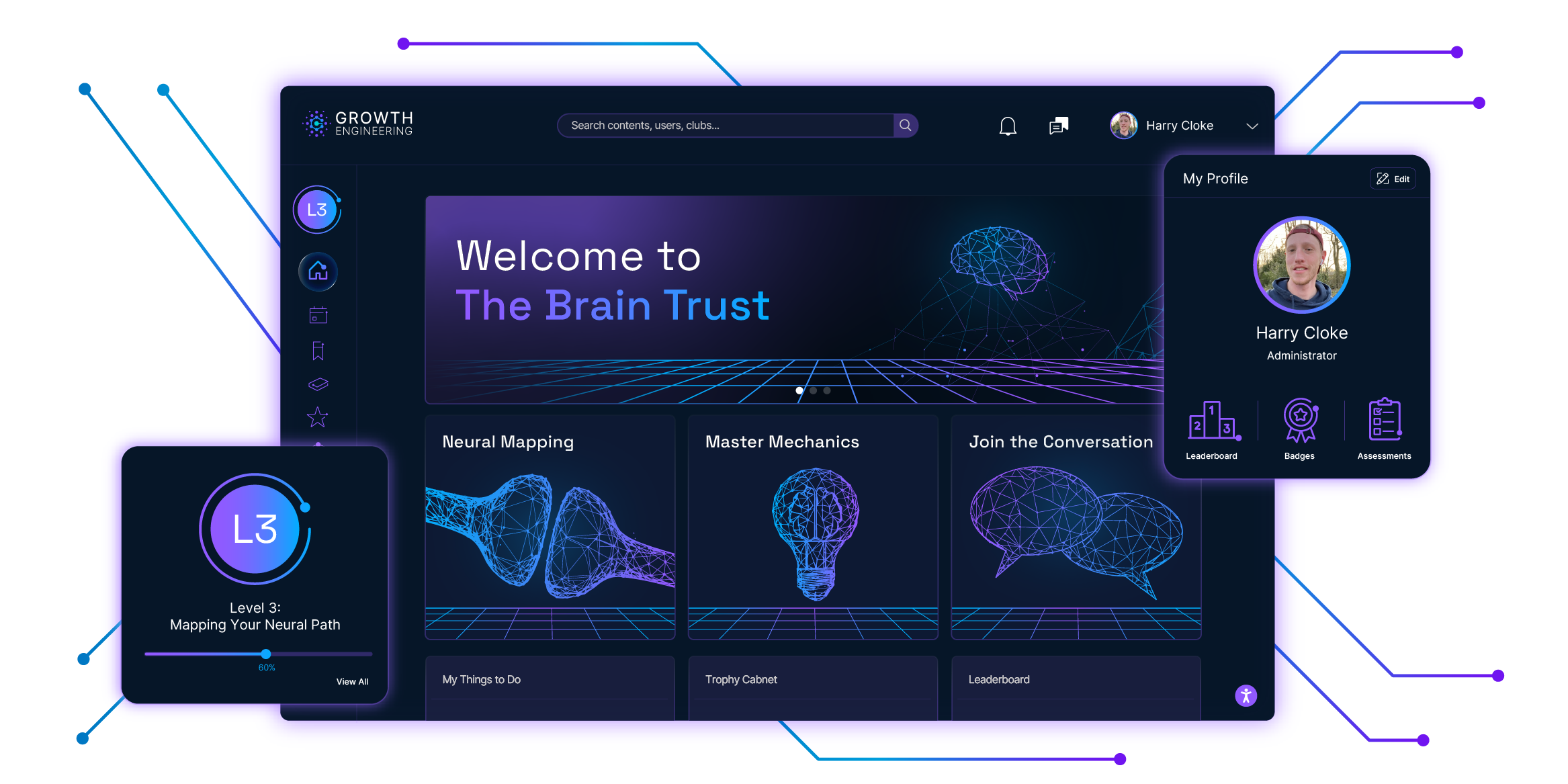
Growth Engineering has built gamification into its platform since 2010, and the Impact Suite designs every mechanic around how memory works. The goal isn’t more logins. It’s helping people to remember what they learned and then put it to use.
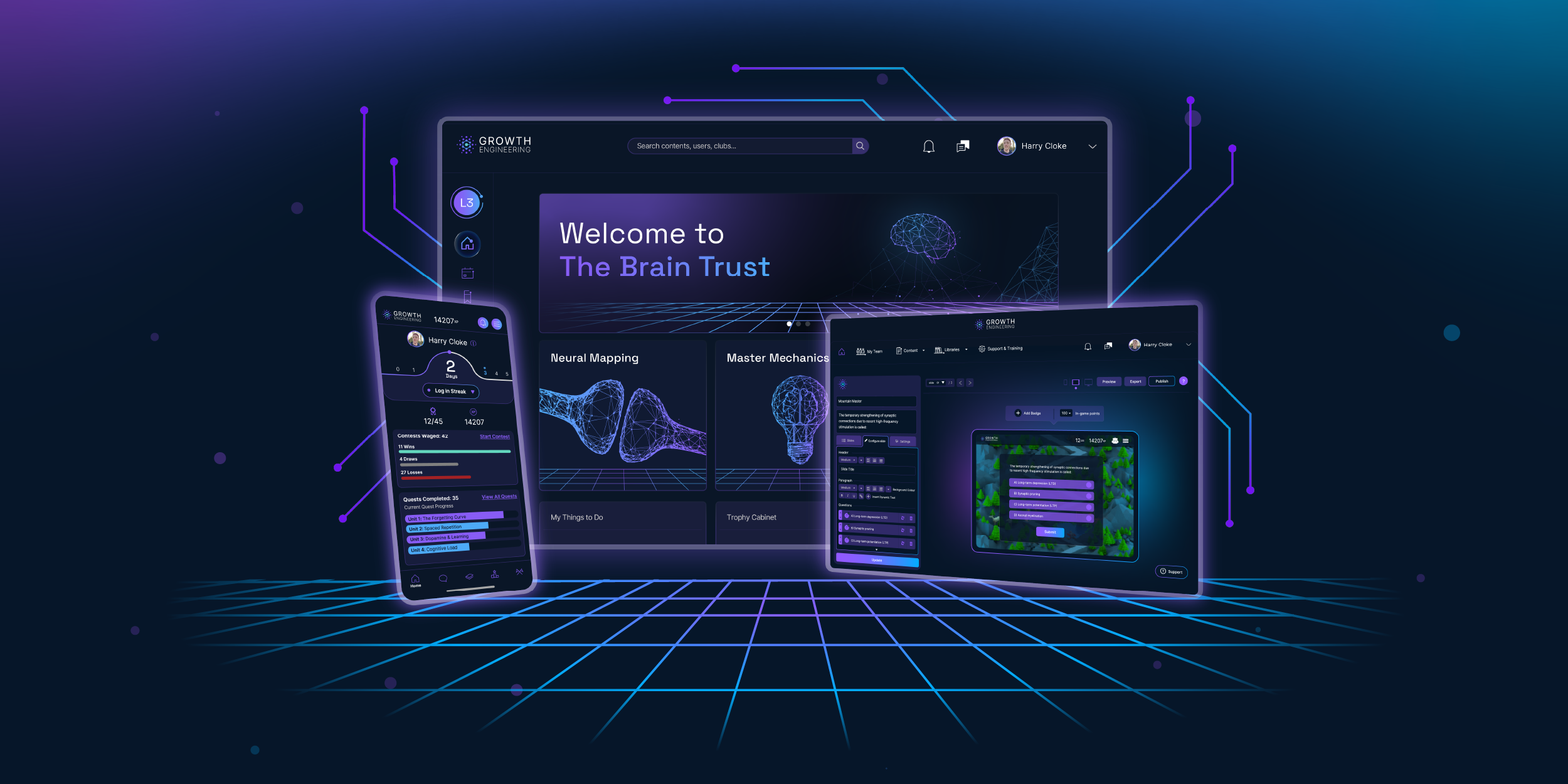
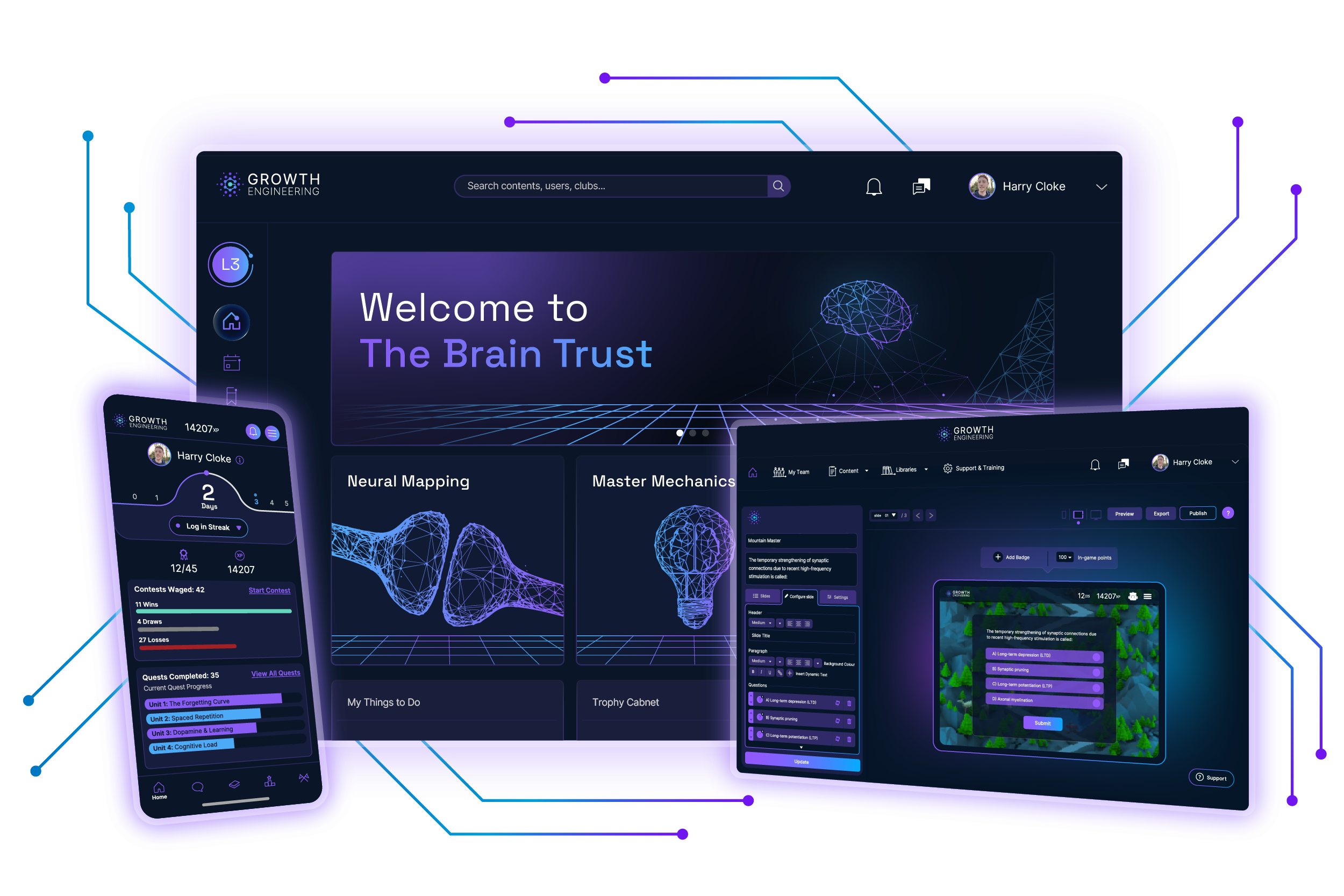
Knowledge Contests are the centrepiece. Learners challenge each other to head-to-head quizzes, which turns retrieval practice into something people choose to do. Squad Contests take that to the team level, with groups battling for territory on a shared map.
The rest of the toolkit rewards the right habits:
- XP and Levels: Learners earn experience points for completing training, exploring the platform, and interacting with colleagues.
- Achievements: Admins set the triggers, from an “Early Bird” badge for logging in before 7am to a “Social Superstar” badge for sharing posts.
- Streaks and Scorecards: The Learning App tracks consecutive days of learning, alongside badges, XP, and contest results.
- The Reward Centre: Learners trade their XP and badges for vouchers, gifts, or perks.
People really do choose to play. L’Oréal’s Beauty Advisors completed an average of 312 contests each, without anyone making them.
The limitation: we provide the platform, not the courses. You’ll bring your own content or build it using our game templates and Authoring Tool. We can also recommend partners for ready-made libraries.

2. Absorb LMS
Best for: adding competition to an established corporate LMS
- HQ: Calgary, Canada
- Ownership: Private, PE-backed
- Hosting: AWS: US, Canada, EU, Australia
- Price: ££
Absorb is a well-established corporate LMS. Its gamification engine sits in Absorb Engage, a module that adds social and competitive features to the core platform. Every mechanic gives learners a compelling reason to log in again tomorrow.
Its leaderboards work as time-limited competitions. Admins set a start and end date, choose who takes part, and decide how many points each course, curriculum, or competency is worth. You can then compare across learners, teams, and departments.
Competencies add a sense of progression. Each one can carry its own badge image, and with help from Absorb, competencies can run across up to 10 levels. Engage also brings billboards, polls, news posts, and a variety of additional functionality.
The limitation: points reward finishing rather than performing. Absorb’s documentation lists completions, competencies, and comments as the ways to earn them. Leaderboards also don’t appear in the mobile app.
3. Axonify
Best for: daily reinforcement with real prizes
- HQ: Waterloo, Canada
- Ownership: Private, PE-backed
- Hosting: Google Cloud: US, EU, APAC
- Price: £££
Axonify is built to deliver short daily sessions through an app-based interface. Gamification is part of every package rather than an add-on. Its method combines retrieval practice and spaced repetition, with questions that adapt to what each person already knows.
Rewards is the stand out feature. Learners spend their points in four ways: auctions, a shop, raffles, and a spin-to-win wheel. Admins create the reward programmes, set prices and ticket costs, target specific teams, and decide how often prizes refresh.
Training questions can arrive inside arcade-style games, with timers admins can adjust, and points to be earned. Leaderboards add a competitive edge, and Axonify says they’re the most popular screen in the app.
The limitation: the games are wrappers rather than lessons. Axonify drops the same training questions into each arcade game, so the game itself has nothing to do with the topic, and learners can skip it entirely.

4. Beedeez
Best for: store teams competing on their phones
- HQ: Paris, France
- Ownership: Private
- Hosting: Scaleway: France
- Price: ££
Beedeez is a mobile-first LMS built for retail and franchise teams. It delivers training as short “capsules” that staff can complete on the shop floor, even offline. AI-assisted authoring helps admins build those capsules quickly, drafting the plan, content, and illustrations.
Its standout mechanic is the Battle. Learners challenge each other to quiz duels on what they’ve just covered. Team challenges sit above that, with departments, stores, or regions competing against each other.
Admins shape the rest from the back office, including points, levels, badges, and leaderboards. You can also rename levels and badges and apply brand colours, so the game speaks the same language as the rest of the business.
The limitation: the games are all quizzes. Battles are quiz duels, and Beedeez’s authoring tool offers more than 20 question formats but no mini-games or game templates.
5. CYPHER Learning
Best for: games tied to skills and competencies
- HQ: Plano, Texas, US
- Ownership: Private, PE-backed
- Hosting: AWS: US, EU, Australia
- Price: ££
CYPHER Learning is an AI-powered LMS with gamification included in its base Enhanced plan. Everything links back to skills and competencies, so points reflect what people can do as well as what they’ve finished. Games run at three levels:
- Course Games: Themed games with levels and point thresholds. A single course can run several at once.
- Team Games: Groups compete on a shared leaderboard that shows each member’s contribution.
- Site-Wide Games: Admins set up scoring that spans the whole platform.
Automation rules do the heavy lifting. Admins award points or badges when a learner finishes a module, page, assessment, or course. You can also tie rewards to performance, such as awarding points for scoring 70 or above on an assessment.
The limitation: points don’t buy anything. There’s no rewards store, so you’d need a separate system to turn points into prizes.
6. Docebo
Best for: enterprises running contests and rewards at scale
- HQ: Toronto, Canada
- Ownership: Public (NASDAQ: DCBO)
- Hosting: AWS: US, Canada, EU, UK, APAC
- Price: £££
Docebo is one of the largest enterprise learning platforms, and its Gamification app brings badges, leaderboards, contests, and a rewards shop together under one roof.
Badges drive the points. Admins give each badge a value (negative values included), award it automatically or by hand, and use badge collections to decide which groups can earn what. Similarly, leaderboards can cover the whole company or a single branch.
Contests add a deadline. Admins pick a goal, such as most courses completed or highest course score, choose up to 10 courses or forums, and rankings refresh every hour.
The Rewards shop gives points somewhere to go. Points convert into coins, admins build catalogues for different groups, and they approve each request before it’s fulfilled.
The limitation: game template options come from a partner. Docebo’s 11 game templates arrive through an integration with ELB Learning Training Arcade and import as SCORM packages. This means your game content relies on a third party.
7. Mitti
Best for: operations teams wanting game templates and spaced repetition
- HQ: Sydney, Australia
- Ownership: Private, founder-led
- Hosting: AWS: US, EU, Australia
- Price: £££
Mitti is the new name for SafetyCulture. Its training product began life as EdApp, a well-known microlearning app for frontline teams. Training sits alongside inspections and checklists, so courses can even be generated from trends in flagged inspection items.
Game templates are the headline. More than 80 of them turn lessons into quick-fire activities, and points come from both courses and quizzes. A quiz answer earns 100 points on the first try and half that on a second attempt, so getting it right the first time around pays.
And there’s more. Individual, course, and quiz leaderboards run on a schedule for chosen groups or sites. Admins can also build badges from “recipes” that combine completions, scores, content types, and how often something happens. Finally, its AI Scenarios add roleplay practice, scored against criteria each team sets.
The limitation: achievements are hard to fine-tune. Once a recipe goes live, admins can’t edit it, and score-based achievements only trigger at 100%.

8. OttoLearn
Best for: reinforcing knowledge alongside your existing LMS
- HQ: Winnipeg, Canada
- Ownership: Private, founder-led
- Hosting: AWS: Canada
- Price: £
OttoLearn, from Canadian developer Neovation, is a microlearning platform that tackles forgetting head on. It launches from any LMS and marks a course as complete once a learner reaches mastery, so it can sit on top of the platform you already have.
Adaptive mastery is the engine. Each concept is scored from level 0 to 5, combining accuracy, response time, and how confident the learner says they are. “Forgetting pressure” then lowers that score over time and brings concepts back for review before they fade.
Gamification follows the same logic. Learners earn a point for every gain in mastery, plus extra points for keeping a retention streak going. Because points track mastery rather than activity, the platform leaderboard reflects what people actually know. Points can also be spent in a rewards store set up by admins.
The limitation: contests aren’t self-serve. OttoLearn’s documentation suggests that its Support team creates leaderboards and contests, so every new competition will have to go through them.
9. Paradiso LMS
Best for: teams wanting detailed point rules on a budget
- HQ: Boca Raton, Florida, US
- Ownership: Private, founder-led
- Hosting: AWS: US, EU
- Price: £
Paradiso is a broad corporate LMS covering employee, customer, and partner training, and gamification comes with both of its paid plans. Since August 2025, it has also offered a free LMS for up to 100 users.
Its point rules are particularly strong. Admins can set custom points for each action, add bonus points for getting things right the first time, and run time-limited multipliers to boost a campaign. Organisations with several business units can give each one its own set of rules.
Paradiso also offers smart leaderboards (with an opt-out option for learners who’d rather not appear), badges and credentials built on the Open Badges 2.0 and 3.0 standards, and AI adaptive challenges that shift in line with each learner’s performance.
The limitation: competition only runs through leaderboards and team challenges. Paradiso offers no games or head-to-head quizzes, so learners can’t challenge each other directly.

10. Thrive
Best for: rewards learners can actually spend
- HQ: Nottingham, UK
- Ownership: Private, founder-led
- Hosting: AWS: UK
- Price: ££
Thrive is a UK learning platform that has grown without outside investment. Gamification is included in every plan. It leans into social, content-led learning, with likes, comments, and recommendations sitting alongside formal training.
Its Spring 2026 release added App Rewards, which gives points real-world value. Learners can spend them on gift cards and air miles in the mobile app, and admins combine completions, points thresholds, and audiences to decide who qualifies for what.
Thrive’s badge setup is particularly flexible. Admins can build custom badges from AND/OR rules across content, then choose the action that counts, from viewing and liking to commenting and completing. Learners can quickly and easily share their progress on LinkedIn.
The limitation: custom badges only respond to content. Thrive’s documentation says they can’t be triggered by events, so you can’t use one to reward attending a session or workshop.
How to Narrow This List Down
All 10 platforms clear the same bar, so the choice boils down to what you want your gamified LMS to achieve. Four questions will split the list quickly:
- Does Knowledge Need to Stick? Favour platforms that bring content back over time. Axonify, Mitti, and OttoLearn use spaced or adaptive practice, and Growth Engineering builds retrieval practice into its Knowledge Contests.
- Where Will People Play? Shop-floor and field teams need a mobile app built for short bursts, which points to Axonify, Beedeez, Mitti, and Growth Engineering.
- Should Points Buy Something? Growth Engineering, Axonify, Docebo, OttoLearn, and Thrive let learners swap points for real rewards. Elsewhere, recognition is the prize.
- Are You Replacing Your LMS? OttoLearn is designed to sit alongside the platform you already have, while the other nine can become your main system.
For gamification that changes what people know, and not just how often they visit, the Impact Suite is a great place to start. Learners challenge each other in Knowledge Contests, squads battle for territory, and streaks and the Reward Centre keep them coming back between campaigns.
Our game mechanics page shows how the pieces fit together.
Before you sit through any demos, our LMS buyer’s guide lists the questions that separate a polished pitch from a platform that actually delivers.
Final Words
Almost every LMS now has a leaderboard. Most have badges and experience points. But far fewer use game mechanics to actually help people learn.
Each platform on this list goes further, whether that means head-to-head contests, rewards worth collecting, or practice that adapts to what people forget.
The real test comes six months after launch. Are people still playing, and do they know more than when they started? Ask every vendor on your shortlist for a customer who can answer yes to both.
Game to train? Watch Knowledge Contests, streaks, and the Reward Centre work together in a live walkthrough of the Impact Suite.