Every list of the best enterprise LMS platforms hands you a dozen names and leaves you to work out the difference. On a feature checklist there barely is one. They all assign learning, track completion, and produce reports.
The difference is what each one is built to be good at. Docebo runs employees, customers, and partners from a single platform. Valamis serves regulated industries. Degreed handles skills and careers. The list goes on.
Pick on features and they all look adequate. Pick on what a platform specialises in and your shortlist will write itself. That’s why every entry below covers three things: each platform’s specialism, what it does well, and what it could improve on.
Right. Twelve platforms with no filler. Let’s find yours.
The 12 Enterprise LMS Platforms Compared
First up, here’s all 12 platforms listed alongside each other for ease of comparison. They are in alphabetical order, not ranked. Growth Engineering LMS sits first because it’s ours and you should know that before you read anything else.
Use the ‘Best for’ column to find two or three platforms that match your specific use case. You can then skip the rest (or read them if you want the full picture).
Nine of these platforms are learning management systems, two are learning modules inside HR suites, and Degreed is a learning experience platform that expects an LMS underneath it. Beyond that the labels have blurred, because most modern LMSs now ship with the same features that used to define an LXP.
| Platform | Best for | Type | HQ | Price |
|---|---|---|---|---|
| Growth Engineering | Behaviour change, not just completion | LMS | London, UK | ££ |
| 360Learning | Learning built by your own experts | LMS | Paris, France | ££ |
| Absorb | Running internal and external audiences at scale | LMS | Calgary, Canada | ££ |
| Cornerstone OnDemand | Global enterprise, learning and talent together | LMS | Santa Monica, USA | £££ |
| D2L Brightspace | Structured, course-based programmes | LMS | Kitchener, Canada | £ |
| Degreed | Skills and career development | LXP | Salt Lake City, USA | £££ |
| Docebo | Employees, customers and partners on one platform | LMS | Toronto, Canada | £££ |
| LearnUpon | Training customers and partners | LMS | Dublin, Ireland | £ |
| Litmos | Fast deployment, compliance-heavy delivery | LMS | San Ramon, USA | ££ |
| SAP SuccessFactors | Organisations already running SAP | HCM suite module | Walldorf, Germany | ££ |
| Valamis | Regulated industries and EU data control | LMS | Joensuu, Finland | £ |
| Workday Learning | Organisations already running Workday | HCM suite module | Pleasanton, USA | £££ |
£ under £70k · ££ £70k to £125k · £££ £125k+
Price bands showcase indicative annual licensing for around 5,000 users, excluding implementation and content. Our LMS pricing guide explains how the banding usually works at enterprise scale.
What Makes a Platform “Enterprise”?
Vendors often use the word freely. It usually means nothing more than “we have some large customers”.
Here’s what it should mean, and it is the test we applied to build this list. The focus isn’t simply on user count. It’s on what happens when you multiply fifty thousand users, thirty countries, and multiple use cases.
- It Doesn’t Buckle: Plenty of platforms are excellent at 500 users and fall over at 50,000. Picture reporting that times out on large catalogues, or enrolment rules that become unmaintainable across multiple business units.
- You’re Not the Bottleneck: Global rollouts fail on permissions more often than on features. Regional teams need to manage their own people without seeing everyone else’s, and without needing to go through you.
- Powered by Your HRIS: Single sign-on, automated provisioning, and joiners, movers, and leavers handled without anyone touching a spreadsheet. If your HR system is not your single source of truth, your completion data will be wrong within a month.
- Separation Without Sprawl: Separate brands, subsidiaries, business units or partner networks, all running from the same platform, without it becoming four systems patched together with duct tape.
- A Truly Global Platform: Your platform should offer different interface languages, localised content, and data residency you can actually specify. And it should be as fast in Singapore as it is in London.
This test is why our list has no content libraries on it, and no academic-focused platforms. Skillsoft, Coursera, and LinkedIn Learning sell courses rather than the system that assigns and records them. Canvas and Blackboard serve universities.
Most platforms look good under demo conditions. Enterprise is what happens on day 400, when four business units all want something different.
The 12 Enterprise LMS Platforms in Detail
Each entry below covers what the platform specialises in, what it does well, and the thing it could improve on. We verified the four fields against vendor documentation, filings, and public procurement listings.
1. Growth Engineering
Best for: organisations who need training to change behaviour, not just be completed
- HQ: London
- Ownership: Independent, owned by its founder
- Hosting: AWS: UK, US, and APAC
- Price: ££
At enterprise scale, most learning problems stop being delivery problems. You can already get a course in front of fifty thousand people and prove they finished it. The harder question, and the one your board will eventually ask, is what changed as a result.
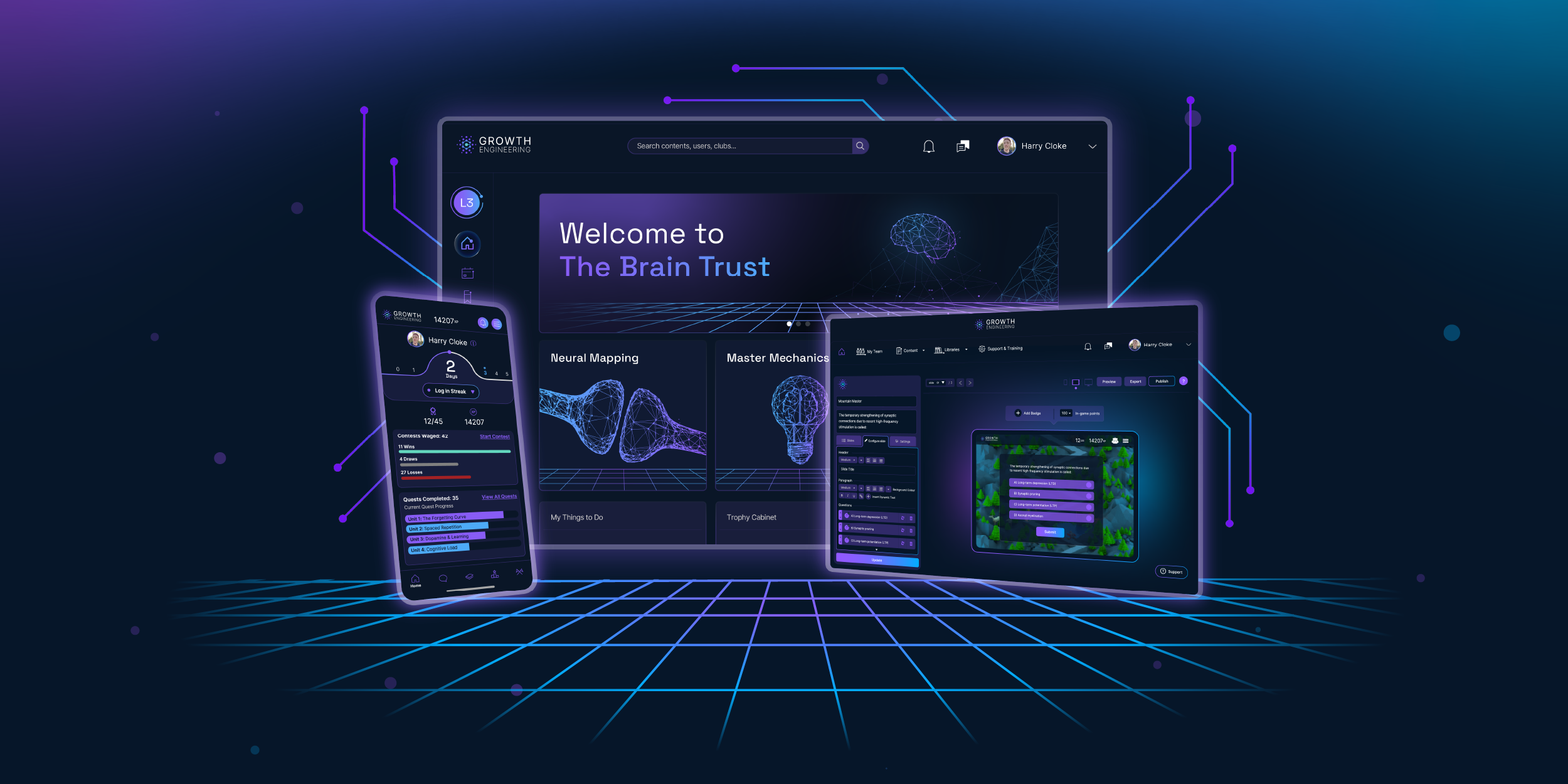
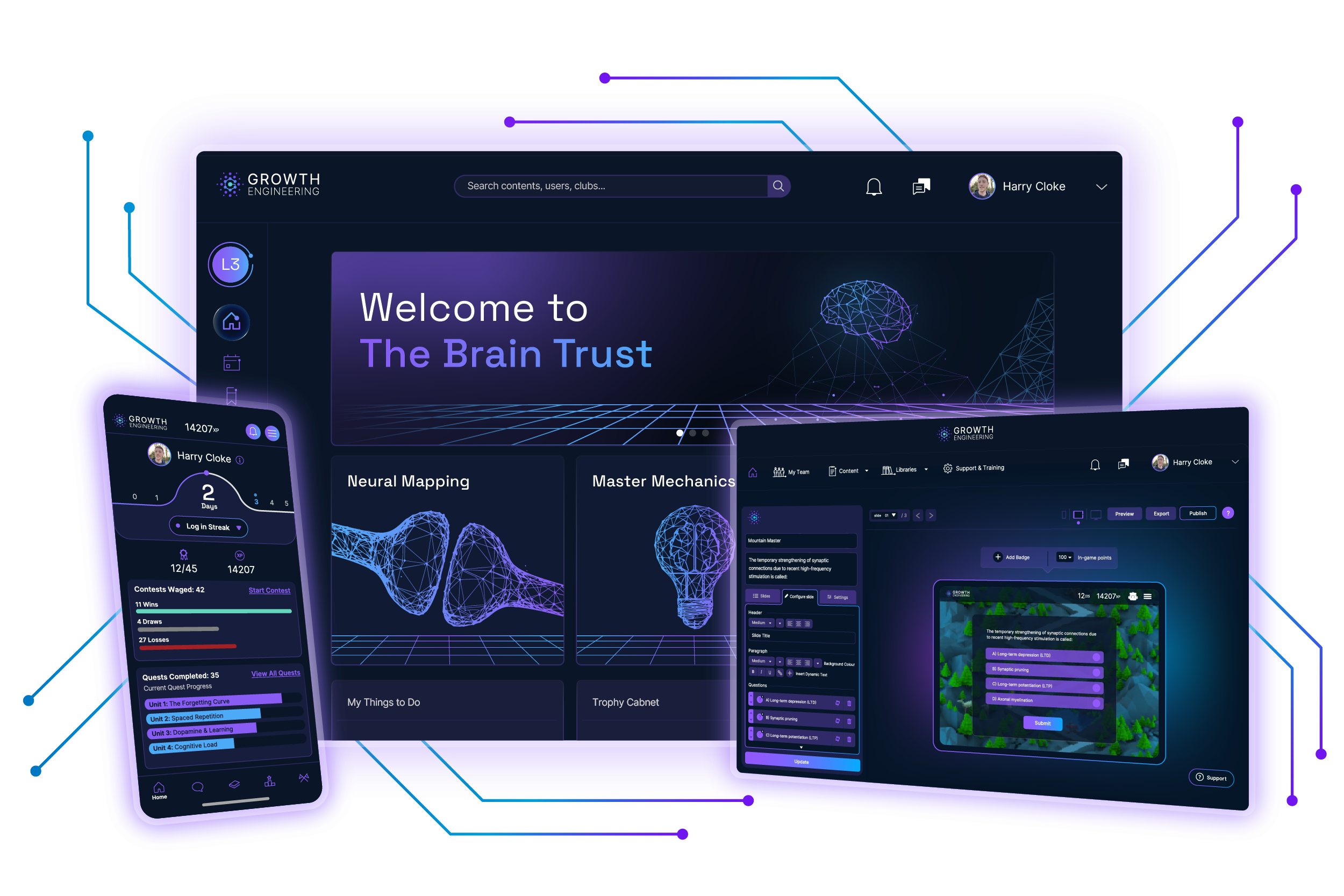
This gap is what the Impact Suite (which includes Growth Engineering LMS, Learning App, Authoring Tool, and Zavmo, our AI learning companion) is built to close. Spacing, retrieval, and cognitive load are not features in a comparison grid here, they are constraints the product is built around. That’s what Neurogogy means in practice.
One thing worth noting on a list like this one. Every other platform here is owned by private equity, listed on a stock exchange, or both. Growth Engineering is independent and owned by the person who founded it. That means our roadmap answers to customers rather than to an exit timeline.
The honest limitation is scope. Cornerstone, SAP, and Workday will sell you learning, performance, recruitment, and succession from one contract. We do learning. If consolidating suppliers is the reason you are running this process, we are the wrong answer.

2. 360Learning
Best for: learning built and maintained by your own experts
- HQ: Paris, France
- Ownership: Venture-backed
- Hosting: Microsoft Azure: Europe as standard. Other locations on request.
- Price: ££
360Learning is built on the premise that your subject matter experts should author and maintain your training, rather than a central instructional design team. Course creation, peer review, and feedback loops assume people have a day job, and the platform pushes content back to its author when learners flag it as out of date.
That makes it a strong fit for organisations whose critical knowledge is internal and changes faster than an agency can rewrite it. Sales enablement, product training, and operational procedure are where it earns its money.
It also has the broadest standards support of any platform here: SCORM 1.2 and 2004, xAPI, cmi5, and AICC.
The limitation is what distributed authoring does to control. Content that anyone can write and update is content nobody has signed off. For regulated training, where the wording matters and an auditor may read it, you will end up building an approval layer the platform is not really designed to have.
3. Absorb
Best for: small teams administering large populations
- HQ: Calgary, Canada
- Ownership: Private equity
- Hosting: AWS: Ireland, USA, Canada, Australia, China (chosen at onboarding)
- Price: ££
Absorb’s specialism is administrative efficiency, and it’s unusually good at it. Forrester named it a Leader in its Q4 2025 evaluation and ranked it top of all vendors for strategy. The automation, bulk actions, and rules engine suit a three-person L&D team running training for thousands of people, including customers and partners alongside staff.
If your constraint is headcount rather than budget, this is the platform on the list that most directly solves it.
The limitation is a hard one if you are migrating. Absorb does not support multi-SCO SCORM packages. If your existing library was authored that way, you are looking at a rebuild rather than a migration. That will need costing up before you get too deep into the discovery process.
4. Cornerstone OnDemand
Best for: global enterprises buying learning and talent together
- HQ: Santa Monica, USA
- Ownership: Private equity
- Hosting: AWS: UK and EEA (customer-selectable)
- Price: £££
Cornerstone is the default learning platform for many L&D teams. Founded in 1999 and listed on NASDAQ from 2011 until Clearlake took it private, it has more genuinely global enterprise deployments than any other platform on this list.
The specialism is breadth. Learning, performance, recruitment, and skills run off one data model, so your completion record and talent record will be one and the same. For an organisation trying to connect training to progression rather than just evidence it, this will be a major plus.
The limitation is what this breadth cost them. Cornerstone is carrying four separately acquired platforms: Saba, SumTotal, TalentLink, and EdCast. It’s actively migrating customers off all of them, and has published an end-of-life date for none. Check what platform you’re actually being sold.

5. D2L Brightspace
Best for: structured, accredited programmes that run to a curriculum
- HQ: Kitchener, Canada
- Ownership: Public (listed on the Toronto Stock Exchange)
- Hosting: AWS: Ireland, USA, Canada, Australia, Singapore, India
- Price: £
D2L was founded in 1999 by John Baker, who is still chief executive, and it grew up serving universities. That heritage is the whole story, for good and for bad.
Firstly, the good. Nothing on this list handles structured, sequenced, assessed learning quite as well. Cohorts, prerequisites, rubrics, and a comprehensive grading system are native rather than retrofitted.
It’s also the cheapest platform on this list, largely because it’s priced against the education market, rather than an enterprise one.
The limitation is that the corporate product is their second business. Features an enterprise buyer would consider core arrive as separately priced add-ons, with Performance+ and Creator+ each carrying their own setup fee on top of the licence.
6. Degreed
Best for: connecting learning to skills, careers, and internal mobility
- HQ: Salt Lake City, USA
- Ownership: Venture-backed and independent
- Hosting: Microsoft Azure: USA, Europe, Canada
- Price: £££
Degreed is the most credible skills platform in this market and has the analyst record to back it, having been named a Strategic Leader by Fosway for four years running.
The specialism is what happens around the learning rather than the learning itself. It infers skills from what people do, maps those skills against roles, shows an individual what they are missing for the job they want, and gives an organisation a live picture of capability.
For anyone building internal mobility or workforce planning on top of L&D, that is a genuinely different proposition from everything else here.
However, this is not a system of record. Degreed’s own documentation describes the platform as surfacing what is already in your LMS, and the assumption is that you already have one. In other words, you’ll have to budget for two platforms.
7. Docebo
Best for: training employees, customers, and partners from one platform
- HQ: Toronto, Canada
- Ownership: Public (listed on the TSX and NASDAQ)
- Hosting: AWS: Nine regions (inc. London, Dublin, Frankfurt)
- Price: £££
Founded in Italy in 2005 and now run from Toronto, Docebo’s specialism is serving audiences that have nothing to do with each other from a single system. Employees, customers, resellers, franchisees, and partners each get their own branded environment, catalogue, and their own rules.
Its multi-tenant architecture is the most mature here, and Docebo’s region list is the broadest. If your training obligations extend past your own payroll, this may be the best platform for your needs.
The limitation is commercial rather than technical. Serious reporting is a separately licensed module, not part of the core platform. It carries both an annual fee and its own implementation cost. Given that reporting is the entire point of running a system of record, you’ll need to price this into your thinking.
8. LearnUpon
Best for: training the people outside your organisation
- HQ: Dublin, Ireland
- Ownership: Independent (minority investment from Summit Partners)
- Hosting: EU, USA, or Australia
- Price: £
Founded in Dublin in 2012 by Brendan Noud and Des Anderson, LearnUpon has been a Fosway Strong Performer for seven consecutive years, which in a market this volatile is its own kind of endorsement.
The specialism is extended enterprise training, delivered through separate portals. Each customer, partner, or region gets an environment that looks and behaves like it belongs to them, with its own branding, catalogue, and administrators. As a bonus, the whole thing is unusually quick to stand up.
The limitation is what these portals cannot do. Data residency is offered to new customers only and depends on your plan, so an existing customer cannot simply move a portal to another region. For a genuinely global business that is a structural constraint rather than a minor inconvenience.
9. Litmos
Best for: getting compliance training live quickly
- HQ: San Ramon, USA
- Ownership: Private equity
- Hosting: EU, USA, or Australia
- Price: ££
Litmos has been doing this since 2007 and its specialism is speed. Where most enterprise platforms assume a six-month implementation, Litmos is built to be live in weeks, with compliance training workflows, certification tracking, and renewal reminders working out of the box.
For an organisation with a deadline imposed by a regulator rather than a loose project plan, that matters more than almost anything else on a feature list. If you’re looking for a quick start, then it’s worth considering Litmos.
The limitation is administration. Litmos ships three predefined administrative roles and does not let you customise them. For a single-country business that is fine. For a global rollout across business units, that’s likely to create some serious bottlenecks.
10. SAP SuccessFactors Learning
Best for: organisations already running SAP
- HQ: Walldorf, Germany
- Ownership: Public (listed on the NYSE and XETRA)
- Hosting: 18 data centres across 13 countries
- Price: ££
The reason to buy this is written on the tin. If your HR, payroll, and finance already run on SAP, the learning module shares the same employee record, the same organisational hierarchy, and the same security model. That means no costly integration projects or technical headaches.
It also operates in every country SAP does, which removes an entire category of question from a multi-country rollout.
The limitation is age. SAP did not build this platform. SuccessFactors bought Plateau Systems in 2011 for its LMS, and SAP bought SuccessFactors the following year, so the platform you license today was built by a company that has been acquired twice. This is why so much of the configuration needs a consultant rather than an administrator.
11. Valamis
Best for: regulated industries that need the platform bent to fit
- HQ: Joensuu, Finland
- Ownership: Private equity
- Hosting: Microsoft Azure: EU as standard, US on request
- Price: £
Valamis is the European answer to a list otherwise dominated by North America, and it has the analyst standing to justify a place, having been named a Core Leader by Fosway.
Founded as Arcusys and renamed in 2018, it has built its reputation in industries where the training requirements are unusual, such as energy, manufacturing, healthcare, and the public sector.
The specialism is configurability. Where most platforms ask you to adapt your process to the software, Valamis is built to be shaped around requirements that no configuration screen anticipated, with EU data control as default rather than an option.
The limitation is the back end. Administrators consistently describe the admin console as dated. It’s the one criticism that recurs across independent reviews. Make sure you spend some demo time in the admin console, not just the learner view.
12. Workday Learning
Best for: organisations already running Workday
- HQ: Pleasanton, USA
- Ownership: Public (listed on NASDAQ)
- Hosting: USA, Canada, Netherlands, Ireland
- Price: £££
If Workday is already your system of record for people, the learning module inherits the worker record, the org structure, and the security model, and your completion data lives beside everything else you already know about that person.
For workforce planning that is genuinely valuable, and it’s often why organisations buy Workday Learning. Standards support is also better than you might expect, covering SCORM 1.2 and SCORM 2004 in all three editions, which is more than either SAP or Oracle manage.
The limitation is that Workday is in the middle of replacing their learning module. In November 2025, Workday spent $1.1 billion acquiring Sana to fix exactly that. Workday has published no migration path, timeline, or updated pricing.
How to Narrow This List Down
The fastest route to a shortlist is ruling things out, not ranking them. The following five questions will help you to do most of the work.
- Who are you training? If it is only employees, almost everything here works. If it is customers, partners, franchisees or resellers, the list immediately shortens to Docebo, Absorb, and LearnUpon, and the question becomes whether you need those audiences connected or genuinely separate.
- Do you already own an HR suite? If SAP or Workday is already your system of record for people, the learning module arrives with no integration project and a commercial case that’s difficult to argue with. Just be clear you are weighing convenience against capability.
- What happens to your content? Support for SCORM and its various editions is far less consistent than vendors imply. Audit your existing library for what it was actually authored in before you shortlist. The answer may determine whether you are migrating your content or rebuilding it.
- Who administers the platform? Global rollouts fail on permissions. If regional teams need to manage their own people without routing every request through a central function, ask to see delegated administration configured properly during the demo rather than described in a slide.
- What’s the total cost? The licence fee quoted is rarely the final number. Docebo’s serious reporting is a separately priced pack. D2L’s enterprise features are add-ons. SAP configuration work is chargeable. Build the real figure at your headcount over three years.
We would argue Growth Engineering belongs on your shortlist, especially if the problem you are solving is people not applying what they learned. Our platform is optimised for whether learning survives on the job, rather than for the administration of it. L’Oréal, Hewlett-Packard, and EE run it at scale.
But don’t just take our word for it. Take a look for yourself. Our LMS buyer’s guide covers how to run a demo that tells you something.
Final Words
That’s the list. Twelve enterprise LMS platforms, and the honest summary is that most of them are good. Cornerstone, Docebo, Absorb and the rest did not get where they are now by being bad software.
That said, they were all built to solve different problems. That means that a platform that transforms one organisation may quietly disappoint another. This means the decision worth spending your time on is not which platform is best.
It is what you are actually trying to fix.
Get that clear and your shortlist will write itself. Happy hunting.
If you want to see what a platform designed around how people actually learn looks like in practice, book a demo of the Impact Suite. And if we have a detail wrong about your platform, tell us and we will correct it.