Here is one of the most reliable findings in the science of learning, and one of the least used. When you practise several related skills or topics mixed together rather than one at a time, you learn them better. It’s called interleaving, and decades of research back it.
So why does almost nobody do it? Well, because it feels wrong. Mixing topics is harder in the moment than drilling one at a time, and that extra effort fools us into thinking it isn’t working.
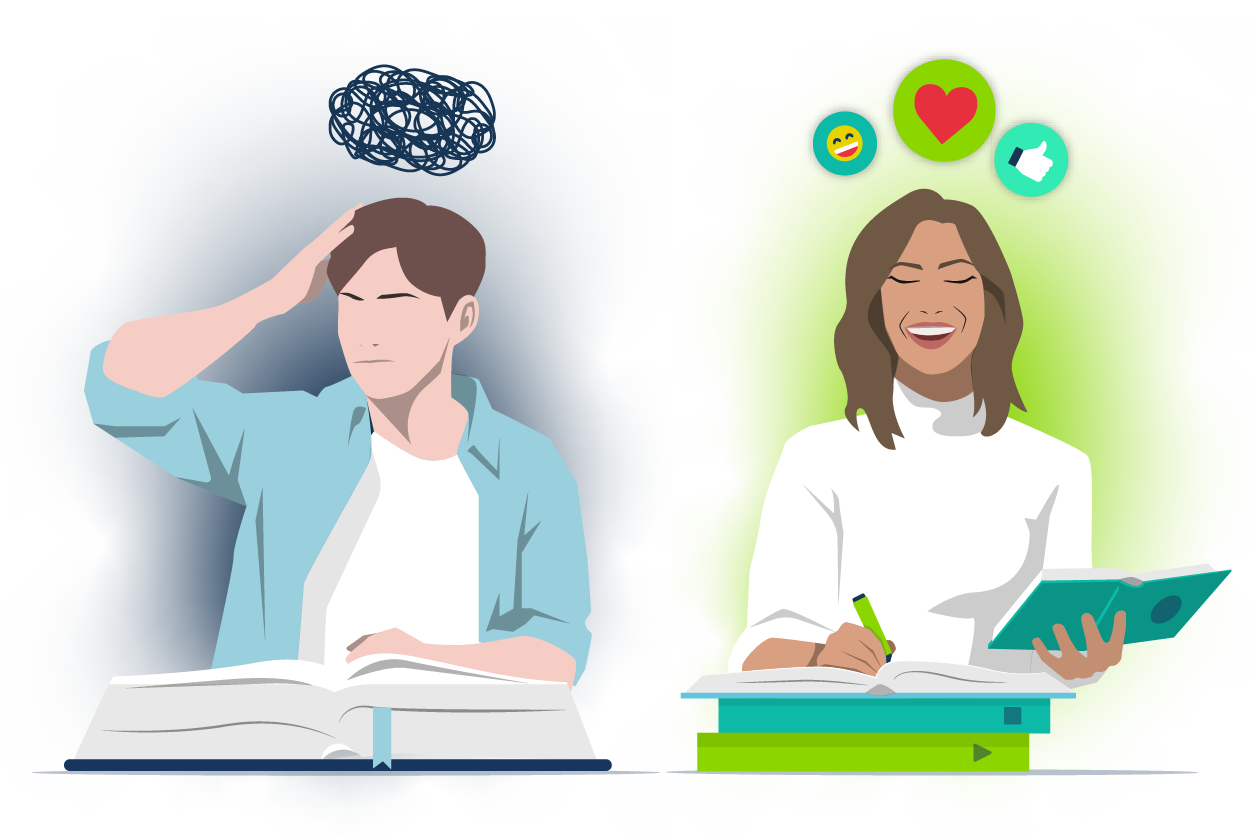
However, the evidence is striking: across a series of experiments, learners kept insisting that blocked, one-topic-at-a-time practice was better for them, even after interleaving had measurably improved their own results. It works, but because it feels like hard work, we assume it doesn’t.
The gap between what feels effective and what is effective is the whole story of interleaving. Blocked practice feels smooth and productive. Interleaving feels awkward and slow. Yet it is the awkward one that builds durable, flexible knowledge. The kind of knowledge learners can use when the problem in front of them doesn’t come helpfully labelled.
This article explains what interleaving is, why it works, when it doesn’t, and how to build it into learning that lasts. Ready? Let’s mix it up.
What is Interleaving?
To interleave is to alternate between things rather than take them one at a time. In learning, interleaving means mixing different topics, skills, or problem types within a single study session, instead of finishing one before moving on to the next.
One confusion is worth clearing up straight away: interleaving is not multitasking. You are still doing one thing at a time and giving it your full attention. You are simply not doing the same thing over and over before switching.
Rather than drilling a single skill to exhaustion, you rotate through several related ones, returning to each in turn.
Let’s take an example, like learning the piano. Blocked practice means an hour of scales, then an hour of chords, then an hour of melodies. Interleaving means moving between scales, chords, and simple melodies across the session. It feels less settled, but it builds more usable skills. It also keeps boredom at bay.
Blocked Practice vs Mixed Practice
Interleaving is also called mixed practice or varied practice, and it is clearest when set against its opposite, blocked practice, where you tackle one kind of problem repeatedly before moving on.
In shorthand, blocked practice looks like AAABBBCCC, while interleaving looks like ABCABCABC.
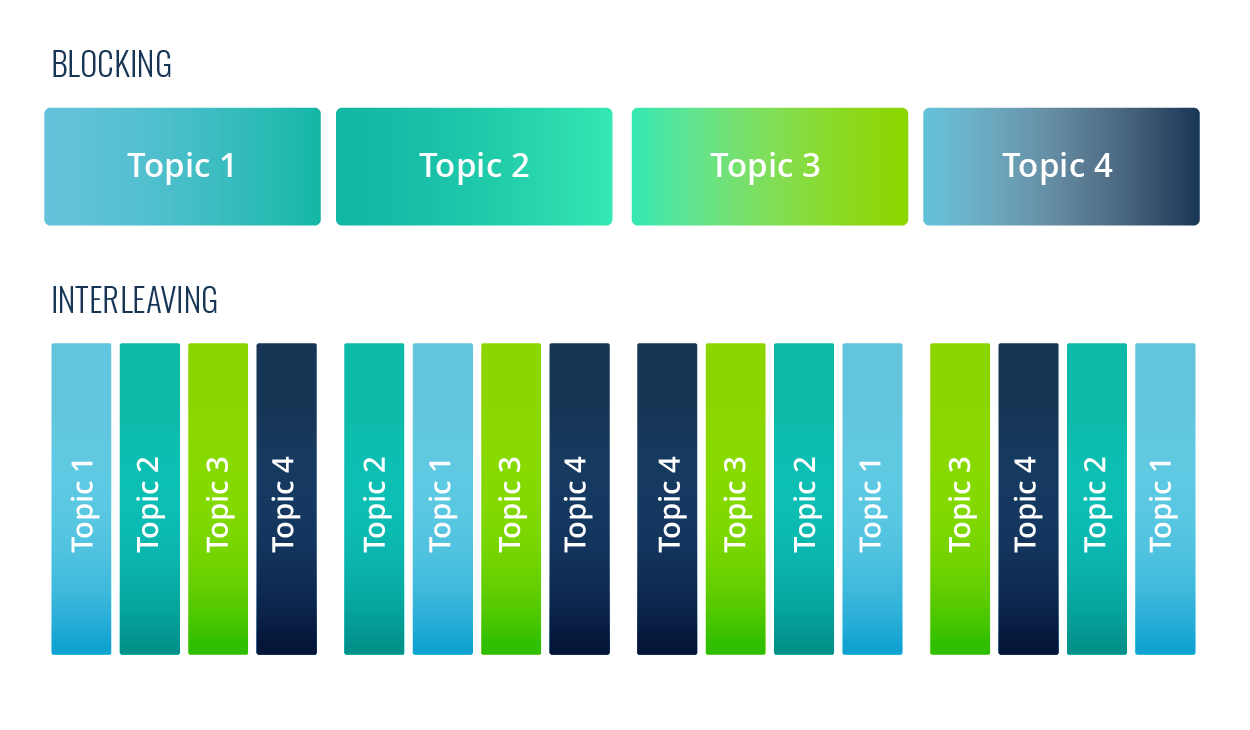
- Blocked Practice: You work through one type of problem again and again before switching. A maths student might complete twenty problems of one kind, then twenty of the next, each in its own block.
- Mixed Practice: You alternate between several related problem types within a single session, so rarely are two problems in a row the same kind.
Blocked practice has its place, especially when someone is first meeting a skill and needs to focus on the mechanics. But its smoothness is deceptive. When every problem is the same kind, you know which method to use before you have even read it.
This means you never practise the hardest step of all: working out what kind of problem you are facing. Interleaving forces exactly that. It’s harder, and that difficulty is the point, as the research shows.
What Interleaving Research Tells Us
Interleaving has been tested for nearly fifty years, across skills, categories, and classrooms. Three strands tell the story.

It Started on the Training Field
The foundational piece of interleaving research is Shea and Morgan’s 1979 study of motor skills. This study found that mixing practice hurt performance during training yet produced better retention and transfer afterwards, the first clear sign that the harder path led to better learning.
The pattern held in sport: college baseball players who faced fastballs, curveballs, and change-ups in a random, interleaved order became better hitters than those who drilled each pitch in its own block. A real at-bat, like a real test, never tells you what’s coming.
It Works for Knowledge, Not Just Skills
In a now-classic study, Kornell and Bjork asked people to learn to recognise different painters’ styles. Those who saw the works interleaved rather than blocked were better at identifying the painter of new pieces they had never seen, because mixing the styles helped them spot what made each one distinct.
Tellingly, participants believed blocking had worked better, even after their own results showed the opposite.

It Holds Up in the Classroom
The strongest classroom evidence comes from mathematics. In a three-month study of seventh-graders, Rohrer, Dedrick, and Stershic found that interleaved practice beat blocked practice on an unannounced test. What’s more, the gap widened over time:
- One day later: interleaved learners scored 80%, blocked learners 64%.
- One month later: interleaved learners scored 74%, blocked learners 42%.
Blocked practice decayed fast. Conversely, interleaving left students almost as sharp a month on as they were the next day.
The Verdict
The definitive review to date is Brunmair and Richter’s 2019 meta-analysis of 59 studies, aptly titled “Similarity matters”. It confirmed that interleaving reliably improves learning, but with a crucial condition: the benefit is largest when the things being mixed are similar enough to be confused with one another.
That single finding is the key to why interleaving works, which is where we turn next.
Why Does Interleaving Work?
So why does mixing things up beat drilling them one at a time? The research points to four different mechanisms, with one doing most of the heavy lifting.
1. It Forces Discrimination
This is the big one, and it’s what Brunmair and Richter’s “similarity matters” finding points straight at. When you drill one kind of problem in a block, you never have to work out what kind of problem it is, because the last ten were the same. Mixing removes that crutch.
Each time the problem changes, you have to notice what makes it different and choose the right approach, which is the very skill you need when a real task turns up without a label. This is why interleaving helps most when the things being mixed are easily confused. It trains the brain to tell them apart.
2. It is a Desirable Difficulty
Interleaving is harder than blocked practice, and that is not a flaw to be smoothed away. It is a desirable difficulty: a challenge that slows you down now but strengthens learning for the long run.
Instead of easing mental effort, interleaving deliberately adds it, raising cognitive load so the brain has to work harder to encode what it is learning. The struggle is the mechanism, not a side effect.
3. It Spaces Practice Automatically
Because you have to come back to each topic later in the session rather than finishing it in one go, interleaving builds in spacing between encounters with the same material.
Spacing is one of the most reliable ways to strengthen memory, so interleaving delivers that benefit almost as a by-product.
4. It Demands Retrieval
Every time you switch back to a topic, you have to pull the relevant knowledge back into mind rather than keeping it conveniently loaded. That act of retrieval strengthens the memory a little more each time, much as testing yourself does.
Notice what these mechanisms share. Every one works by making learning harder, not easier. That’s the thread running through interleaving, and through the family of desirable difficulties it belongs to: the effort that makes a technique feel ineffective is the very thing that makes it work.
The Benefits of Interleaving

Given the research we’ve reviewed and the underlying cognitive principles, you can likely already envision the potential benefits of interleaving. To further clarify the effectiveness of this learning approach, let’s summarise its key advantages.
- Improved Retention: As we’ve seen, studies show a direct link between interleaved learning and long-term retention of material. By spacing out topics and problems, learners can no longer rely on rote memorisation. Instead, they’ll have no choice but to embrace a deeper understanding of the information.
- Enhanced Understanding: This deeper understanding comes from learners forging meaningful connections between different topics. This leads to an integrated network of knowledge, which can be particularly useful for complex topics that require a holistic perspective.
- Better Motivation: There’s a reason why studying always feels like a chore. Learning the same thing over and over can be a real drag. Thankfully, interleaving can make learning more engaging by breaking up the monotony of blocked practice. In turn, this can improve your learners’ focus.
- Increased Performance: Why does all this matter? Well, improving motivation, understanding, and retention will ultimately have a positive impact on learner performance. Indeed, you should expect your audience to develop new critical thinking skills and increased flexibility in problem-solving.
Overall, interleaving is a powerful learning technique that can significantly improve learning outcomes. If applied correctly, there’s no telling what kind of impact it will have on your business or educational institution. We’ll explore this application process next.
How to Design Interleaved Learning Experiences
Hopefully by now you are on board with the concept of interleaved learning. However, you may still be unsure about how to implement it within your learning or teaching. After all, it’s a significant departure from the traditional, sequential approach we’re all familiar with.
Well, fret not. We’re here to guide you. We’ll be sharing 9 top tips for designing interleaved learning experiences. These strategies will be valuable in various settings, whether you’re a teacher, instructor, or learning and development professional. Let’s dig in!
- Educate Your Audience: Unfortunately, many educators and learners are unaware of interleaving and its benefits. With this in mind, we recommend preparing educational materials that outline the advantages of this approach.
- Embrace Diversity: As we’ve seen, variety keeps learners engaged and motivated. With this in mind, create a wide range of problems within each topic to challenge your learners in different ways.
- Increase the Difficulty: At every stage, ensure you gradually increase the difficulty of the information covered and the problems presented. This ensures your learners are consistently challenged and engaged.
- Real-World Application: Take care to connect problems and challenges to real-world scenarios. This will ensure your learning is meaningful and relevant. It will also help your learners to forge new mental connections.
- Assess Your Pathways: If you have existing learning materials, review their structure. Are the subtopics presented in a blocked format (e.g. AAABBBCCC) or a mixed format (e.g. ABCABCABC)? If it’s the former, then consider a restructure.
- Strategic Spacing: You should also carefully space out different types of problems and tasks. This encourages spaced repetition which has been shown to improve retention. You’ll also avoid overwhelming your audience.
- Randomisation: Consider incorporating an element of unpredictability and randomisation into your learning programmes. This could involve a fun approach like a ‘spin the wheel’ topic picker to help foster learner curiosity.
- Don’t Overdo It: While it’s beneficial to switch focus, there is a balance to maintain. Ensure your learners have a solid foundation in a topic before moving on and introducing new concepts.
- Adaptive Technology: Technology can also assist you in achieving your interleaved learning dreams. Adaptive learning platforms can adjust learning pathways based on your learners’ specific needs and performance.
Remember, the right approach to interleaving will depend on the subject matter at hand. Take the time to consider how sub-topics can be interleaved effectively to drive the best understanding of your overall topic.
Ultimately, your goal should be to avoid the mindless repetition that is often associated with massed practice. Learning should be more than rote memorisation. Instead, aim to guide your learners towards higher-order thinking skills, as outlined in Bloom’s Taxonomy.
When Interleaving Doesn’t Work
Interleaving is powerful, but it’s not universal and using it well means knowing where it stops working. Here are three considerations you should keep in mind.
1. It Needs Confusable Material
The whole mechanism depends on discrimination, so interleaving pays off when the things being mixed are similar enough to be muddled. For instance, problem types, categories, and concepts learners routinely confuse.
Mixing genuinely unrelated material has little to offer, because there is nothing to tell apart. If the topics aren’t confusable, blocking is fine.

2. It Can Overload Complex Thinking
This is the important caveat, and recent evidence sharpens it. In a 2025 study, 376 students learned complex physics under interleaved or blocked conditions. Interleaving on its own produced no immediate benefit and actually worsened performance weeks later.
It helped only when paired with collaboration, which shared the heavy mental load the complex material imposed. The lesson is not that interleaving fails with hard content, but that hard content already taxes working memory, and piling interleaving on top without support can tip learners into overload.
With this in mind, ensure you match the difficulty to the learner, and provide ample support when the material is demanding.
3. It Comes With Real Friction
Interleaving asks more of everyone. Learners resist it because it feels harder and slower. Instructors have to design and sequence it deliberately, which takes more time than stacking topics in blocks.
Likewise, an assessment has to shift from testing recall of one thing at a time to testing whether learners can choose the right approach when problems come mixed.
None of these is a reason to avoid it, but each needs planning, and it helps to explain to learners why the extra effort is worth it.
When used in the right place, on confusable material, with a foundation in place and support where the load is high, interleaving is one of the most effective tools in learning design. Used everywhere, indiscriminately, it will disappoint. The skill is knowing which is which.
Final Words:
Interleaving asks you to do the one thing that feels wrong: to mix things up when every instinct says to master one thing at a time. That is exactly why it’s so underused, and so powerful. The discomfort you feel while doing it is not a sign that it is failing. It’s a sign it’s working.
The evidence is clear on what interleaving does. By forcing the brain to tell confusable things apart, choose the right approach, and retrieve knowledge again and again, it builds learning that lasts longer and transfers further than blocked practice ever manages.
It’s not a cure-all, and this article has been honest about where it stops working. But if the right support is in place then this approach is one of the most effective tools in learning design. So mix it up, but mix wisely. Your learners will thank you later, even if they doubt you at the time.
Thanks for reading. If you’ve enjoyed this content, please connect with me here or find more articles here.
Interleaving is just one of many effective learning strategies. To get the full breakdown please download our guidebook, ‘The Learning Theories & Models You Have to Know’.