

Have you ever felt overwhelmed after a study session, or when trying to keep up with a training instructor? You’re not alone. Cognitive load theory (CLT) helps us to understand why our brains sometimes feel like they’re about to burst (metaphorically, of course).
Just as you become less effective when multitasking, your brain processes information less efficiently when it’s overloaded. According to Sweller’s original 1988 research, this overload can reduce learning by measurable amounts. And 35+ years of follow-up studies have documented exactly why.
British researcher Dylan Wiliam once called cognitive load theory ‘the single most important thing for teachers to know’. And guess what? If teachers need to know about it, then so do instructors, coaches, mentors, and learning professionals of all stripes.
In this article, we’ll explore cognitive load theory’s key concepts, its robust evidence base, and the three different types of cognitive load. To wrap things up, we’ll offer practical tips for reducing the strain on your mental processes. Ready to load up your knowledge?
What is Cognitive Load Theory?
Cognitive load theory is a psychological theory focused on how the human brain processes information and how this affects learning. It suggests that our cognitive resources are limited. This is particularly true when it comes to our working memory.
Put simply, the theory suggests that our brains can only handle so much information at once. Yes, our brains are powerful. After all, they can store 2.5 million gigabytes of information. But that doesn’t mean they have unlimited processing power.
When we exceed this capacity, it can impede our ability to effectively acquire and retain knowledge. This highlights the importance of designing learning experiences that don’t overburden our cognitive functions or tax our working memories.
That would be like trying to fill a glass that’s already overflowing.
Who Developed Cognitive Load Theory?
So, where did the idea of cognitive load come from? To answer that, we need to trace two parallel research threads. One is about the raw limits of working memory. The other is about what those limits mean for instruction.
The Working Memory Foundations
Cognitive load theory rests on decades of research into how working memory functions. Here, three researchers are essential to know.
- George Miller (1956): In a paper with one of the most quoted titles in psychology, ‘The Magical Number Seven, Plus or Minus Two’, Miller proposed that people can hold 7 ± 2 chunks of information in their short-term memory at any one time. Want to test it? Create a mental list of random items and see how many you can accurately recall without referring back.
- Alan Baddeley (1974): Baddeley refined Miller’s single-store model by proposing that working memory is a system with multiple components: a phonological loop for verbal information, a visuospatial sketchpad for visual information, and a central executive that coordinates them. This matters because it means working memory isn’t one bottleneck. It’s several processes that can be used in parallel.
- Nelson Cowan (2001): In an influential paper titled (in homage to Miller) ‘The Magical Number 4 in Short-Term Memory’, Cowan argued that the true capacity of working memory is closer to four chunks, not seven. The difference is what’s being measured: Miller’s seven includes the mental tricks we use to combine items. Cowan’s is the raw capacity when those tricks are accounted for.
The four-chunk figure is now the widely accepted number in cognitive psychology, and it makes the case for CLT even stronger. Working memory is more limited than we once thought.
Sweller Formalises the Theory (1988)
The person credited with formalising cognitive load theory is John Sweller, an Australian educational psychologist. In his 1988 paper for the journal Cognitive Science, he explored the cognitive demands of problem-solving.
Sweller found that unguided problem-solving placed a huge burden on working memory. Every time a learner solves a novel problem from scratch, they’re using their cognitive resources to work through unfamiliar procedures. Meanwhile, they’re also trying to build new mental models (or what Jean Piaget would call ‘schemas’).
No wonder it’s hard. This led Sweller to propose a set of principles aimed at reducing this load. That kicked off a body of research that continues today.
The Theory Evolves (1998 and 2006)
Cognitive load theory hasn’t stood still since 1988. Two significant updates are worth knowing about.
- In 1998, Sweller, Jeroen van Merriënboer, and Fred Paas formalised the now standard three-load model (see below). This is the version most people are taught, and it’s the one you’ll see referenced most often in L&D literature.
- In 2006, Sweller extended the theory further by incorporating the work of developmental psychologist David Geary. Geary distinguished between biologically primary knowledge (which we’re evolved to acquire without conscious effort) and biologically secondary knowledge (which requires deliberate instruction). Sweller argued that CLT applies primarily to secondary knowledge.
More recent researchers like Paul Kirschner have examined CLT’s implications for classroom instruction, while Richard Clark has explored its relationship to instructional technology (more on this shortly).
Sweller himself continues to publish actively. Most recently, this includes a 2025 paper on an integrated cognitive architecture and a 2026 paper on evolutionary perspectives, both in Educational Psychology Review.
The 3 Types of Cognitive Load (With Examples)
According to cognitive load theory, not all cognitive burdens are equal. In his work, John Sweller outlined three distinct types of cognitive load. Each one influences how learners process and retain information.
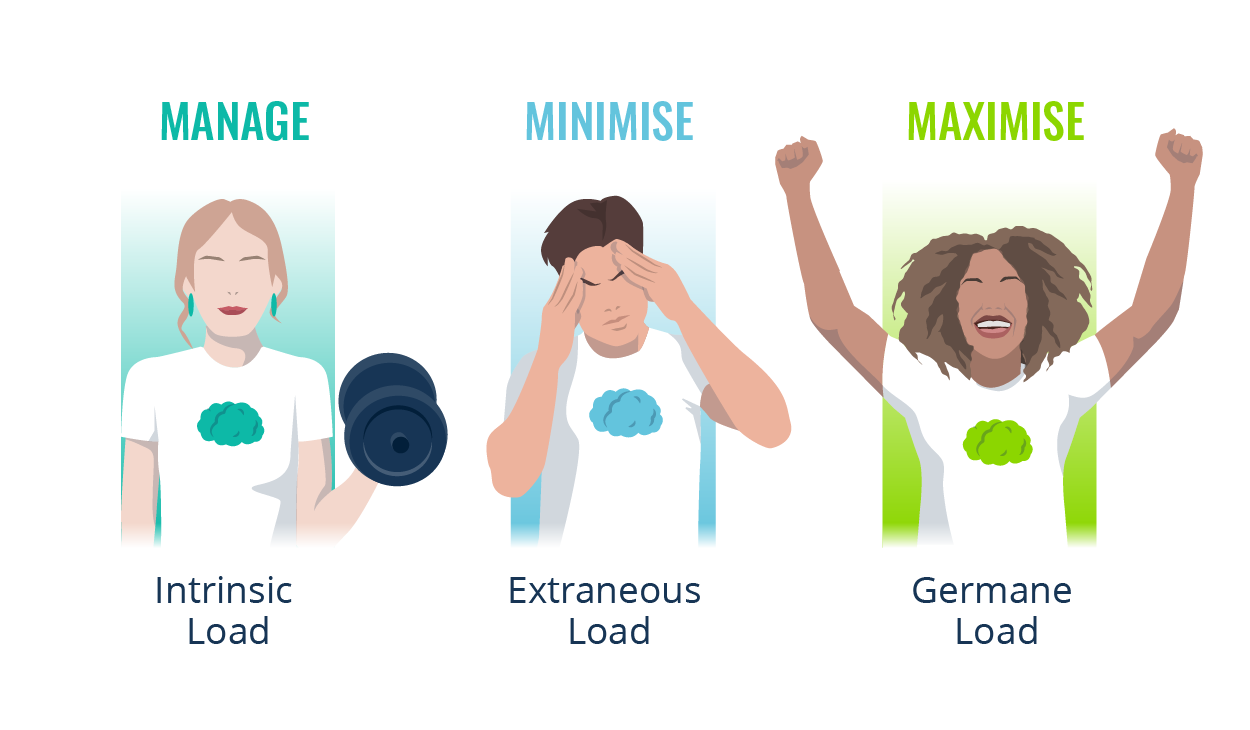
- Intrinsic Load: This refers to the inherent complexity of the learning material itself. After all, some topics are more challenging than others. This could be due to the topic’s abstract nature or the overwhelming amount of information to convey. For example, it’s easier to learn how to bake brownies than it is to make a soufflé.
- Extraneous Load: This load type arises from irrelevant or distracting elements within the learning environment. It’s often a consequence of ineffective instructional design. For instance, consider a cluttered presentation brimming with text, distracting images, and (gulp) star swipe animations.
- Germane Load: This is the mentally taxing effort that’s required to forge connections between new information and existing knowledge. It’s easier to onboard information when we can link it to familiar concepts. For instance, attempting to learn about quantum mechanics without a solid understanding of physics would be a fool’s errand.
Ultimately, all three load types share one thing: they compete for the same limited working memory space. When the total load exceeds Cowan’s four-chunk ceiling, learning breaks down. That’s what we’ll explore next.
But first, there’s one nuance worth knowing. In his 2019 revision, Sweller reframed germane load as a component of intrinsic load rather than a standalone category. The three-load framing remains the most widely used, but the theory is evolving.
The 5 Cognitive Load Effects You Should Know
Over 35 years of research, cognitive load theorists have documented specific instructional phenomena that emerge from working memory’s limits. Each has practical implications for how you design learning experiences. Here are the five effects you should know about.
1. The Worked Example Effect
Novice learners perform better after studying worked examples than after solving equivalent problems themselves. This is because unguided problem-solving forces the learner’s working memory to juggle the problem, potential solutions, and the underlying principles all at once. That’s cognitive overload waiting to happen.
On the other hand, a worked example lets the learner focus on how the solution works, freeing up capacity to build the underlying schema.
The evidence: A 2023 meta-analysis of worked examples in mathematics education found an average effect size of g = 0.48, a moderate improvement over traditional problem-solving approaches.
2. The Split-Attention Effect
When learners have to mentally integrate information from two or more separated sources (like a diagram and a caption on the other side of the page), extraneous load increases and learning deteriorates.
This is because the learner has to use working memory to hold their place, remember what they just saw, and mentally combine the pieces. That’s cognitive resources you’d rather have going toward understanding.
The evidence: Ginns’ 2006 meta-analysis of the split-attention effect found a weighted mean effect size of d = 0.85, one of the larger effects in CLT literature.
3. The Redundancy Effect
Presenting the same information in multiple forms simultaneously (for example, narration reading aloud the exact words that also appear on screen) can increase cognitive load rather than decrease it.
After all, the brain has to reconcile the two identical streams, which is a waste of working memory. If the information is genuinely redundant, one of the two channels is doing the work for nothing.
The evidence: First demonstrated by Kalyuga, Chandler and Sweller (1999), the effect has since been replicated across dozens of studies.
4. The Modality Effect
When information is presented across both auditory and visual channels (e.g. a narrated diagram), learning is stronger than when everything comes through a single channel (e.g. text next to a diagram).
This is because working memory has separate subsystems for verbal and visual information (Baddeley’s phonological loop and visuospatial sketchpad). Using both increases the total available capacity.
The evidence: Ginns’ 2005 meta-analysis of 43 modality-effect studies (n = 1,887 learners) found a mean effect size of d = 0.72 for high-interactivity content, and d = 0.93 for system-paced presentations.
5. The Expertise Reversal Effect
In some cases, instructional support that helps novice learners actively hurts expert learners.
Novices need scaffolding because they don’t have well-developed schemas. Experts already have those schemas lodged in their long-term memory, so that additional guidance becomes redundant. In other words, it transforms into extra load for experts.
The evidence: Documented across dozens of studies since Kalyuga, Ayres, Chandler and Sweller’s 2003 paper in Educational Psychologist.
What Happens When Cognitive Load Is Too High?
Imagine a scenario where your intrinsic and extraneous loads are elevated, while your germane load is low. It hurts just to think about it! This cognitive imbalance can have several detrimental effects on learning and overall cognitive function.
- Reduced Comprehension: As we’ve seen, when our cognitive resources are overloaded, we struggle to process and understand information effectively. This results in poor learning outcomes.
- Increased Frustration & Stress: The mental strain associated with heavy cognitive load can be difficult to manage. Some learners may find this frustrating or stressful and may even experience a decline in motivation.
- Increased Stereotyping: A heavy cognitive load may force us to rely on subconscious processes and schemas, such as basic pattern recognition. This can inadvertently lead to unhelpful stereotypical associations.
- Decreased Retention: Information acquired under conditions of high cognitive load is less likely to be retained. In other words, our working memory is less likely to transfer it to our long-term memory.
- Impaired Performance: Reducing comprehension and retention will naturally have negative consequences. Without access to the right information, our ability to think critically and solve problems will be impaired.
As you can see, heavy levels of cognitive load have tangible real-world implications. As such, it’s important to create learning environments that minimise intrinsic and extraneous load while maximising germane load. We’ll explore how this can be achieved next.
How to Reduce Cognitive Load in Learning Design
1. Reducing Intrinsic Load
Ultimately, intrinsic load is determined by the inherent complexity of your learning material. As such, there are limits to what you can control or modify. Thankfully, however, there are some strategies you can use to mitigate its impact.
- Chunk it Up: Here at Growth Engineering, we’re big advocates for microlearning and nanolearning experiences. We recommend dividing complex information up into smaller, more digestible chunks. As a result, your learners will be able to concentrate on the most crucial aspects, reducing cognitive overload.
- Use Visual Aids: They say a picture paints a thousand words. With this in mind, why not use diagrams, charts, or images to represent complex concepts visually? By empowering your learners to visualise information, you’ll enhance their ability to process and understand it.
- Make it Simple: Where possible, use analogies and metaphors to explain key concepts. This enables learners to relate complex ideas to familiar examples or previous experiences. This helps, as we’ve seen that connecting new information to existing knowledge drives better understanding.
- Add Context: While metaphors and analogies can be useful, strive to go beyond them and explain the relevance of the material to your learners’ lives. This will help your audience to understand the value of the material and can even boost their motivation levels.
- Get Hands On: Experiential learning can be particularly effective. Offer your learners opportunities to practise applying what they have learned. This gives them a chance to solidify their understanding, whilst simultaneously reducing the cognitive demands of learning.
2. Reducing Extraneous Load

Extraneous load is created when learning environments are filled with irrelevant or distracting elements. To combat this successfully, we’ll need to create a winning learning environment. Here are our top tips to get started.
- Clear Instructions: Every good learning experience starts with clearly stated learning objectives, expectations, and assessment criteria. This guidance supports your learners in focusing their attention on the most relevant tasks, preventing wasted time and energy.
- Minimise Distractions: Ensure your learning environment is free from distractions. If you’re a learning professional, consider offering your audience dedicated study time. If you’re a learner, enhance your focus by turning off your notifications and investing in noise-cancelling headphones.
- Avoid Redundancy: While it may seem obvious, it’s worth emphasising: avoid unnecessary repetition. Summarising key points is essential, but redundancy can increase extraneous load and make it difficult for your learners to focus on essential information.
- Offer Support: Learning’s better when we do it together. We recommend cultivating a social learning environment where your learners can share their knowledge. Implementing a mentoring or coaching programme can also facilitate the flow of information throughout your organisation.
- Be Positive: You should also seek to foster a positive and supportive learning environment. Encourage a growth mindset and make yourself readily available for questions, help, and general guidance. You’ll be amazed with the impact this can have on learner motivation.
3. Maximising Germane Load
Unlike intrinsic and extraneous load, which we aim to minimise, we’ll focus on maximising germane load. This is what aids us in forging meaningful connections between new information and existing knowledge. Here are some tips to get you started.
- Activate Prior Knowledge: Before learning begins in earnest, start by activating your learners’ existing knowledge on the topic. This can typically be achieved through encouraging brainstorming, summarising, or asking relevant questions. As a result, you’ll make it easier for learners to build the right connections.
- Get Reflective: Allow your learners ample time and space to connect different topics. If you rush through your learning material there’ll be no opportunity for reflection. This matters, as it will hinder your learners’ overall understanding and comprehension.
- Encourage Elaboration: One way to encourage reflection amongst your learners is to ask them to elaborate on a topic. For example, you could ask them to explain new information in their own words, provide relevant examples, or to connect it to previously covered material.
- Scenario-Based Learning: Providing opportunities for scenario-based learning helps learners to see the relevance of the material. In turn, they’ll be able to make connections between information and their own experiences. This can be a highly-effective learning approach.
- Offer Feedback: Feedback is the breakfast of champions. Providing timely and specific suggestions can help your learners to strengthen their understanding. Focus your feedback on supporting learners’ efforts to connect concepts and identify areas for improvement.
Cognitive Load and Multimedia Learning: Mayer’s Principles
Cognitive load theory has a sister framework that L&D professionals should know: Richard Mayer’s Cognitive Theory of Multimedia Learning (CTML). If CLT explains why working memory is the bottleneck, CTML explains how to design around it, specifically for content that combines words, images, and sound.
It rests on three claims about how human learners process information:
- Dual Channels: The brain processes visual and auditory information through separate systems.
- Limited Capacity: Each channel can only handle a small amount of information at once.
- Active Processing: Meaningful learning happens when the learner actively integrates information across channels.
It’s easy to see how this maps onto cognitive load theory and dual coding theory. Indeed, Mayer’s coherence principle (which advises removing extraneous material) has one of the largest effect sizes in educational psychology, with a median d = 0.97 across the studies.
For workplace training that combines slides, video, and audio, Mayer’s principles are worth knowing alongside the CLT effects listed above.
Cognitive Load in the Age of AI

Cognitive load theory has always been shaped by the technology of the moment. In 1988, that meant textbooks and blackboards. Today, it means learning management systems, adaptive platforms, and increasingly, artificial intelligence.
How Learning Technology Reduces Cognitive Load
Modern learning platforms are, in effect, cognitive load management tools. Well-designed learning management systems (LMSs) and learning apps distribute complex content into manageable chunks, deliver it on a schedule, and adapt to the learner’s progress.
Learning pathways reduce intrinsic load per session. Adaptive delivery matches difficulty to the learner’s level. Interactive elements like simulations and retrieval-based quizzes encourage active processing. Automation of admin tasks frees working memory for actual learning.
The AI-powered version of these tools takes each of the principles further.
AI’s Dual Effect on Cognitive Load
The promise of AI in learning is that it can personalise, scaffold, and adapt at scale. An AI tutor can generate a worked example for a novice or step back for an expert (the expertise reversal effect in action). It can also identify where a learner is stuck and offer just-in-time explanations.
But the picture isn’t uniformly positive.
A 2025 MIT Media Lab study tracked 54 participants writing essays over four months while their brain activity was recorded via EEG. The findings were striking.
- The LLM-assisted group showed up to 55% reduced brain connectivity compared to unaided writers.
- 83% of LLM users couldn’t quote from the essays they had just written.
- Over four months, LLM users underperformed at neural, linguistic, and behavioural levels.
This led the researchers to coin a new term: cognitive debt. When AI takes over the effortful work of thinking, working memory doesn’t just get less use. It gets less capable. Cognition is like a muscle. Use it or lose it.
The principle for L&D is straightforward: AI should act as a scaffold, not a substitute. It should reduce the extraneous load of learning without removing the productive struggle that creates the schema. For more on this, see our article on desirable difficulties.
Criticisms of Cognitive Load Theory
No theory survives four decades of scrutiny without attracting some legitimate criticism. With that in mind, here are some of CLT’s limitations.
- The Measurement Problem: The most persistent criticism concerns how we measure cognitive load. As Professor Christian Bokhove has argued, the field has relied for decades on Paas’s nine-point self-report scale, in which learners rate the mental effort they’ve invested in a task. Clearly, this approach lacks objectivity.
- The Web of Effects: CLT has accumulated a growing list of specific effects. In certain contexts, some of them contradict each other. For example, while the worked example effect is great for novices, it can hinder experts’ learning. The risk is that CLT becomes what Bokhove calls “the Very Hungry Caterpillar of learning theories“, expanding to swallow up any finding that contradicts it.
- Individual Differences: Cognitive load theory was built on assumptions about a “typical” learner, and those assumptions don’t hold for everyone. Indeed, a 2024 study found that neurodivergent learners experience significantly higher extraneous load than neurotypical learners, with ADHD traits the strongest predictor.
Of course, none of this invalidates CLT. The core insight, that working memory is limited and instructional design should respect those limits, remains well-evidenced and useful. Use it as a thinking framework and stay open to the fact that some learners, contexts, and effects sit outside its neat predictions.
Final Words
Cognitive load theory provides a valuable and research-backed framework for understanding how the brain processes information. In turn, we can use this knowledge to optimise learning experiences and improve our impact.
When we overburden our brains with complex or irrelevant information and distractions, our cognitive capacity is compromised. Unfortunately, our working memory has a limit, so we need to adjust our instruction accordingly.
Thankfully, there are strategies to counterbalance this and manage your mental workload. Start by chunking information, providing clear learning objectives (and links to previous materials), and offering support to your learners throughout the process.
The simpler you make it, the more your learners will learn. Who would have guessed?
Thanks for reading. If you’ve enjoyed this content, please connect with me here or find more articles here.
Cognitive load theory is one of many effective and influential learning theories. To get the full breakdown, please download our guidebook, ‘The Learning Theories & Models You Need to Know’.