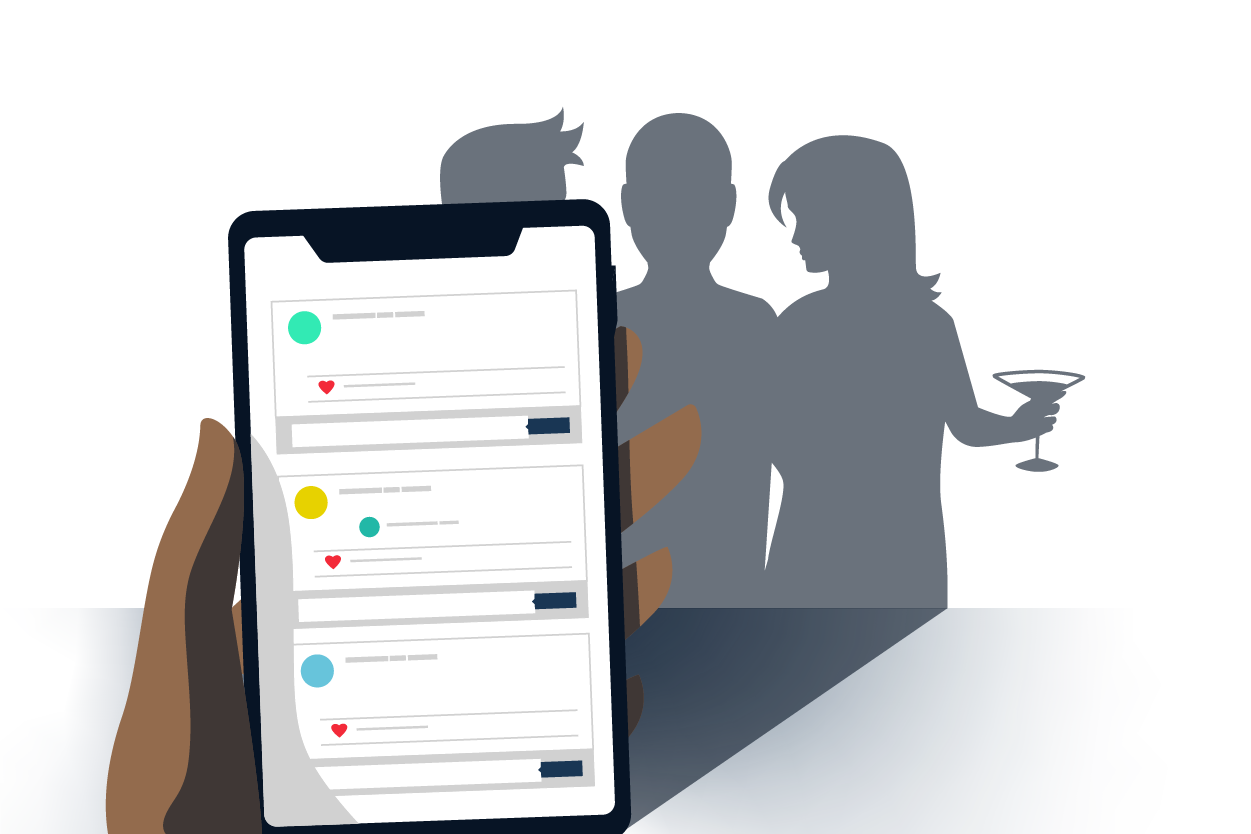
What is social learning? In its simplest form, it’s the process of learning by observing and interacting with others. It’s also the way most workplace learning already happens, whether organisations design for it or not.
The theory behind it was developed by Albert Bandura in the 1960s, building on the foundations laid by Lev Vygotsky decades earlier. The core idea is that humans don’t just learn through direct experience or formal instruction. We learn by watching, imitating, and interacting with the people around us.
Organisations are catching on. CIPD data shows that peer collaboration usage grew from 30% to 36% between 2021 and 2024, now outpacing apprenticeships and instructor-led training as a development method.
This article explains what social learning theory is, the neuroscience behind it, Bandura’s core principles, and how to apply it in your training programme.
Let’s learn about it together. It’s what Bandura would have wanted.
What is Social Learning?
Let’s start with a formal definition of this informal type of learning (oh, the irony!).
Social learning describes the way humans naturally acquire knowledge, behaviours, and skills through observing and interacting with others. But it’s more than passive observation. It includes imitation, modelling, conversation, feedback, and the social reinforcement that tells us whether a behaviour is worth repeating.
To get a better understanding of how this works, let’s break this down further.
Learning is the process of acquiring new information through self-study, experience, or formal instruction. In the case of social learning, learning takes place within a social context. It happens through our observations and interactions with friends, family, colleagues, or even strangers.
Indeed, research by Robin Dunbar found that social topics, personal stories, and gossip account for roughly 65% of all human conversation. In a 2025 replication, Dunbar himself found the figure to be closer to 85%. We don’t default to facts and bullet points when we communicate. We default to stories, shared experiences, and observation.
Social learning is just a name for what we already do.
Social Learning in the Workplace: 6 Examples
Today, organisations across the world have taken inspiration from our natural human urge to interact. Social learning is no longer just an academic concept. It’s a business essential.
Within the workplace, social learning can take place in a variety of contexts. For example:
| Format | What it looks like | Real-world example |
|---|---|---|
| Peer-to-peer teaching | Employees volunteer to teach colleagues on topics they have expertise in | Google’s Googler-to-Googler (G2G) programme: 80% of all tracked training is delivered peer-to-peer by over 6,000 employee volunteers |
| Peer circles | Small groups of 5–6 peers meeting regularly to solve shared challenges | Mars runs monthly peer circles for managers over six months, using “case clinics” where one manager presents a problem and the group helps solve it |
| Job shadowing | Following a senior colleague through their working day to learn by observation | McCormick & Company’s “Empower” leadership programme pairs employees with senior leaders, described as “one of the most powerful social learning experiences in the programme” |
| Scenario role-play | Learners act out realistic workplace situations with a pre-briefed actor or colleague | Byrne Dean uses “real play” in financial services firms: a manager responds to an employee who has made a serious error, while colleagues observe and learn |
| Communities of practice | Open-ended groups of employees who share expertise through webinars, events, and regular knowledge exchange | Mars supports expert-led communities around technical skills: “You’re not only learning new skills, you’re also learning how to listen and ask questions” |
| Employee-led conferences | Multi-day internal events where employees deliver sessions to colleagues | Kaplan’s Develop U Virtual Conference: a four-week online conference where employees train peers in their area of expertise |
More learning happens socially than you might expect. The 70:20:10 model vividly illustrates this, by showcasing the different means by which we acquire knowledge. It tells us:
- 70% of learning happens through experience.
- 20% comes from interactions with colleagues and friends.
- 10% is derived from formal training and education.
This model underscores the critical role of social learning and experience in developing skills and knowledge. The exact ratios have been debated, but the direction is widely accepted. The majority of workplace learning happens informally through experience and interaction, not through formal training.
But let’s take a step back to explore the roots and foundations of social learning.
The History of Social Learning Theory
The 1920s: Lev Vygotsky’s Socio-Cognitive Learning Theory
Lev Vygotsky, a pioneering Russian psychologist, laid the groundwork for much of our understanding of social learning. His groundbreaking theory suggests that learning is fundamentally a social process, where knowledge and skills are co-constructed through interaction with others.
He proposed that learning flourishes when individuals operate within their Zone of Proximal Development (ZPD). This is the sweet spot between what learners can accomplish independently and what they can achieve with guidance from a ‘more knowledgeable other’.
This insight would later be quantified dramatically by Bloom’s 2 Sigma research, which found that one-to-one tutoring produced a two standard deviation improvement over conventional instruction.
Essentially, Vygotsky provided a theoretical foundation for understanding how social interactions can accelerate learning and development. Sadly, his theories didn’t catch on during his lifetime. Thankfully, they continue to be discovered and studied to this very day.
The 1960s: Albert Bandura’s Social Learning Theory
Our modern understanding of social learning owes a significant debt to Albert Bandura, a Canadian-American psychologist whose 1960s theory redefined how we learn.
The theory was Bandura’s response to the popular behaviourist models of the time. These theories suggested that learning is solely a product of direct experience and conditioning. Bandura proposed a more comprehensive view.
He argued that people learn through a combination of observing others, processing information cognitively, and then reproducing observed behaviours. This is exemplified by Bandura’s iconic Bobo doll experiments.
1961: The Bobo Doll Experiment
Bandura’s famous Bobo doll experiments were designed to test his social learning theory. In these experiments, children observed adults interacting with a large inflatable doll called Bobo. Bandura broke the process into three stages:
- Observation: Children watched as adults either behaved aggressively towards the doll (hitting it, for instance) or played with it gently.
- Imitation: After observing the adult, the children were placed in a room with various toys, including a Bobo doll.
- Behaviour: Researchers then observed the children’s behaviour to see if they imitated the aggressive or non-aggressive actions that they had witnessed.
The children who observed aggressive behaviour replicated it. Those who hadn’t, didn’t. The implication was striking: behaviour could be learned purely through observation, without direct experience, instruction, or reinforcement.
Bandura’s 3 Core Concepts of Social Learning
Bandura’s theory rests on three ideas that, at the time, challenged everything psychologists believed about how learning works.
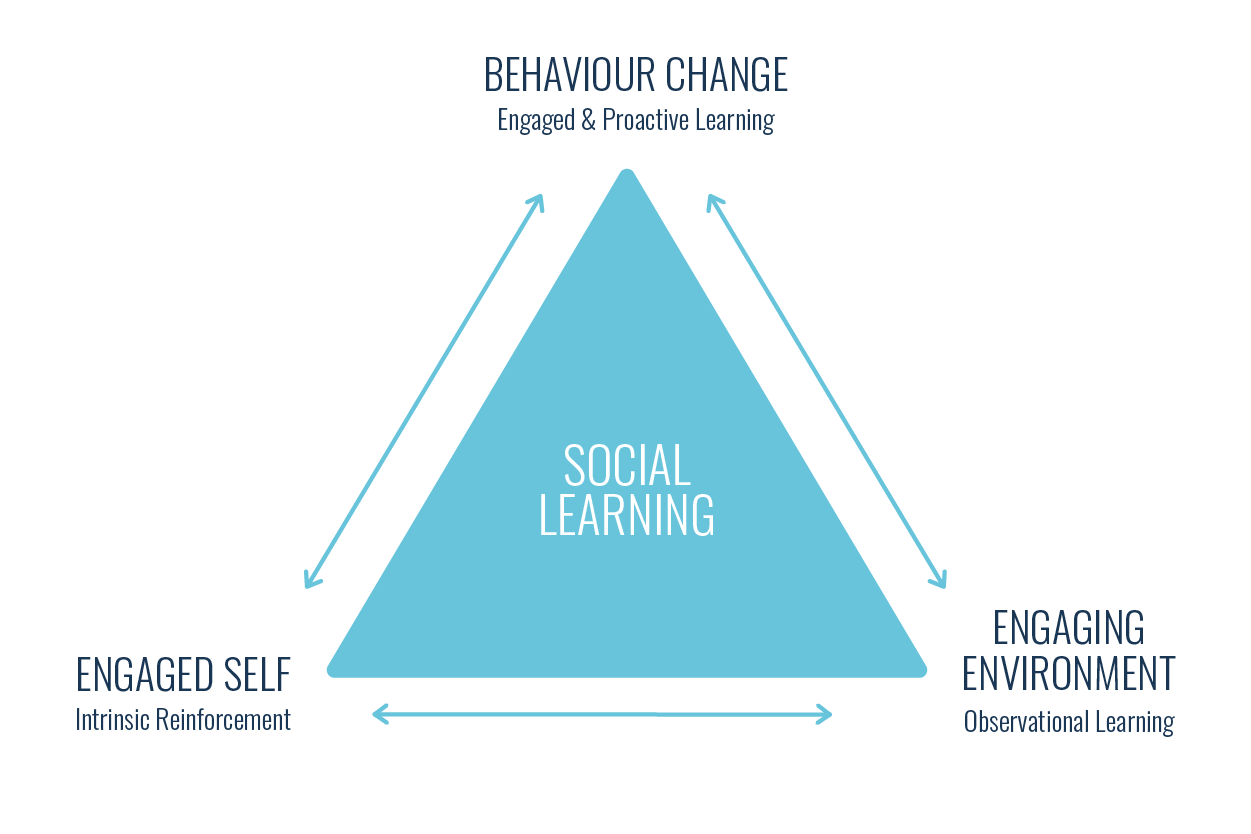
1. People Can Learn Through Observation
Before Bandura, the dominant view was that learning required direct experience and reinforcement. In other words, you had to do something and be rewarded or punished for it. Bandura proved otherwise. The Bobo doll experiment demonstrated that children could acquire entirely new behaviours simply by watching someone else.
This extends well beyond childhood. In the workplace, a new hire learns how to handle a difficult client by watching their manager do it. Likewise, a sales rep refines their pitch by observing a top performer. Similarly, a team absorbs its communication norms from its leader, often without anyone explicitly teaching them.
Most of this happens without anyone calling it training.
2. Internal Mental States Matter
Bandura argued that learning isn’t just an external process of stimulus and response. Internal cognitive and emotional states play an essential role. He described intrinsic reinforcement as the internal rewards that follow learning: pride, satisfaction, and a sense of competence.
These internal states can be just as powerful as external rewards in driving behaviour. Indeed, Bandura placed cognition at the centre of social learning, arguing that learners don’t just absorb what they see. They interpret it, evaluate it, and decide whether it’s worth repeating.
3. Learning Doesn’t Always Lead To Behaviour Change
This is perhaps Bandura’s most important insight, and one that often gets overlooked. Just because someone has learned something doesn’t mean they’ll act on it. A learner can observe a behaviour, understand it fully, and still choose not to replicate it.
Behaviourists assumed that learning and behaviour change were the same thing. Conversely, Bandura drew a clear line between the two. A person might learn a new skill through observation but lack the motivation, confidence, or opportunity to apply it.
This distinction between learning and performance is critical for L&D professionals: completion of a training module proves exposure, not behaviour change. The gap between the two is where most training programmes fall short.
The 4 Stages of Social Learning (Bandura’s Modelling Process)
The three core concepts describe what social learning is. Bandura also identified four sequential stages that determine whether observation actually leads to learning. All four must be present. If any one is missing, the chain breaks.
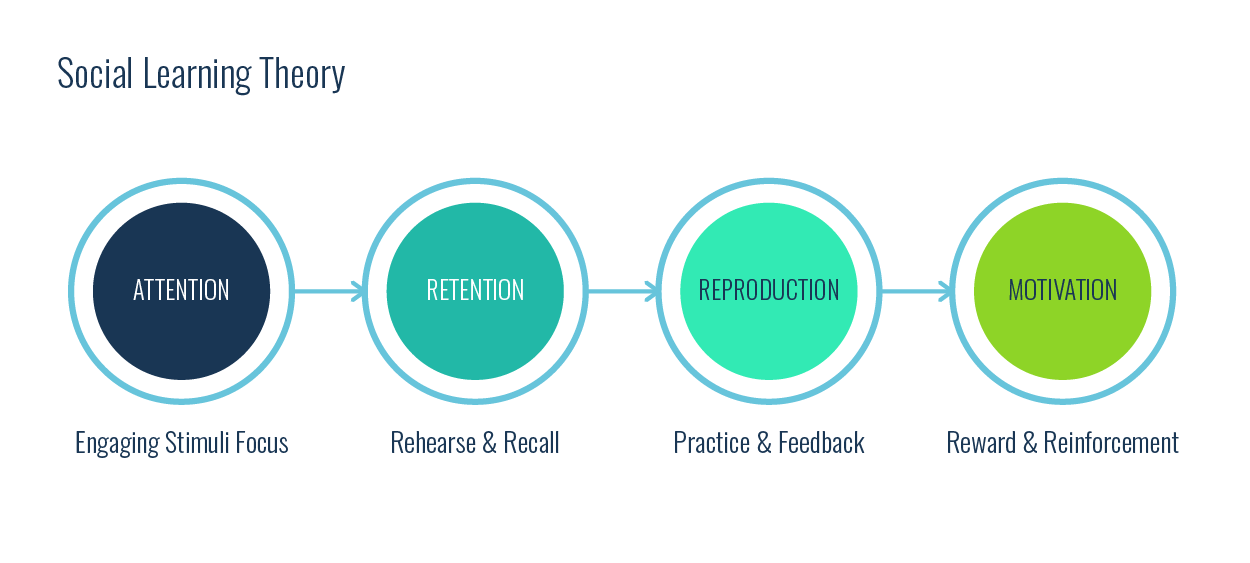
1. Attention
The learner must notice the behaviour in the first place. This may sound obvious, but attention is selective. Bandura found that learners are more likely to attend to models who are competent, high-status, or similar to themselves.
In the workplace, this explains why peer learning from a respected colleague often outperforms instruction from an external trainer the learner has no relationship with.
It also explains why storytelling is such an effective delivery mechanism. Narrative captures and holds attention in ways that abstract instruction cannot.
2. Retention
Observation is worthless if the learner can’t remember what they saw. The learner must encode and store the behaviour in memory for later use. Bandura described this as “symbolic coding”, where the learner converts the observed behaviour into an internal model they can draw on in the future.
This is where dual coding becomes relevant. Behaviours that are both observed visually and described verbally are retained more effectively than those processed through a single channel.
3. Reproduction
The learner must have the ability and the opportunity to reproduce the behaviour. Most corporate training programmes skip this stage entirely. Learners observe a demonstration, watch a video, or sit through a workshop, then return to their desks without ever practising what they saw.
Without reproduction, social learning stalls at theory. Scenario-based learning, role-play, and simulated practice environments exist to close this gap. They give learners a safe space to attempt the behaviour before the stakes become real.
4. Motivation
Finally, the learner must have a reason to replicate the behaviour. Knowing how to do something and choosing to do it are not the same thing. Indeed, Bandura identified three types of reinforcement that drive motivation:
- Direct reinforcement: the learner is personally rewarded
- Vicarious reinforcement: the learner sees others being rewarded
- Self-reinforcement: the learner experiences internal satisfaction or pride
This is where gamification maps directly onto Bandura’s framework. Points and badges provide direct reinforcement. Leaderboards provide vicarious reinforcement. You see others earning recognition and want to join them.
The Evidence for Social Learning
Researchers have been building the theoretical case for social learning for over fifty years. But L&D professionals need more than theory. They need evidence that it works in practice, at scale, and in the workplace. Thankfully, that evidence is growing, and it’s compelling.
- McKinsey research indicates that organisations can boost productivity by up to 25% by leveraging social learning tools.
- A Harvard Business School study found that incorporating social learning elements into courses can boost completion rates by as much as 85%.
- Finally, Comcast achieved a remarkable 40% increase in productivity by integrating social learning into their sales training programme.
We also have firsthand evidence. L’Oréal Travel Retail use Growth Engineering Learning App to train Beauty Advisors across Asia Pacific. Their learners are able to share their knowledge through automatically translated social posts and activity updates.
As a result, L’Oréal have reduced their training costs by 30% and have seen an average 20% increase in sales revenue across targeted territories.
The Neuroscience of Social Learning
The evidence shows social learning works. The neuroscience explains why.
Neural Coupling: Two Brains, One Act
When two people communicate effectively, their brains don’t just process the information independently. They synchronise. Uri Hasson’s landmark 2010 study at Princeton was the first to demonstrate this directly.
Using fMRI, his team recorded a speaker’s brain activity while they told a story. They then played the recording to a separate group of listeners, also inside fMRI scanners, and compared the two sets of brain activity. The listeners’ brains mirrored the speaker’s, with the same regions activating in the same patterns.
In some areas, the listeners’ brains got ahead, anticipating what the speaker would say next. As Hasson put it, communication truly is “a single act performed by two brains.”
Synchrony Predicts Learning
Neural coupling isn’t just a fascinating brain phenomenon. It predicts outcomes. Dikker et al. (2023) used portable EEG in a real classroom and found that students whose brainwaves were more synchronised with their teacher and peers retained more of the information they were taught.
The implication is clear: the stronger the neural coupling during a social learning experience, the more the learner takes away from it.
Mirror Neurons: Learning by Simulating
Part of the explanation lies in the mirror neuron system. Mirror neurons fire both when you perform an action and when you observe someone else performing it.
Speer, Reynolds, Swallow, and Zacks (2009) showed this using fMRI: when participants read about a character picking up an object, their premotor hand area activated. When a character moved location, their spatial navigation regions responded.
The brain doesn’t just process observed behaviour. It simulates it. This is the neural mechanism behind Bandura’s first stage: observation is never passive.
It Goes Deeper Than Language
The most recent research pushes further still. Zada, Nastase, Speer et al. (2026) used fMRI hyperscanning to simultaneously record two people’s brains during real-time conversations.
They found that speaker-listener coupling extends beyond the language network into regions associated with social cognition. The brain isn’t just processing words. It’s modelling the other person’s intentions, beliefs, and mental state.
Bandura knew that social learning was powerful. Now modern neuroscience shows us why: the brain has dedicated systems for observing, simulating, and synchronising with other people. This isn’t a pedagogical preference. It’s how the brain is built to operate.
The Limitations of Social Learning
Social learning is powerful, but it does have clear boundaries.
For a start, social learning amplifies whatever knowledge exists in the group. If that knowledge is accurate, the effect is positive. If it’s inaccurate, the information spreads just as effectively (with the added ‘credibility’ of coming from a trusted peer).
What’s more, critics such as Shaffer (2005) argue that social learning theory overemphasises environmental factors at the expense of individual differences. Biological predispositions, personality traits, and attention spans all influence learning capacity in ways the theory doesn’t fully account for.
While it’s effective in explaining certain behaviours, social learning theory may struggle to account for the development of complex skills or behaviours. This is particularly true for behaviours that require extensive practice and innate abilities.
Social learning works best as one component of a broader strategy, not the entire strategy. It combines powerfully with retrieval practice, spaced repetition, and experiential learning, each one addressing a limitation the others can’t.
How to Apply Social Learning Theory
The theory and the evidence are clear. But knowing that social learning works and how to implement it are two very different things. The challenge isn’t creating it from scratch. It’s designing the conditions for it to happen more consistently, more visibly, and more effectively.
Here are five practical steps to get you started.
- Give it a Home: Social learning happens whether you design for it or not. The difference is whether you capture it. A platform (such as an LMS) with discussion forums, social feeds, peer challenges, and expert Q&A areas turns fleeting interactions into searchable, reusable knowledge.
- Make It Easy to Share: The biggest barrier to social learning isn’t willingness. It’s friction. If sharing knowledge requires extra steps, logins, or formal write-ups, people won’t do it. The best social learning platforms make contributing as simple as posting a comment. User-generated content, peer ratings, and visible recognition for top contributors all lower the threshold.
- Build in Practice: Bandura’s third stage (‘Reproduction’) is the one most organisations skip. Learners observe, but never practice. Scenario-based exercises, role-play, and peer simulations give learners a safe environment to reproduce what they’ve seen before the stakes are real.
- Reinforce Socially: Bandura identified vicarious reinforcement as a key driver of motivation. In other words, seeing others getting rewarded makes you want to join in. Gamification is purpose-built for this. Leaderboards, badges, XP, and knowledge contests create visible social proof that learning is valued and rewarded.
- Protect the Quality: Social learning amplifies whatever knowledge exists in the group. That includes misinformation. Pair social channels with expert moderation, peer review mechanisms, and clear escalation routes. The goal isn’t control. It’s to ensure accuracy without killing spontaneity.
Final Words
Bandura and Vygotsky understood something sixty years ago that neuroscience has since confirmed: the brain is built to learn from other people.
Neural coupling synchronises our brain activity during communication. Mirror neurons simulate observed behaviour as though we were performing it ourselves. And the research consistently shows that social learning doesn’t just feel natural. It produces measurably better outcomes than learning alone.
The question for L&D professionals isn’t whether social learning works. It’s whether your training programme is designed to support it, or whether you’re leaving it to chance.
The Impact Suite is built for social learning at scale, with discussion forums, peer challenges, social feeds, and gamified recognition, all engineered into a single platform. Book a demo to see it in action, or download our ‘Social Learning Guidebook‘ to unleash a bounty of actionable insights and practical tips.