
Here’s a familiar story. A team finishes a training course. The scores are good, the feedback is glowing, and everyone leaves energised. However, six months later, nothing about how they actually work has changed. By the only measure that matters, the training failed.
This is the transfer problem, and it is the quiet crisis at the heart of workplace learning.
Transfer of learning is whether what people learn in training shows up in what they do on the job. It’s not whether they enjoyed the course, passed the quiz, or felt more confident. It’s whether their behaviour changed where and when it counts. And by that measure, a great deal of training achieves very little.
This matters because transfer is the entire point of training. An organisation does not train people so they can pass a test. It trains them so they will do something differently, and better, when they’re back at work. Every other idea in learning science, memory, attention, and motivation, is ultimately in service of this one:
Getting learning to travel from the classroom to the coalface.
So why does it so often fail to make the journey, and what does it take to help it across?
What is Transfer of Learning?
Transfer of learning is the application of what was learned in one context to a different one. It’s the extent to which knowledge, skills, and behaviours picked up in training actually get used on the job.
Put differently, it’s the bridge between learning and doing. It comes in two forms:
- Near Transfer: Applying learning to situations closely resembling the ones it was learned in. For example, a call handler trained on one enquiry system using it to handle a slightly different enquiry is near transfer. The contexts are similar, so the learning carries across readily.
- Far Transfer: Applying learning to situations quite unlike the training. For example, using a principle from a leadership workshop to defuse a real conflict months later, or adapting a technique to a problem it was never taught for. The greater the gap between where you learned something and where you use it, the harder transfer becomes.
As we’ll see, far transfer is much rarer than most training assumes.
This idea of learning transfer is over a century old. In 1901, Edward Thorndike and Robert Woodworth proposed the theory of identical elements: transfer depends on how much the training and the target situation share. The more alike they are, the more learning transfers across.
It was a quietly radical finding, because it demolished the popular belief in “formal discipline”, the idea that studying difficult subjects like Latin or geometry trained the mind in general, much as exercise strengthens a muscle. This isn’t the case. You just get better at the topic at hand.
One more distinction matters. An influential model proposed by Timothy Baldwin and Kevin Ford in 1988 splits transfer between two demands:
- Generalisation: Applying learning to the job at all.
- Maintenance: And keeping it up over time.
Training has not truly transferred until it clears both hurdles. Plenty of skills are used once and abandoned, which, as the next section shows, is exactly what tends to happen.
How Much Does Training Actually Transfer?
Ask around and you will hear a striking figure: only 10% of training ever transfers to the job. This number turns up in blogs, books, conference talks, and even academic papers. It is also, like many other learning myths, made up.
Trace the “10%” claim back through its citations and it leads to a single 1982 article by David Georgenson, who offered it as a personal, off-the-cuff estimate with no study or data behind it.
Every repetition since has simply passed the number along. It has survived for more than forty years not because anyone measured it, but because it sounded about right and nobody checked. This is the same reason why the learning pyramid and learning styles myths have perpetuated.
The real figures are more encouraging, and more useful. Alan Saks and Monica Belcourt asked training professionals at 150 organisations to estimate how much of their training was still being applied:
- Immediately after training: 62%
- After six months: 44%
- After one year: 34%
That’s a very different story from a flat 10%. Transfer, it seems, is not doomed from the outset. It starts reasonably well and then decays, with roughly half of what was applied at first slipping away inside a year.
So why do estimates vary so wildly, from 10% to over 60%? That’s largely because transfer is barely measured at all. A review first published in late 2025 found the assessment tools organisations use to be heterogeneous and fragmented.
The study also found that, in practice, most organisations never actually check whether training has changed behaviour. Donald Kirkpatrick won’t be happy.
Two things, though, are beyond dispute. A significant share of training never reaches the job, and much of what does reach it fades over the year that follows. That’s the transfer problem in a nutshell. The rest of this article is about what causes it, and what to do about it.
Why Does Training Fail to Transfer?
When training doesn’t stick, the instinct is to blame the training: the content, the delivery, the design. And while this is part of the picture, it’s not the biggest part. In fact, decades of research points to a more uncomfortable conclusion:
What happens before and after the training often matters more than the training itself.
The foundational model from Baldwin and Ford groups three influences on transfer: the learner, the training design, and the work environment they return to. Most organisations pour their effort into the middle one, perfecting the course, at the expense of the other two.
However, the evidence suggests that is the wrong emphasis. When Blume and colleagues pooled 89 studies and 12,500 people, no single driver dominated. Cognitive ability came top at r = .37, then voluntary participation, supervisor support and transfer climate. Their conclusion was that neither the learner nor the environment is decisive on its own.
There is no lever. There is a system.
A wider review of the transfer literature by Burke and Hutchins pinned down what “supportive” means in practice:
- Whether people actually get the opportunity to use the new skill.
- Whether their manager backs them in doing so.
- And whether the wider work climate expects them to.
This is the insight most training misses. A learner can leave a brilliant course genuinely able to do something new, and still change nothing, because they return to a job with no time to apply it, a manager who never asks about it, or a culture that carries on exactly as before.
That reframes training as a shared responsibility. It’s not something an L&D team can deliver alone, however good the design. It depends on managers, on workload, and on the wider organisation itself.
Which is also good news. Because these conditions can be altered and designed, transfer can be engineered rather than merely hoped for.

Transfer Has a Shelf Life
Even when training does reach the job, it rarely stays there. Recall the figures from earlier: the share of employees still applying their training fell from 62% immediately to 34% after a year. Transfer is not just a one-time event that either happens or doesn’t.
It’s a signal that fades over time.
The reason for this is the forgetting curve. A skill that is learned and then left alone decays like any other memory, and the busier the job, the faster old habits reassert themselves over new ones.
This exposes the flaw in how most training is delivered. The single, one-off event is close to the worst possible design for lasting transfer. It front-loads everything into one moment, then leaves the brain to forget it at its leisure.
The fix is to treat training as a process, not an event. This means embracing spaced reinforcement across weeks, revisiting key skills, and giving people an opportunity to use them before they slip away. Transfer that is topped up is transfer that lasts.
The Hard Truth About Transfer
There is a transfer limit that no manager can fix, and that lies in the distance itself. The further learning has to travel from where it was learned to where it gets used, the less reliably it makes the trip.
Near transfer, to similar tasks, happens fairly readily. Far transfer, to genuinely different tasks, is stubbornly rare.
The clearest evidence for this comes from the brain-training industry. This market is worth billions, and it’s built on the promise that playing simple cognitive games will make you sharper across the board: better focus, better memory, better problem-solving acumen, and so on.
However, when a large group of scientists reviewed the evidence, they found something deflating. Brain training reliably makes people better at the trained game, and often at very similar tasks, but there is little good evidence that it improves the broader, real-world abilities it claims to.
The same holds for working-memory training, which does not transfer to general intelligence or unrelated skills. This pattern repeats across decades of research. Skills tend to stay close to the domain they were learned in.
For learning design, this is a warning worth heeding. Generic “critical thinking”, “problem solving” or “agility” programmes promising skills that apply anywhere are promising precisely the far transfer that is hardest to achieve.
Thorndike’s century-old lesson persists. The more training resembles the real task, the more of it survives the journey to the job.
How to Design Training That Transfers
This brings us to the question you’ve likely been asking all along. If transfer is this hard, how do you design for it?
Well, transfer is not luck. It can be designed for, at every stage, from the course itself to the weeks that follow. The six principles below, drawn from everything above, turn the science into practice.
- Make Training Relevant: This is Thorndike’s identical-elements lesson, and it’s the single most reliable way to improve transfer. The closer your training looks, feels, and functions like the real thing, the more will carry across. Focus on using realistic scenarios, actual tools, and genuine tasks rather than abstract exercises.
- Teach Principles, Not Just Procedures: Rote steps transfer only to near-identical situations. Conversely, understanding why something works gives learners something they can adapt when circumstances change. This is the best route to harder, further transfer.
- Vary the Practice: Learning rehearsed in one narrow context tends to stay stuck there. Mixing problem types through interleaving, and varying the situations in which a skill is practised, builds flexible knowledge that travels well. These are desirable difficulties. Learning is harder in the moment, but far more portable.
- Build in Retrieval: As we’ve seen, transfer has two demands: applying learning and maintaining it. The second is where most training fails as skills fade over the months that follow. Thankfully, retrieval practice and spaced reinforcement can help keep learning alive long enough for it to be put into practice.
- Adapt Your Environment: Give your people genuine opportunities to use their new skills quickly, before they fade. Brief their managers on what to expect, provide support, and check in as necessary. After all, a skill that is never used, or never gets noticed, is a skill that disappears.
- Measure Whether it Worked: Most organisations never check whether training changed behaviour on the job, which is exactly why the myths about transfer persist. Decide up front what applying the learning would look like, then go and look for it weeks later.
Follow these steps, and transfer stops being something you hope for and becomes something you work towards.
Final Words
Learning only matters if it changes what people do. A brilliant course that leaves behaviour untouched has failed, however good it may have felt in the room. Transfer is not just a feature of effective training. It’s the test of it.
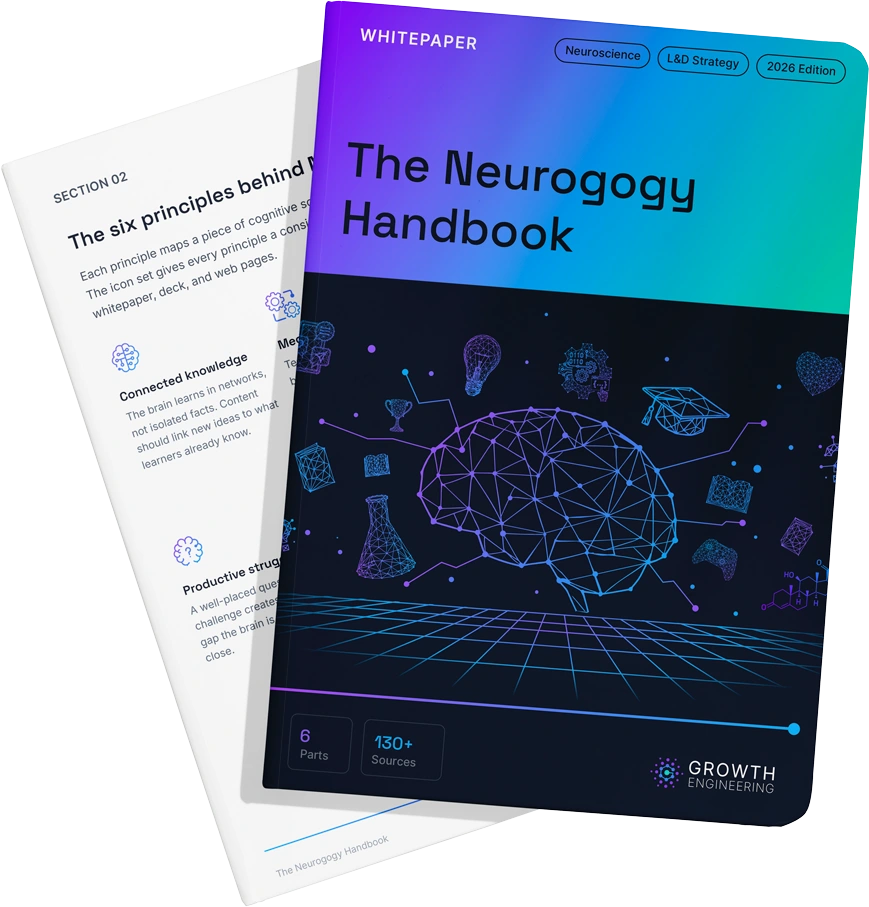
This is what neurogogy means in practice: designing learning around how the brain actually acquires, keeps and applies knowledge, rather than how training has always been delivered.
A brain that transfers what it learns needs training that resembles the real task, principles it can adapt, practice varied enough to travel, reinforcement that outlasts the session, and a workforce that’s ready for the change.
Get those right and learning will inevitably reach the job. Get them wrong and it’ll never leave the classroom.
Ready to build learning that lasts?
- Book a demo to see how the Impact Suite turns the science of transfer into training that sticks.
- Explore the Impact Suite and the neuroscience behind every feature.
- Download the Learning Theories guidebook for the full picture of the science that makes learning stick.