
In 1953, a young man had brain surgery to stop his epileptic seizures. It worked. It also took his memory.
The operation removed a structure deep in the brain called the hippocampus, and from that day Henry Molaison could not form a single new conscious memory.
When the surgeon William Scoville and neuropsychologist Brenda Milner documented his case in 1957, they established something that reshaped brain science. Memory is not one thing, and it’s not stored in one place. It’s a specific, physical process, built by specific structures doing specific jobs.
That’s the idea this whole article rests on, and it’s why training can be made to work. If memory were just a passive recording, there would be little we could do to strengthen it. But because it’s a process the brain runs in stages, learning can be built to work with each and every step.
Ready for a memorable experience? Let’s jump in.
What is Memory?
Memory feels like a single thing. A single mental filing cabinet we drop things into and pull them back out of. However, it’s nothing of the sort. Memory is a set of processes, and psychologists have long divided it into three parts:
- Encoding: This is the act of getting information in. When you meet someone new, the sight of their face, the sound of their name, and the context you met them in are converted into a form the brain can work with. Nothing can be remembered if it’s not encoded properly in the first place.
- Storage: Next up, information gets stored over time, from the fraction of a second a sound lingers in your ears to the decades a childhood home stays with you.
- Retrieval: Finally, retrieval is the process of pulling information back out when you need it, whether it surfaces on its own or you go searching for it.
The classic account of how these fit together is the multi-store model proposed by Richard Atkinson and Richard Shiffrin in 1968. In it, information flows from a brief sensory register into short-term memory. If it’s rehearsed and encoded well enough, it then gets moved over into your long-term memory storage.
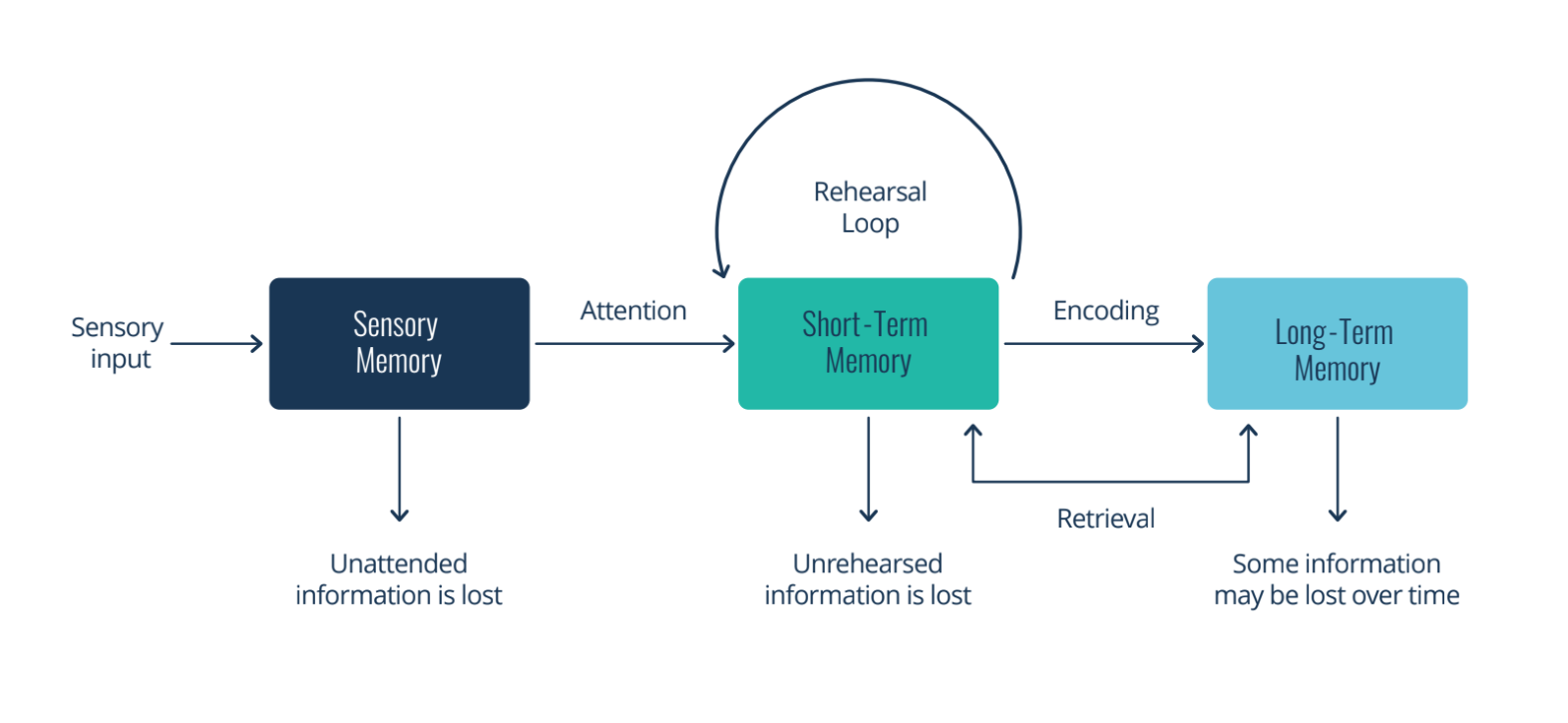
The model has been refined many times since, as we will see, but its core sequence still frames how we understand memory today. It also maps neatly onto a simple truth for anyone who designs learning: break the chain at any point and the memory is lost.
What Makes Information Stick?
Not everything we encode is encoded equally. In 1972, Fergus Craik and Robert Lockhart proposed that what decides whether something lasts is not how long we hold it, but how deeply we process it. Their framework sets out a scale from shallow to deep. The same piece of information can be encoded at any level on it:
- Visual Encoding: Captures how something looks (its shape, colour, or layout). This is the shallowest level.
- Acoustic Encoding: Captures how it sounds, which is why a catchy phrase lodges in your head. This goes a little deeper.
- Semantic Encoding: Captures what it means, and how it connects to what you already know. This is the deepest, and the most durable level.
The deeper the processing, the stronger the memory. This is why rereading a slide achieves so little, and why asking someone to explain an idea in their own words achieves so much. One skims the surface, the other forces the brain to process for meaning.
How Are Memories Formed in the Brain?
A memory is a physical thing. Every fact you hold and every skill you own exists as a pattern of physical change inside your head. So what actually changes?
The connections between your brain cells.
Neurons That Fire Together, Wire Together
Your brain contains roughly 86 billion neurons, and they communicate across tiny gaps called synapses. Learning something new does not add a neuron. It strengthens the connections between the ones you already have.
The neuroscientist Donald Hebb set out the principle in 1949, later boiled down to a now-famous phrase: neurons that fire together, wire together.
When two neurons activate together often enough, the link between them strengthens, and that strengthened circuit is the memory.
From Theory to Proof
For decades this was an elegant idea with no direct proof. Then, in 1973, Timothy Bliss and Terje Lømo found the mechanism. Stimulating a pathway in the hippocampus with a rapid burst of activity produced a lasting increase in synaptic strength. They called this effect long-term potentiation.
Fifty years on, it remains the leading explanation of how learning is written into the brain: activity strengthens synapses, and strengthened synapses hold memories.
Where Memories Live
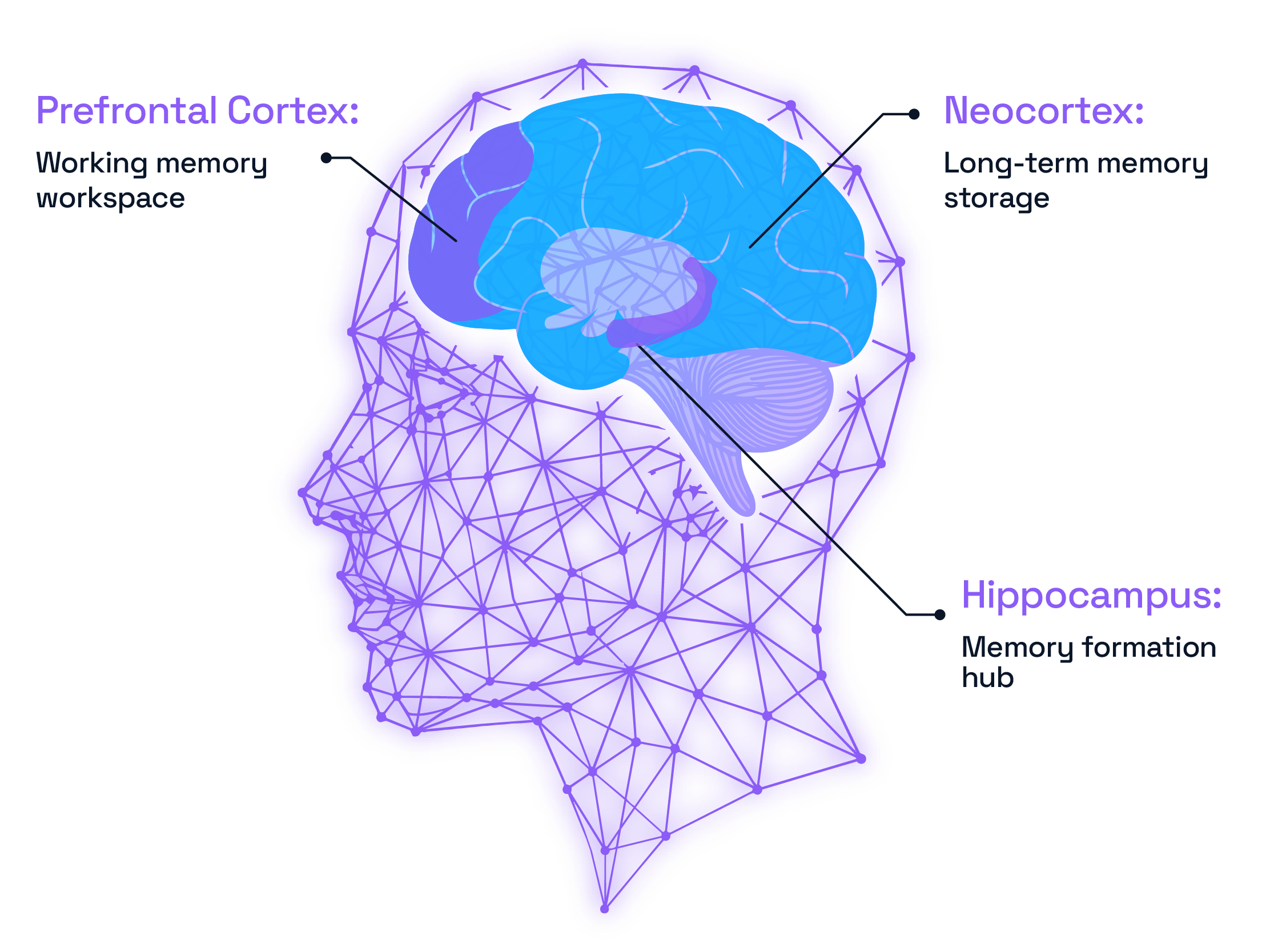
This brings us back to Henry Molaison. The hippocampus he lost is the brain’s memory-forming hub, where new experiences are first captured. But memories do not stay there.
Over days and weeks, through a process called consolidation, they are gradually moved to the neocortex for long-term storage. Much of this filing happens when we sleep.
This is why losing the hippocampus does not erase a lifetime of older memories. Those had already moved out.
What We’ve Learned Since
The frontier is stranger still:
- A Memory Can Be Switched On: Using light-sensitive proteins, researchers located the exact cluster of neurons holding a single memory in a mouse and reactivated it at will, triggering the memory on demand.
- A False Memory Can Be Planted: The same team went further, implanting a memory of an event that never happened, leading a mouse to fear a place where nothing bad had occurred.
- Forming a Memory Breaks Your DNA: A 2024 study found that encoding a memory causes breaks in a neuron’s DNA, setting off an inflammation-like repair process that helps lock it in place.
Put differently, the physical trace of memory, once just a theory, is now something scientists can see, switch on, and track.
What Are the Different Types of Memory?
Just as memory is not a single process, it is not a single store. It splits in two useful ways: by how long it lasts, and by what kind of information it holds.
By duration, information moves through the stages we met earlier. It begins in sensory memory, a near-instant buffer holding a raw impression of what you just experienced. This comes in forms matched to the senses:
- Iconic memory: for what you see
- Echoic memory: for what you hear
- Haptic memory: for what you touch
- Gustatory memory: for what you taste
- Olfactory memory: for what you smell
These traces last no more than a few seconds. Whatever you pay attention to passes into short-term memory, and what is encoded well enough settles into long-term memory, which has no known limit and can last a lifetime.
Working Memory: The Mental Workbench
Short-term memory is more than a holding tray. In 1974, Alan Baddeley and Graham Hitch reframed it as working memory: an active workspace where you hold and manipulate information in the moment, whether you are following instructions, doing mental arithmetic, or keeping a sentence in mind until its end.
Its defining feature is how little it holds. George Miller’s famous 1956 paper put the limit at seven items, plus or minus two. Later work revised that down. When people cannot group items cleverly, the real ceiling is closer to four.
This narrow bottleneck is why overloading learners backfires, and it’s the foundation of cognitive load theory. However, you can stretch it through chunking, where single items are grouped into meaningful units. For example, this is how a phone number becomes three clumps rather than eleven separate digits.
The Types of Long-term Memory
Long-term memory divides again, by the kind of knowledge it holds:
- Explicit (Declarative) Memory: This is what you can consciously recall and put into words. It covers episodic memory, your record of personal events, and semantic memory, your store of facts and meanings.
- Implicit (Non-Declarative) Memory: This is knowledge you show rather than state. Above all, it is procedural memory: skills like riding a bike or touch-typing, which run automatically once learned.
This is the very split Henry Molaison revealed. He could form no new explicit memories, yet he could still learn new skills without any memory of practising them.

Why Do We Forget?
Forgetting feels like a malfunction, the system letting us down. Mostly, however, it is the system working exactly as designed. Memories fail for a handful of distinct reasons:
- Encoding Failure: The memory was never properly formed. As we saw, information you do not attend to never gets captured, so there’s nothing to retrieve.
- Decay: Traces fade with time when they are not used. A connection that is never reactivated gradually weakens.
- Interference: Other memories get in the way. Older knowledge can disrupt new learning, and new learning can crowd out the old. This is why similar things learned close together blur into each other.
- Retrieval Failure: The memory is intact but you cannot reach it in the moment. This is the maddening ‘tip-of-the-tongue’ state. The right cue often unlocks it all at once.
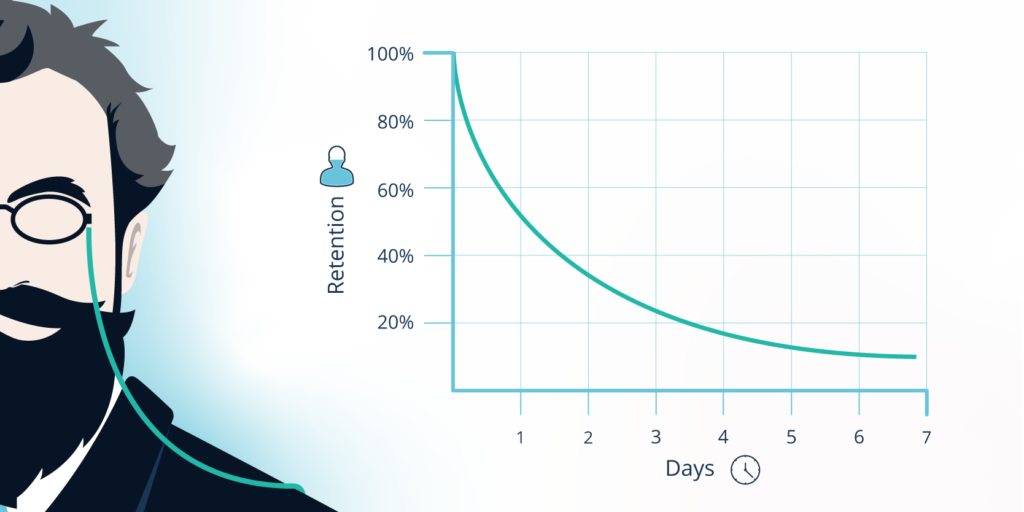
The pattern of this decline was first charted by Hermann Ebbinghaus in the 1880s, whose forgetting curve showed how quickly newly learned information slips away without reinforcement.
Forgetting as a Feature
Here’s the reframe, though. Forgetting is not a flaw in the system. It’s a feature, not a bug. In a 2017 review, neuroscientists Blake Richards and Paul Frankland argued that the brain actively works to forget, and this is part of what makes it intelligent.
Clearing out dated and irrelevant detail lets us generalise, adapt, and decide without drowning in noise. The proof is the rare person who cannot forget.
Solomon Shereshevsky, one of the most famous case studies in psychology, could recall almost anything, yet the flood of unfiltered detail left him unable to grasp abstractions. He could not see the wood for the trees. A perfect memory was a burden, not a gift.
For anyone designing learning, this shifts the goal. The aim is not to stop forgetting, which is neither possible nor desirable. It’s to protect the memories that matter, by giving the brain the signals that mark information as worth keeping.
Memory Is a Reconstruction, Not a Recording
We treat memory like video footage: a faithful recording we replay on demand. But that’s not how it works. Every time you recall something, your brain rebuilds it, and the act of rebuilding can quietly change it.
In a 2000 study, Karim Nader and Joseph LeDoux showed that recalling a well-established memory returns it to a fragile, editable state before it is stored again.
In other words, retrieval does not simply read the memory. It reopens it. For a short window after each recall, the memory can be strengthened, weakened, or altered before it is filed back.
This reflects our everyday experience. In Elizabeth Loftus’s classic experiment, viewers of a filmed car crash gave faster speed estimates when asked how fast the cars were going when they “smashed” rather than “hit”. A week later, the “smashed” group were more likely to recall broken glass in the film.
There was none. A single word had rewritten what they saw.
This carries real consequences for learning. It’s the reason why a learner’s confidence is a poor guide to what they actually know: a memory can feel vivid and certain and still be wrong. And it’s why the act of retrieval matters so much.
Every time a learner pulls something back from memory, they are not just testing it. They are reshaping it, making the retrieved version stronger and easier to reach next time.
How to Design Learning That Works With Memory
Everything above points to one practical conclusion for anyone who designs training: if memory is a process that the brain runs in stages, learning can be built to support each stage.
Most training fails not because the content is poor, but because it works against how memory functions. Here’s how to work with it instead.

1. Help the Brain Encode
Nothing is remembered that is not encoded well in the first place, and the biggest threat to encoding is overload. Working memory is narrow, which is why cognitive load theory matters: strip out noise, chunk information, and do not fill the channel faster than it can cope.
Strengthen what does get through by pairing words with visuals, which dual coding shows the brain files more richly, and by making learners do something with the material rather than receive it passively. Emotion helps too: material that carries emotional weight is tagged as significant and encoded more deeply.

2. Protect Consolidation
A memory is not fixed at the moment of learning. It is stabilised over hours and days, much of it during sleep. This is why cramming fails: it loads information but gives the brain no time to file it.
Spacing learning across days works with consolidation instead of against it. This is the principle behind spaced repetition.
The effect runs remarkably deep. A 2024 study found that even non-neural human cells register a spaced signal more strongly than a massed one, which suggests the advantage of spacing is written into the basic biology of our cells, not just our brains.
3. Build in Retrieval
The most powerful memory tool of all is recall itself. As we saw, retrieving a memory strengthens it. This is why retrieval practice, testing yourself rather than rereading, beats almost every other study technique.
It’s also why mixing topics through interleaving makes retrieval harder in the moment but far stronger over time. A quiz is not just an assessment. It’s one of the best ways to build the memory in the first place.
One point cuts across all three stages: state matters. A stressed, distracted, or exhausted brain encodes and retrieves poorly, which is why stress and poor sleep quietly erode the return on any training a business invests in.
Final Words
Everything in this article comes back to one idea. Memory is not a passive recording. It is a living process, built at the synapse, stabilised over time, and rewritten each time it is used. Learn how that process works, and you can design for it rather than against it.
That’s what neurogogy means in practice: building learning around how the brain actually forms, keeps, and retrieves knowledge, instead of how we assume it should.
A brain that encodes through attention, consolidates over time, and strengthens through retrieval does not need more content thrown at it. It needs content delivered in the way memory is built to receive it.
This is the principle behind the Impact Suite. Every part of it, from spaced reinforcement to retrieval-based challenges, is designed to work with memory rather than overwhelm it.
Because forgotten training helps no one.
Ready to build learning that lasts?
- Explore the Impact Suite and the neuroscience behind every feature.
- Book a demo to see how the Impact Suite turns the science of memory into training that sticks.
- Download the Learning Theories guidebook for the full picture of the science that makes learning stick.