
Think back to a training course you completed over the last year. Can you remember what it covered?
Now think about where you were when you heard a significant piece of personal news (a birth, a death, a moment that mattered). You can probably recall the room, the time of day, who told you, and what you were wearing.
The difference isn’t how long ago each event happened. It’s how they made you feel. Your brain treats emotion as a filing instruction: “this matters, keep it”. Everything else gets quietly discarded.
For anyone who designs training, this has a profound implication. Learning that generates no emotional response is learning the brain is biologically inclined to forget. As neuroscientist Mary Helen Immordino-Yang puts it: “It is neurobiologically impossible to build memories, engage complex thoughts, or make meaningful decisions without emotion.”
Emotion isn’t the enemy of serious learning. It’s the mechanism that makes learning stick. But why would the brain be built this way? The answer goes back a very long time.
Why the Brain Remembers What It Feels
Forgetting is not a flaw.
Your brain takes in an enormous amount of information every day, and it discards almost all of it. You don’t remember what you had for lunch three weeks ago. And you (sadly) won’t remember all the words in this paragraph by tomorrow.
This isn’t a failure of memory. It’s a feature. A brain that remembered everything would be overwhelmed by noise and unable to separate what matters from what doesn’t. As such, the brain has to make decisions about what to keep. And one of its most reliable signals for this is emotion.
Neuroscientist James McGaugh, one of the world’s leading memory researchers, has spent decades studying this. His conclusion, set out in a 2013 paper, is that emotional arousal enhances the storage of memories, selectively creating lasting records of our most significant experiences.
In evolutionary terms, this makes complete sense. The experiences that carried emotional weight for our ancestors (a dangerous predator, a poisonous food, a social alliance, etc.) were exactly the ones worth remembering.
This logic still governs how we learn today. When an experience triggers an emotional response, the brain flags it as significant and prioritises it for long-term storage. Conversely, when an experience is emotionally flat, the brain treats it as noise and lets it fade.
But what’s the biological mechanism behind this process?
The Neuroscience: The Amygdala as Memory Amplifier
The answer starts with a structure the size of an almond.
The amygdala is a small region deep in the brain’s temporal lobe. It’s often described as the brain’s emotional processor. For learning, however, its most important job is subtler. The amygdala doesn’t store emotional memories itself. It modulates how strongly other regions store them.
When you experience something emotionally arousing, your body releases the stress hormones, adrenaline and cortisol. These are the same hormones that drive your fight-or-flight response. Your survival machinery is kicking into gear.
These hormones activate the amygdala, which in turn signals the hippocampus and neocortex, the regions responsible for forming and storing long-term memories. In effect, the amygdala tags the experience as important and lets the rest of your brain know about it.
The Case for Emotional Intensity
The proof for this comes from an elegant study by Cahill and McGaugh (1994). Participants were shown two versions of a story, illustrated with slides.
- Version 1 (Emotionally Neutral): A boy visits a hospital, sees some equipment, and goes home.
- Version 2 (Emotionally Arousing): The boy is in a terrible accident and gets rushed into emergency surgery.
The two stories shared identical opening and closing sections. Only the middle differed in emotional intensity. As you’ve probably guessed, two weeks later, the participants who had seen the emotionally arousing version remembered significantly more.
Then came the crucial second experiment. Another group was given propranolol, a beta-blocker that blocks the action of stress hormones, before viewing the emotional story. Their memory advantage vanished.
This proved that the enhancement was driven by the amygdala’s hormone-triggered modulation and not simply because the emotional story was more interesting.
In other words, emotion doesn’t just make an experience feel more memorable. It triggers a specific neurochemical process that physically strengthens how the memory is stored.
How Emotion Slows the Forgetting Curve
The proof runs even deeper than the Cahill and McGaugh experiments. Anderson et al. (2006) tracked memory decay over time and found a dramatic split:
- Neutral scenes suffered a 41% reduction in recollection after a delay.
- While emotionally negative scenes suffered only a 19% reduction.
In other words, emotional memories decay at roughly half the rate of neutral ones. The amygdala doesn’t just tag memories as important. It physically slows the forgetting curve for the memories it protects.
This isn’t just a lab finding. It plays out in the memories that shape our lives. Sharot and Phelps (2007) scanned New Yorkers three years after 9/11 as they recalled the day.
- Among participants who had been in Downtown Manhattan, 83% showed selective amygdala activation while retrieving those memories.
- Among participants further away in Midtown, that figure was just 40%.
The Downtown group also gave longer, more vivid, and more confident descriptions of what they remembered. The closer the emotional event, the harder the amygdala worked to preserve it.
Not All Emotional Arousal Helps: The Inverted-U
Here’s where emotional engagement sometimes gets misunderstood. If emotion strengthens memory, the logical conclusion seems to be: make training as emotionally intense as possible. But that conclusion is misguided.
The relationship between arousal and performance isn’t a straight line. It’s an inverted U. This is the Yerkes-Dodson Law. It shows us that performance and memory improve as arousal rises, but only up to a point.
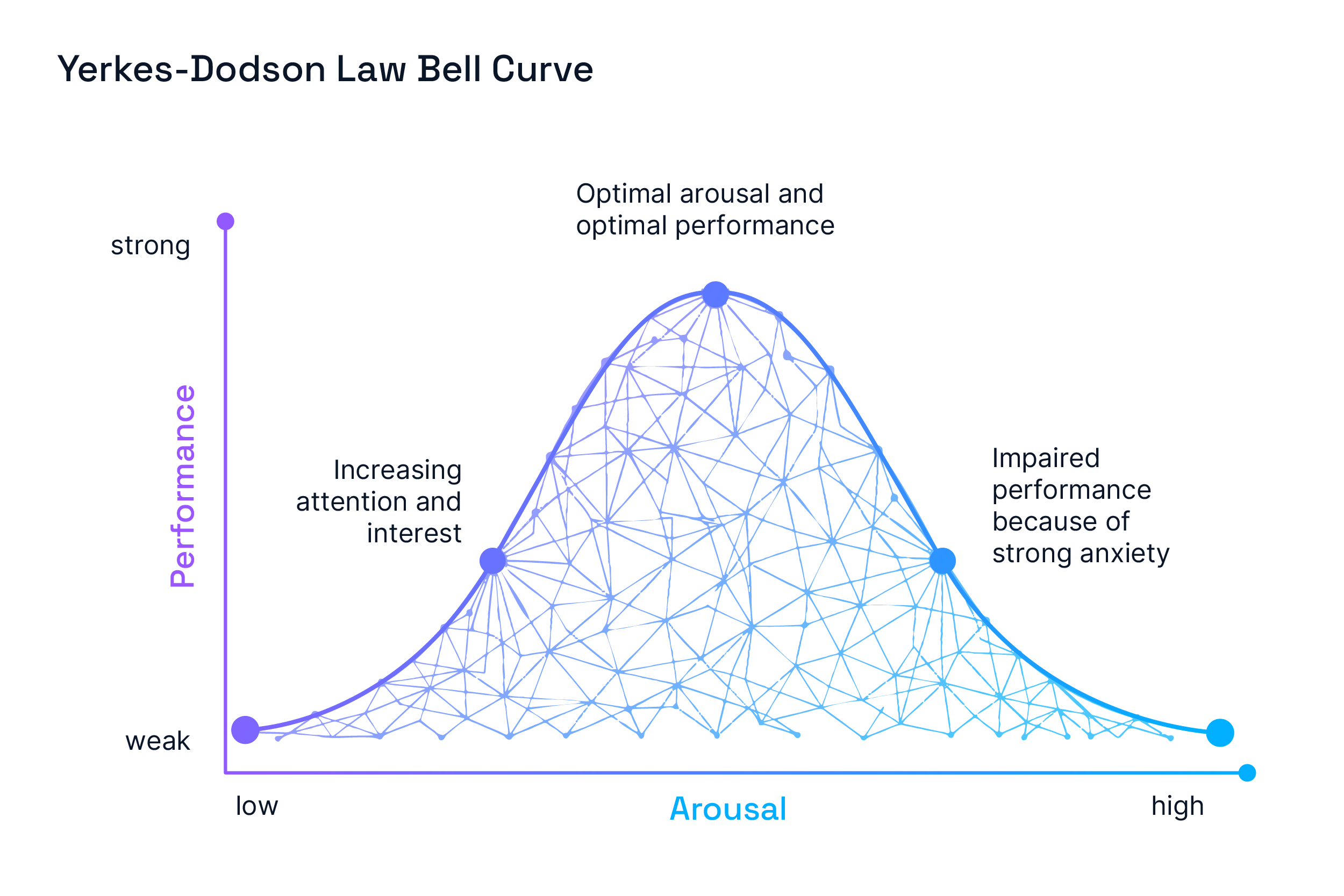
The 1908 experiments behind this are often misremembered. Yerkes and Dodson used mice, electric shocks and a brightness discrimination, and found that strong stimulation sped up easy learning and impaired difficult learning.
The familiar arousal curve came later. Reviewers have argued that practitioners “should not seek to increase performance through the manipulation of employee stress levels.”
Past that peak, further arousal can impair performance. Too little produces boredom and disengagement. Too much produces anxiety and stress. The sweet spot sits right in the middle.
There’s a second, crucial detail. The optimal level of arousal is lower for complex tasks than for simple ones. A burst of high arousal might sharpen performance on a simple, well-practised task. But for the kind of complex cognitive work most training involves, the optimal level of arousal is lower.
High-stress, high-pressure learning environments don’t sharpen complex learning. They diminish it. The goal isn’t maximum emotional intensity. It’s to find the right level for the task: enough to signal the material matters, but not so much that anxiety crowds out the cognitive resources the learner needs to actually think.
Not All Emotions Are Equal: The Control-Value Framework
The inverted-U tells us how much emotional arousal helps. But intensity is only half the picture. The type of emotion matters just as much.
This is the contribution of Reinhard Pekrun, whose Control-Value Theory of achievement emotions has become the dominant framework for understanding how emotion shapes learning. His insight is that emotions arise from two appraisals:
- Control: do I feel capable of succeeding at this?
- Value: does this task matter to me?
These two judgements determine which emotion a learner experiences. In turn, that emotion shapes their attention, motivation, strategy, and ultimately their performance.

The Four Types of Achievement Emotion
Pekrun organises achievement emotions along two dimensions: whether they’re positive or negative, and whether they’re activating or deactivating.
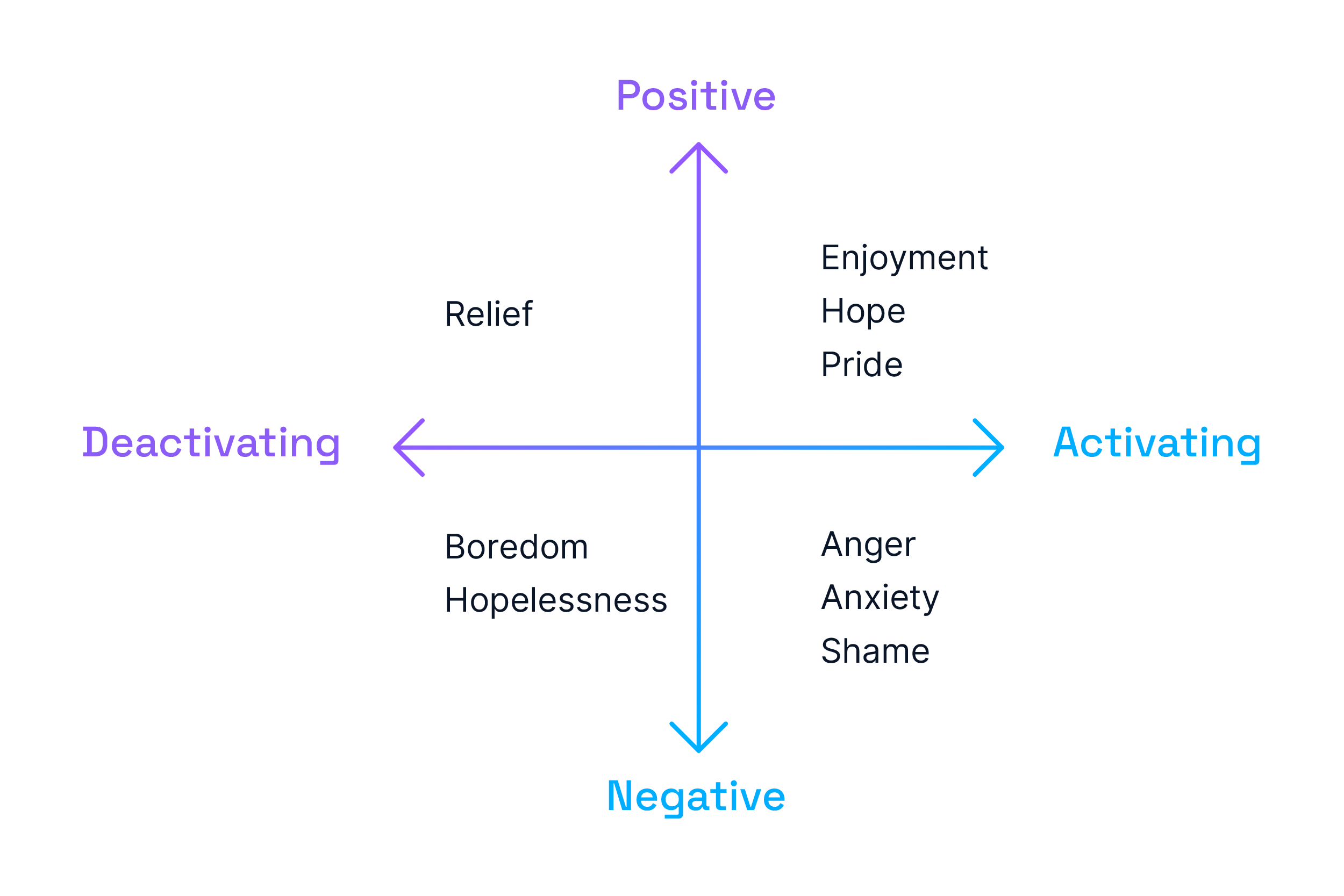
Cross those two axes and you get four categories, each with a different effect on learning.
- Positive and Activating: Such as enjoyment, hope, or pride. These are the emotions that drive learning. They increase effort, deepen processing, strengthen self-regulation, and sustain persistence.
- Negative and Activating: Such as anxiety or shame. These are more complicated. A little anxiety can sharpen focus, but as the inverted-U predicts, too much overwhelms working memory and impairs performance.
- Negative and Deactivating: Such as boredom or hopelessness. These are the most damaging. Boredom, in particular, is a silent killer of learning. It eviscerates attention, reduces effort, and tells the brain that nothing here is worth encoding.
- Positive and Deactivating: Such as relief or relaxation. These emotions are pleasant, but not always helpful. Relief after passing an assessment feels good, but it can reduce the strategic engagement needed for continued learning.
Recent research backs this up. A 2025 meta-analysis by Qi and colleagues, covering 21 studies and 240 effect sizes, found negative emotions moderately associated with worse online learning performance (r = −0.30), while positive emotions tracked with better performance (r = 0.48).
And Shui and Zhu’s three-level meta-analysis of 131,446 students found boredom correlates negatively with academic achievement at r = −0.19. This is a real and consistent link, though a modest one.
Clearly the goal isn’t just emotional engagement. It’s the right emotional engagement: enjoyment, curiosity, pride, and hope. All built on a foundation where learners feel both capable (control) and invested (value).
Get those two appraisals right, and good learning is sure to follow.
Content Emotion vs Learner Emotion
A point of order before we move on. Notice that Pekrun’s framework is about the emotions a learner feels toward the learning process itself, not the emotional content of the material.
A sad, frightening, or distressing story can be extraordinarily effective, as Cahill and McGaugh’s emergency-surgery study demonstrated. There’s a reason why horror movies are so popular. Negative emotional content is often the most memorable of all.
What Pekrun’s research warns against is negative emotion in the learner’s relationship to the task: the boredom of a tedious module, the hopelessness of material pitched beyond reach, or the anxiety linked to a difficult assessment.
So keep this in mind. The emotion that matters for engagement is the emotion directed at the experience of learning, not the emotion depicted in the content.
Emotion and Cognition Are Inseparable
There’s a lingering assumption in workplace training that emotion and serious thinking are opposites. That real learning is cool, rational, and detached, and that emotion is a distraction from the cognitive work that matters.
Neuroscience has comprehensively dismantled this idea. Mary Helen Immordino-Yang, a neuroscientist at the University of Southern California, has shown that emotion and cognition are not separate systems that occasionally interact. They are deeply interdependent and supported by overlapping neural processes.
In her work with Antonio Damasio, she demonstrated that the brain regions responsible for emotion are also recruited during the higher-order thinking we prize most in learning: attention, memory, and decision making.
Her most striking finding comes from studying people with damage to the emotional-processing regions of the brain. These individuals retained their logical reasoning and factual knowledge. Yet they struggled to learn from experience, make sound decisions, or apply their knowledge in real-world situations.
Indeed, Damasio’s most famous patient, Elliot, retained his IQ and factual knowledge after damage to his ventromedial prefrontal cortex. But on the Iowa Gambling Task, where healthy participants learn to avoid decks with high short-term rewards but larger long-term losses, Elliot never developed the aversion.
Without the emotional signal that tells the brain what matters, knowledge became inert. They knew things, but couldn’t use them. As Immordino-Yang puts it, emotional processes provide a “rudder to guide judgement and action.”
Emotional Engagement in Training Design
If emotion is the mechanism that turns experience into memory, a practical question follows naturally: how do you build it into training without tipping into stress, distraction, or gimmickry?
Well, here are five tips to get you started.
- Lead With Stakes: A module that opens with a real consequence (for example, a safety failure with a human cost), gives the brain a reason to care before the facts arrive. The emotion signals importance, and importance drives encoding.
- Become a Storyteller: Narrative is the most reliable emotional delivery mechanism we have. A character facing a problem the learner recognises triggers the same neural and chemical responses that make personal memories stick.
- Make it Personally Relevant: Immordino-Yang’s work tells us that we only think deeply about what we care about. Training that connects to a learner’s own role, goals, or identity carries built-in emotional weight. Generic, one-size-fits-all content carries none.
- Protect Psychological Safety: High-stakes, high-fear environments push arousal past the optimal point and impair the complex learning most training requires. Emotional engagement works when the learner feels the material matters, not when they feel personally threatened by failure.
- Build in Achievement: Positive activating emotions (such as pride, hope, and enjoyment) are the ones that drive learning. Gamification, visible progress, and earned recognition generate these states deliberately.
Keep in mind that most of these tactics work best in short, focused bursts. In a 2026 study, facial-expression analysis of 40 students watching ten-minute lecture videos showed disengagement rising sharply around the six-minute mark. Engagement tracked quiz scores at r = 0.68.
Work with the brain’s attention limits, not against them.
The Line Between Engagement and Distraction
Emotional engagement is powerful. But the same force that strengthens learning can also undermine it. The difference comes down to what the emotion is attached to.
This connects directly to the seductive details effect. Emotional content that serves the learning objective enhances encoding. Emotional content that’s compelling but irrelevant creates arousal that binds to the wrong information.
After all, the brain doesn’t discriminate between “important to the objective” and “merely vivid.” If the emotional peak of your training is an irrelevant shock tactic, that’s what will get encoded.
So when building your training experiences, ask yourself this: “Is this emotional element both interesting and relevant to what the learner needs to take away?” If the answer isn’t “yes” in both cases, then remove the element from your content.
Final Words
For decades, workplace training treated emotion as noise. Something to strip out in the name of professionalism and objectivity.
Now the neuroscience shows this was exactly backwards. Emotion isn’t a distraction from learning. It’s the mechanism that decides what the brain keeps and what it discards.
Forgetting is the brain’s default. Emotional arousal is one of the few signals reliable enough to override it.
This gives L&D professionals a new mission. The goal isn’t to make training more emotional for its own sake. It’s to engineer the right emotional conditions. If we get those conditions right, then the brain will do what it evolved to do:
Remember what matters.
Thanks for reading. If you’ve enjoyed this content, please connect with me here or find more articles here.
The Impact Suite is built to share learning experiences with real emotional stakes. Book a demo now to see it in action, or download our Science of Learner Engagement guidebook to go deeper into the research.