Gamification is the application of game design elements and principles in non-game contexts to motivate and engage users.
By borrowing the mechanics that make games compelling (points, badges, leaderboards, progress tracking), gamification turns ordinary tasks into more engaging experiences.
First coined by Nick Pelling in 2002, the term has since become a fixture of software design, learning, marketing, and workplace performance.
As the physician and medical futurist Bertalan Meskó writes in The Guide to the Future of Medicine, “gamification might be the key for a broad range of issues for which we currently have no good solutions.”
This guide unpacks what gamification actually is, where it came from, and how leading organisations are using it today.
Where Did Gamification Come From?
Gamification has a rich history. Loyalty cards, merit badges, and frequent flyer schemes were all applying game mechanics to non-game problems long before anyone named it.
The naming happened in late 2002. Nick Pelling, a British game designer working on game-like interfaces for cash machines, needed a word for the approach and landed on what he later called a “deliberately ugly” one: gamification.
He then founded a consultancy to sell it, and dissolved it three years later “after eliciting no significant customer interest”. The word sat unused for most of a decade, resurfaced around 2008, and by 2014 Gartner was publishing formal definitions of it (see below).
Today it’s a $36.86 billion market, which is a decent return on a word its inventor gave up on.
Does Gamification Actually Work?
You’ve probably heard the term before, even if your relationship with it ranges from ‘enthusiastic’ to ‘allergic’. The evidence base is also far stronger than it was a decade ago.
For example, a 2024 meta-analysis pooled 22 studies and found a moderate-to-large effect of gamification on academic performance (g = 0.78). The authors note that the effect varied by educational stage, by subject, and by which game elements were used. Gamification in itself isn’t the active ingredient. Design is.
In the workplace, the clearest published example is Microsoft’s “Making Agents Great” programme, which applied points, badges, and leaderboards across outsourced contact centres and reported a 10% productivity increase, a 12% improvement in absenteeism, and a doubling of the attach rate for paid support services.
We see the same pattern in our own client work. L’Oréal report that territories using My Beauty Club (powered by Growth Engineering Learning App) in the Americas see an average 20% increase in sales revenue. What’s more, HP Uni App users log in an average of 84 times a month, and complete 19.3 knowledge contests.
A 2026 tms survey of more than 1,200 UK and US consumers found that 72% had engaged with a gamified experience from a brand they’d never tried before within the previous three months. And one in three said it motivated them to make a first purchase.
Gamification is also evolving. A 2026 integrative review of 61 studies argues that the next phase of gamification will be more adaptive. Rather than relying only on points and badges, AI-enhanced gamification can personalise challenge, improve feedback, and help create fairer learning experiences.
The message is not that gamification is a silver bullet, but that well-designed game elements can support learning when they are aligned with clear objectives.
Why Is Everyone So Confused About Gamification?
Unfortunately, no two people seem to have the same working definition of gamification.
What’s more, it doesn’t help that there are two different types of gamification (‘structural’ and ‘content’). Then there’s ‘learning games‘ and ‘serious games‘, which are different from gamification, but often spark confusion and get mislabelled.
Additionally, some use the term too broadly, applying it to nearly anything remotely associated with gaming. As it happens, Snoop Dogg (of all people!) was guilty of this back in 2013.
Gamification’s reputation isn’t spotless either. From think pieces like ‘How gamification can ruin your life‘ to hit pieces on its darker applications, plenty of critics argue that game mechanics — used carelessly — can do more harm than good.
Clearly, there’s confusion about this word. Thankfully, the gamification experts here at Growth Engineering are here to clear up the misconceptions and provide a clear and differentiated definition.
Gartner’s Definition of Gamification (And Why It Falls Short)
Back in 2014, Gartner sought to redefine ‘gamification’. According to Gartner, gamification is “the use of game mechanics and experience design to digitally engage and motivate people to achieve their goals”.
This is an interesting definition. It covers structural gamification (‘game mechanics’) and content gamification (‘experience design’). It also highlights the importance of engagement and driving motivation.
And yet, this definition comes off as both a little too precise and a little too loose. Let’s break it down.
1. Is Gamification Digital Or Analogue?

Interestingly, Gartner’s definition hones in on ‘digital’ engagement. But whilst digital experiences tend to be easier to gamify, they’re not the only types of experience that can be gamified.
For example, think about the loyalty card you receive from your local coffee shop. There’s nothing particularly digital about a piece of paper and a stamp. Yet, like many loyalty programmes, this is clearly an example of gamification in action.
What’s more, we often use gamification in classrooms and training venues, without using any digital applications as a crutch. It’s easy enough to give out badges and create a makeshift leaderboard.
As such, gamification is clearly not limited to a single domain.
2. Does Gamification Require Goals?

According to Gartner’s definition, gamification focuses on enabling people to achieve ‘their’ goals. This begs the question: can you not gamify an experience to help people achieve your goals?
In reality, gamification can be used to encourage desired behaviours. For instance, you could use it to motivate your audience to complete a survey or fill in a form.
You could even use it to encourage readers to fully engage with written content. Now’s probably a good time to note the progress bar at the top of this article.
Regardless of your specific goals, gamification can be effectively deployed to achieve a wide range of objectives.
3. Where Does Gamification Apply?

Gamification can’t exist in a vacuum. Game mechanics need to be applied to something. Gartner’s definition fails to capture this necessity sufficiently.
After all, there’s no mention of where the game mechanics need to be applied, beyond the ‘digital’ qualifier. This means they could theoretically be applied anywhere, including within fully-fledged game environments.
This is something we’ll seek to tighten up with our definition.
What Is Gamification? Our Definition

As nit-picky as this all may sound, consensus is an important thing. A clear definition will enable us to have more productive and meaningful conversations about gamification.
Hence, here at Growth Engineering, we define gamification as “the application of game design elements and principles in non-game contexts to motivate and engage users.”
We can break this down further:
- Structural Gamification: Applying game mechanics like points, badges, and leaderboards to existing processes or activities without changing the content itself.
- Content Gamification: Embedding game mechanics and elements directly within content itself, making the experience itself more interactive and engaging.
These game mechanics can be applied across a wide variety of contexts (including the world of learning and development) to transform tedious tasks into engaging experiences.
They tap into the neuroscience of motivation, fostering a sense of enjoyment and accomplishment that drives people to participate and achieve. Let’s take a closer look at these mechanics.
Gamification Game Mechanics Explained

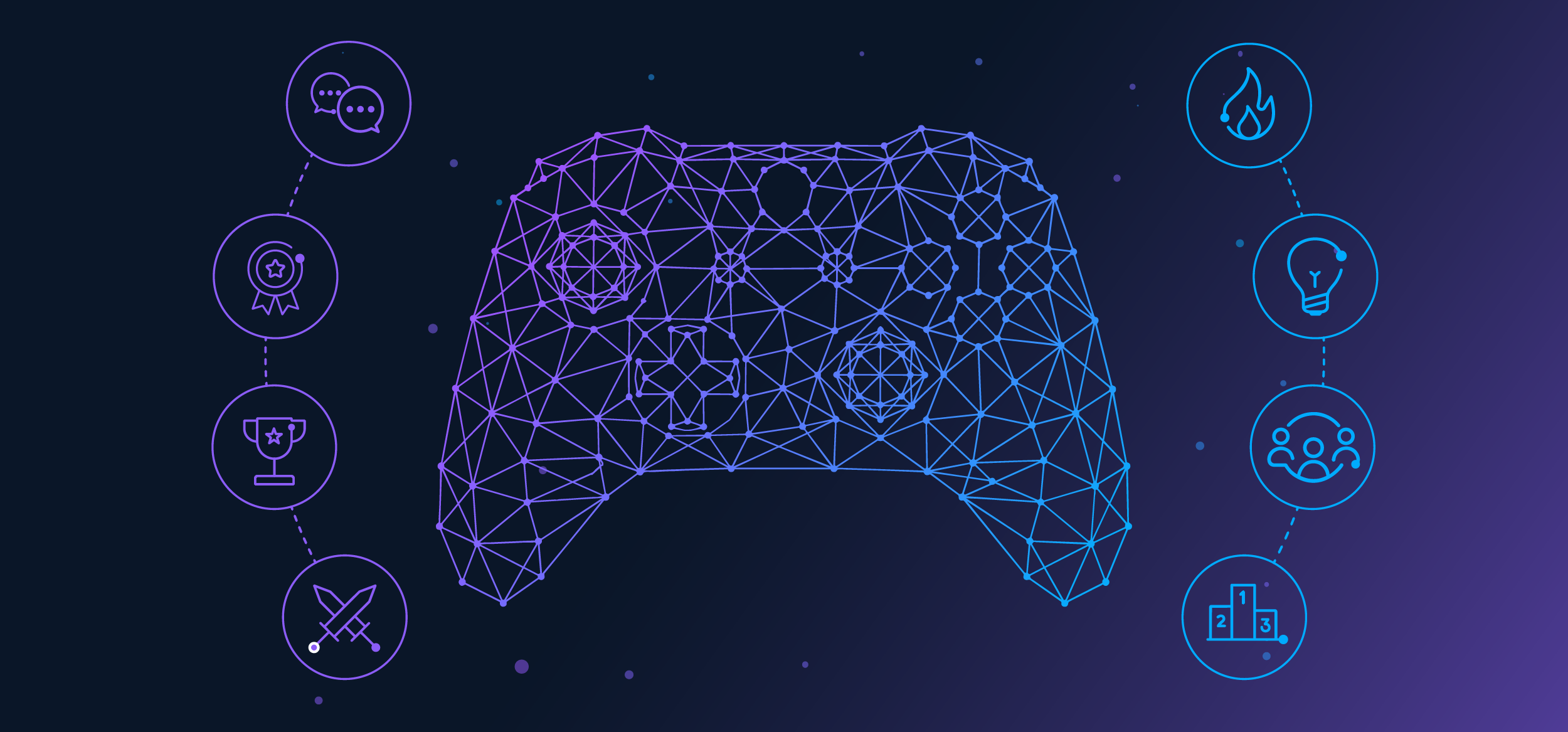
Gamification uses a variety of game mechanics to create engaging and motivating experiences. Here are some of the most popular mechanics:
- Experience Points: Awarding points for completing tasks or achieving goals provides a sense of progress and achievement.
- Badges: Earning badges for specific accomplishments adds a layer of recognition and motivates users to complete challenges.
- Leaderboards: Leaderboards display user rankings, fostering healthy competition, comparison, and social engagement.
- Levels: Earning enough experience points enables users to ‘level up’ and unlock new challenges, experiences or rewards.
- Progress Bars: Similar to levels, progress bars visually represent our progress towards a goal, motivating us to continue our efforts.
- Streaks: Completing a desired action (for example, logging into a platform every day) for a consecutive period creates a streak.
9 Gamification Examples
As with anything, gamification is much easier to understand if you see examples of it in action. As such, we are now going to explore some of our favourite examples of gamification in different settings. Let’s start with the modern gold standard.
1. Duolingo
Duolingo is the textbook example of consumer gamification done well. The language-learning app takes famously dull tasks, vocabulary drills and grammar exercises, and turns them into something genuinely habit-forming.
The mechanics are layered, and each one reinforces the others: daily streaks (the green flame you’ll do anything to protect), weekly leagues that learners climb and tumble down, gems to spend, hearts to lose, daily quests, and a famously persistent owl mascot who won’t let you forget your lesson.
The result? Duolingo is the top-grossing app in the Education category on both Google Play and the Apple App Store, with more than 140 million monthly active users.
2. The Boy Scouts

A classic example of gamification in action is the Boy Scouts of America awarding badges for activities like fishing or orienteering. These badges are typically sewn into the right sleeve of the Scout’s uniform.
Notably, each badge taps into core motivators like status, achievement, competition, and a sense of belonging within an inclusive community. They’re like a permanent record of the Scout’s achievements.
Did you know: 11 of the 12 individuals who have walked on the moon were Scouts. They must be doing something right!
3. Pokémon GO
Pokémon GO has proven to be one of the most successful mobile games of all time. While it’s no longer the global phenomenon it was in 2016, it continues to be popular today thanks to its gamified approach.
Similar to earning badges in scouting, Pokémon GO rewards users with rare and powerful Pokémon for walking significant distances. This is another example of applying game mechanics to fitness tracking (see below).
Without the motivating power of gamification, encouraging individuals to walk such distances would be challenging. Perhaps this is why Pokémon GO has generated more than $9 billion in player spending across its first ten years, and still had around 20 million weekly players a decade after launch.
4. Foldit
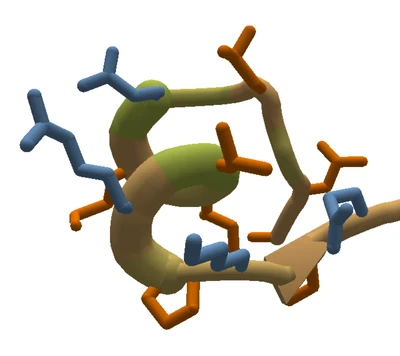
Back in 2011, players of the online game Foldit established the structure of a retroviral protein that had defeated crystallographers for over a decade: the protease of Mason-Pfizer monkey virus, a model for the enzymes retroviruses including HIV use to mature and replicate.
As biochemist Firas Khatib notes: ‘Citizen science can actually help solve unsolved scientific problems’.
5. Salesforce Trailhead
Salesforce Trailhead is what corporate gamification looks like at scale. It’s the learning platform Salesforce uses to train its own employees, partners, customers, and the broader developer community on everything from CRM administration to AI implementation.
The mechanics are familiar but exceptionally well-executed: points for completing modules, badges for finishing ‘trails’ (learning paths), ‘superbadges’ for harder challenges, and a rank system that takes learners from Hiker through Adventurer, Mountaineer and Expeditioner, all the way up to Ranger and beyond.
The result is one of the largest gamified learning ecosystems in the world. More than 7 million people have used Trailhead, with a Trailblazer Community of over 20 million.
6. Microsoft
Microsoft, one of the largest companies in the world, have also got in on the gamification action. They used game mechanics to reward their support agents and introduce important behavioural changes.
In fact, as part of a larger initiative called ‘Making Agents Great‘, they’ve made a significant investment in interactive gamification solutions, leaderboards, and new key performance indicators. This has yielded impressive results:
- Agent productivity increased by 10%.
- Absenteeism reduced by 12%.
7. Apple Fitness
Apple has quietly turned hundreds of millions of wrists into gamification dashboards. The Apple Watch’s three Activity rings (Move, Exercise, and Stand) give wearers a simple daily goal: close them all.
There’s a clear daily objective, a visible progress indicator, monthly challenges with shareable badges, and the slow heartbreak of a broken streak when you forget to stand up before the day runs out. Users routinely report squeezing in late-evening walks just to close their last ring.
In short, it’s gamification so deeply embedded in everyday life that most users don’t even register that’s what it is.
8. Starbucks Rewards

Starbucks Rewards is one of the largest and most successful loyalty programmes in the world. It’s gamification through and through. Members earn ‘stars’ for every purchase, redeem them for free drinks and food, and unlock progressively better perks the more they engage with the brand.
Every coffee run becomes a small game with a small win. And it works. Starbucks reports that Rewards drove nearly 60% of its US company-operated revenue, more than $13 billion, from over 35 million 90-day active members.
9. HP

HP, the world’s biggest personal computer vendor, wanted an effective way to improve the cybersecurity knowledge of their sales staff.
In partnership with Growth Engineering, a gamified mobile application called The HP Uni App was launched. This app uses experience points, badges, leaderboards, streaks and more to produce impressive levels of engagement. Each user:
- Logs in an average of 84 times per month.
- Completes an average of 6.1 microunits per month.
- Completes an average of 19.3 knowledge contests per month.
Growth Engineering and Gamification
And what about us here at Growth Engineering? Why do we care so much about the definition of gamification and what gives us the right to define the term?
Well, we’re the #1 provider of gamified learning technology. In fact, we’re the team who pioneered its use within L&D. When it comes to gamification techniques, we know what we’re talking about.
Our learning platforms are gamification solutions through and through. Everything we do is meticulously designed to engage learners, from their very first login to their one-thousandth.
As such, we’re big gamification advocates. Now that you know the definition and you’ve seen the examples, the next challenge is applying it in your own business. Follow the link below to get started.
Thank you for reading. Please join our mailing list for more learning insights. And our ‘Ultimate Guidebook to Gamification in Online Learning‘ is your one-stop-shop for all things gamification!