

Think about the last training module you completed. Can you remember what it said?
Now think about the last diagram, infographic, or annotated screenshot you saw. Can you remember what it looked like?
If the second answer came faster, that’s not a coincidence. Your brain processes words and images through two entirely separate channels. When both channels encode the same information, the memory you create will be stronger, more durable, and easier to retrieve.
This is dual coding theory. And if you design training for a living, it should change how you think about every piece of content you create. Ready? Then let’s crack the code!
What is Dual Coding Theory?
The theory was proposed by Canadian psychologist Allan Paivio in 1971. And the idea is deceptively simple: the brain has two distinct cognitive systems for processing information.
- One handles verbal input: words, speech, written language, etc.
- The other handles non-verbal input: images, diagrams, visual scenes, etc.
These aren’t two options. They’re two channels that run in parallel. And the critical insight is that they’re interconnected. After all, when you read the word “car”, your verbal system processes the language, but your visual system may already be picturing one.
Likewise, when someone shows you a photograph of a car, your verbal system quietly names it. The two channels don’t just coexist. They talk to each other.
When both systems activate simultaneously, two memory traces are laid down instead of one, with each reinforcing the other. Each system has its own decay rate, its own retrieval cues, and its own resilience to interference.
Indeed, Richard Mayer, the most prolific researcher in multimedia learning, has built an entire research programme on this foundation. His conclusion: “People learn more deeply from words and pictures together than from words alone.”
That’s not a design preference. It’s a cognitive principle. And the evidence behind it is extensive.
The Neuroscience Behind Dual Coding
Paivio’s theory was based on behavioural experiments. He could see the effects of dual coding in recall data, but he couldn’t see inside the brain. Thankfully, modern neuroimaging has since confirmed his suspicions:
Verbal and visual information are processed through genuinely separate neural pathways. This isn’t a metaphor. It’s architecture.
1. Verbal Processing
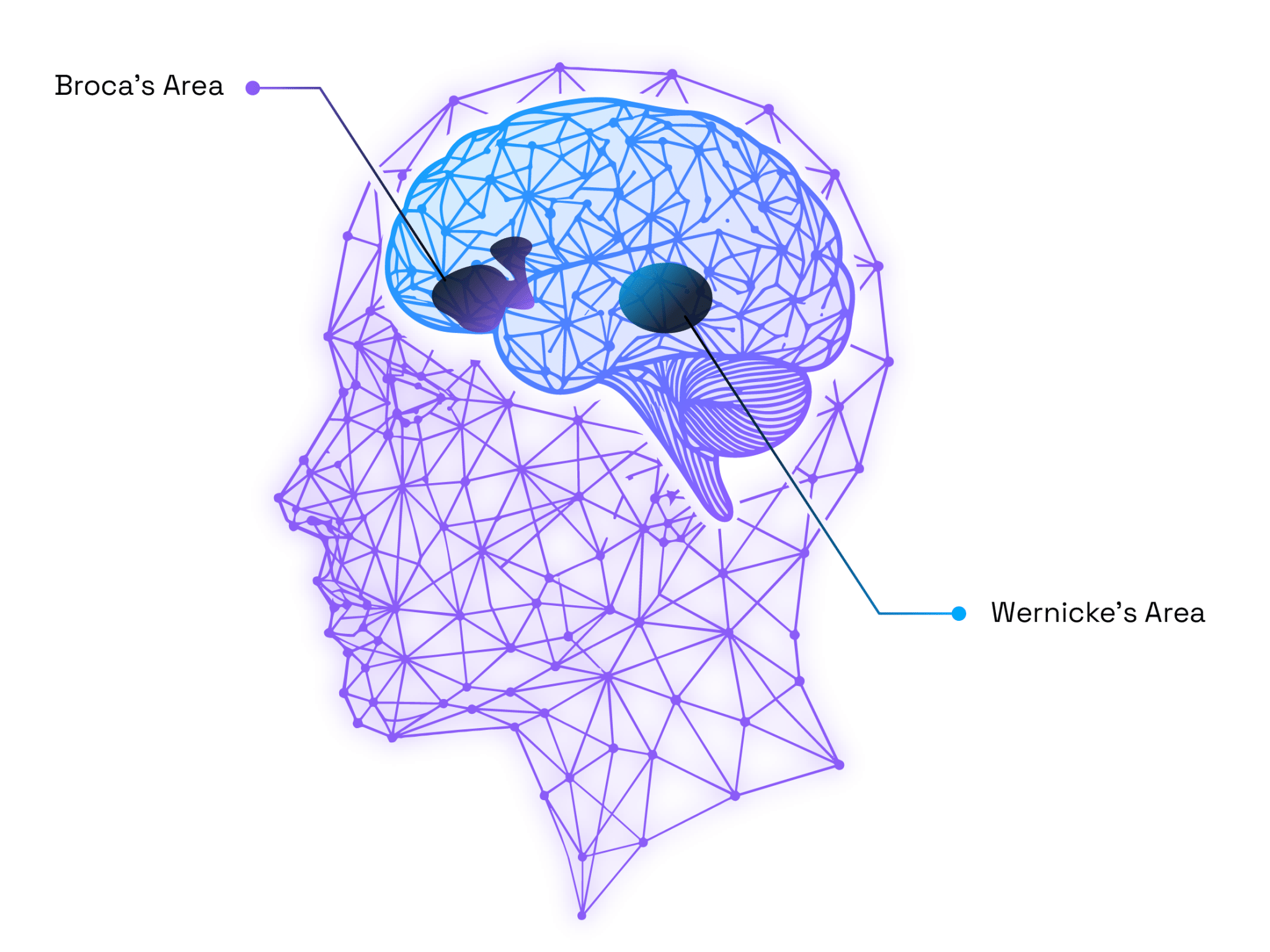
Reading, listening, and inner speech activate a network centred in the left hemisphere of your brain. Broca’s area (in the left frontal lobe) handles language production. Wernicke’s area (in the left temporal lobe) handles comprehension.
Together with connecting pathways, they form the brain’s language circuit. This is the system processing every word you’ve read in this sentence.
2. Visual Processing
Images, diagrams, and spatial information take an entirely different route. They’re processed by the primary visual cortex in the occipital lobe, then split into two streams:
- The ventral stream (running towards the temporal cortex), which identifies what you’re looking at.
- And the dorsal stream (running towards the parietal cortex), which processes where it is in space and how you might interact with it.
Here’s why this distinction matters for learning: when a piece of information activates both networks simultaneously (such as a labelled diagram, an annotated process flow, or narration paired with a visual) two memory traces are created in two different neural systems.
Each trace serves as an independent retrieval route. If one fades, the other can still be accessed. If both hold, they reinforce each other. The result is a memory that is more resistant to decay than one encoded through a single channel.
Think of it this way. A tent held down by one peg might survive a calm night. But a tent held down by two, on different sides, can survive a storm.
This is the neural basis of dual coding. It’s not that visuals are better than words, or that words are better than visuals. It’s not hierarchical in that sense. Instead, it’s an acknowledgement that the brain has two systems, and that using both is better than one.
The Evidence for Dual Coding
Dual coding theory has been tested, replicated, and extended across hundreds of studies over more than five decades. Five findings in particular stand out, with each one building on the last.
- The Picture Superiority Effect: Your brain remembers images better than words. Shepard (1967) showed participants 612 pictures, each for about six seconds, then tested recognition. Accuracy hit 98%. Parallel conditions using words and short sentences scored 90% and 88%.
- The Capacity Effect: Standing (1973) pushed the picture superiority effect to its limit. They showed participants 10,000 photographs, each for just five seconds. Recognition accuracy was still 83%, on a two-way choice where guessing scores 50%. The brain’s capacity for visual memory isn’t just good. It’s staggering.
- The Concreteness Effect: Not all words are created equal. Concrete words (words that evoke a mental image, like “car” or “apple”) are recalled far better than abstract words like “justice” or “theory”. Paivio put the gap at roughly 2:1 on average across his experiments.
- The Multimedia Principle: Richard Mayer took dual coding out of the laboratory and into instructional design. Across 11 controlled experiments in Mayer’s own lab, learners given words and pictures together beat those given words alone on every single comparison, with a median effect size of d = 1.39. Across a separate set of animation studies, learners generated a median of 97% more correct solutions to problems they hadn’t seen before.
- The Redundancy Principle: Here’s where things get counterintuitive. If two channels are better than one, surely three inputs are better than two? They’re not. Mayer found that narration paired with graphics and on-screen text made memory encoding worse. The reason: audio and text both compete for the verbal channel.
Side note: the redundancy principle is one of the most commonly violated rules in eLearning design. Every slide deck with voiceover playing alongside bullet points is doing exactly this.
Dual coding isn’t about adding more. It’s about activating both channels without overloading them. A labelled diagram does this. A stock photo next to a paragraph of text does not. That just adds visual noise without a second encoding route.

Dual Coding vs Learning Styles
There’s a misconception that needs addressing before we go any further, because it undermines the credibility of dual coding theory by association. Dual coding is not learning styles.
Learning styles, the idea that individuals learn better when instruction is matched to their preferred sensory channel (visual, auditory, kinaesthetic), is one of the most widely believed and thoroughly debunked concepts in education.
In fact, 93% of UK teachers believe it to be true, despite a lack of any credible evidence.
Dual coding says something fundamentally different. It doesn’t claim that some people are visual learners and others are verbal learners. It claims that everyone learns better when both channels are engaged simultaneously.
This distinction matters because learning styles has become such a well-known myth that some practitioners dismiss anything involving ‘visual and verbal’ as pseudoscience by association. Dual coding deserves better.
The theory isn’t about preference. It’s about architecture. It applies to every learner, regardless of how they’d describe their own style. And unlike learning styles, it’s grounded in over fifty years of experimental research.
How to Implement Dual Coding in Training Design
The theory is clear. The evidence is strong. The question for L&D professionals is: what does this actually look like in practice? Next up, we’ll examine six steps for implementing dual coding within your training design.

1. Don’t Combine Narration And Text
This is the most important rule and the most commonly broken. When a voiceover plays alongside a diagram or animation, the learner is processing verbal information through the auditory channel and visual information through the visual channel. That’s dual coding.
But when a voiceover plays alongside bullet points on screen, both elements compete for the verbal channel. The result? Cognitive overload.

2. Avoid Irrelevant Images
Focus on explaining, not decorating. A labelled process diagram creates a second encoding route. The learner processes the labels verbally and the spatial relationships visually. Adding stock imagery alongside your text does not.
Before adding any image, ask yourself: does this carry meaning that the words alone don’t? If the answer is ‘no’, then it’s decoration. And Mayer’s research suggests it should be cut. He called this the coherence principle: people learn better when extraneous words, pictures, and sounds are excluded.

3. Use Visuals That Add Value
Remember, dual coding isn’t about illustrating what the text already says. It’s about encoding complementary information through a secondary channel.
A paragraph explaining a workflow paired with a flowchart showing that workflow is a good example of dual coding. After all, the text explains the why and the diagram shows the how.
Conversely, a paragraph explaining a workflow paired with the same information rephrased as bullet points is single coding twice. Two verbal inputs, zero visual encoding. This is where most corporate eLearning falls short.

4. Position Is Information
The brain’s visual system doesn’t just process images. It also processes the spatial relationships between images. Here are some examples:
- A timeline communicates sequence.
- A Venn diagram communicates overlap.
- An org chart communicates hierarchy.
The spatial structures are encoded through the visual channel in ways that a paragraph of text describing the same relationships cannot replicate. Take advantage of this.
5. Design For Both Channels
Dual coding fails when visuals are an afterthought. If images are dropped in after the text is written to “break up the page”, then they are unlikely to be effective. The visual and verbal elements should be planned together, with each carrying a distinct piece of the message.
This is where authoring tools earn their value. They make it easy to create content where text and visuals work in parallel, without requiring a graphic design degree.

6. Audit Your Content
Before you build your next module, run your existing content through these four questions.
- Is narration competing with on-screen text?
- Are the visuals earning their place?
- Are both channels carrying different information?
- Were the visuals planned or patched in?
This doesn’t stop with content design. It applies to your assessments too. A quiz question paired with a relevant diagram triggers retrieval from both channels. This strengthens the memory trace during the test, as well as during the lesson.
If you answered “no” to any of the above questions, you’ve found your starting point. If you answered “yes” to all four, you’re already designing for two channels, and your learners’ brains will thank you for it.
Dual Coding And Neurogogy
Dual coding doesn’t work in isolation. But pair it with retrieval practice, and learners are pulling information from two encoding channels instead of one, doubling the routes available for recall.
Pair it with spaced repetition, and each revisit reinforces both the verbal and visual memory traces before either has time to fade.
Finally, pair it with gamification, and the emotional arousal triggered by competition strengthens the encoding across both channels simultaneously.
This is the core idea behind neurogogy, the fusion of neuroscience and pedagogy that underpins everything we build at Growth Engineering. Follow the links below to learn more.
Final Words
Your brain has two channels. Most training only uses one.
That’s the gap dual coding theory identifies, and it’s a gap that’s remarkably easy to close. Pair narration with diagrams, rather than on-screen text. Use visuals that explain, not visuals that decorate. And plan both channels from the start, not as an afterthought.
The science has been settled for over fifty years. And the practical application is straightforward. The only question is whether your training is designed for one channel or two.
Thanks for reading. If you’ve enjoyed this content, please connect with me here or find more articles here.
Ready for more? Explore the Impact Suite to see dual coding in practice, book a demo for a live walkthrough, or download our Science of Learner Engagement guidebook to go deeper into the research.