


Here’s the sad truth. Most LMS buyers overpay. Not because they picked the wrong vendor — but because they didn’t understand how LMS pricing works before they signed.
Setup Fees. Licence Fees. Per registered user. Per active user. Integration costs. AI add-ons. Renewal uplifts. The sticker price is rarely the price you actually pay.
That’s where we come in. This guide walks you through every pricing model you’ll encounter, what each one includes, and the hidden costs most buyers miss. As an LMS provider ourselves, we’ve seen where the gotchas live — and where to push back.
By the end, you’ll know what to ask, what to negotiate, and what to walk away from.
The LMS Market in 2026
The global LMS market is currently valued at $35.2 billion in 2026, with a forecast of $88.4 billion by 2032. North America still leads spending, but Asia-Pacific is the growth engine.
All this growth is unsurprising. After all, there are hundreds of LMS vendors on the market, each with their own speciality, and a hefty price tag.
Furthermore, an ATD survey found that 83% of organisations currently use an LMS, with 71% agreeing that usage had increased over the last two years. That’s a lot of businesses spending a lot of money on learning technology.
How LMS Pricing Works

Most LMS vendors use a Software as a Service (SaaS) model. Your platform is hosted in the cloud, accessed through the web, and updated by the vendor without interrupting your learners.
It’s the dominant model for a reason: lower upfront cost, predictable billing and someone else maintaining the infrastructure.
If you’re an LMS buyer, there are two main fees to watch out for — a Setup Fee (one-off) and a Licence Fee (recurring).
1. Setup Fees
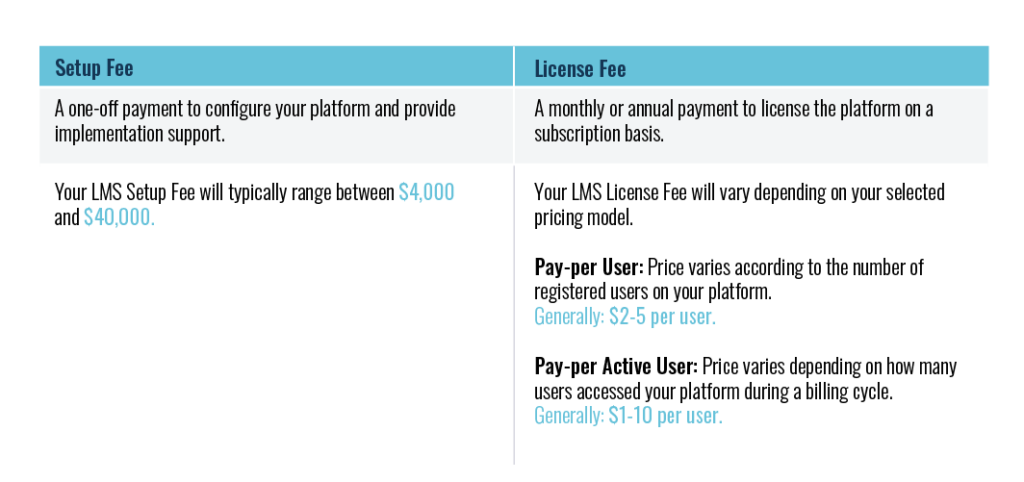
Setup Fees are one-off payments that an LMS provider requires to configure and implement your LMS. They cover:
- Design and configuration of your platform.
- Comprehensive administrator training.
- Project planning and management until platform launch.
In some cases, they also include data and course migration from previous platforms.
For a SaaS LMS, the price of a Setup Fee is likely to range between $5,000 and $25,000 — varying based on the complexity of the implementation and the amount of custom development work required.
2. Licence Fees
Next, the Licence Fee. You’ll typically have two licensing options:
- Monthly: A monthly fee based on the number of user licences you require.
- Annual: An annual fee, again based on user licences. You’re paying for a longer term upfront, so you’ll usually receive a discount.
If you know you’ll be using your solution for at least a year and can make the commitment, we always recommend paying annual licence fees. They lead to larger savings over time. Any variations in users over the course of the year (for instance, adding new users to your platform) are typically invoiced pro rata.
The size of these fees will also depend on the length of your overall contract terms. If you’re willing to sign a three-year agreement rather than a single-year deal, you may receive further discounts.
There’s one more wrinkle to consider: do you pay per registered user, or per active user?
Option 1: Pay-per User

The price you pay depends on how many users are registered on your LMS during each billing cycle (based on bands of users, rather than single units — more on this below). You’re charged for each user, regardless of whether they log in or complete any learning activities.
This is a good fit for those who don’t expect many user changes in each cycle and prefer a consistent figure. However, if you experience a volatile number of users (perhaps due to seasonal or temporary staff), then this likely isn’t the best fit.
Fees for this model are generally around $5 per user.

Option 2: Pay-per Active User
With a pay-per-active-user model, the price varies depending on how many users actually accessed your LMS during a billing cycle. You’re only paying for what you’ve used.
Sounds good, right? On the other hand, your fees are much harder to forecast, which can affect your annual budgeting. The price per active user is also typically higher than the price per registered user.
Fees for this pricing model can vary between $1–$10 per active user.

User Bands
Most providers offer tiered pricing based on user bands. The price per head decreases as the number of users on your platform increases.
So the price per head for 10,000 users will be lower than the price per head for 1,000 users. It helps you keep costs under control as you scale — and means you’ll get more value from your LMS as you grow.
Open-Source LMSs
You could forgo the SaaS model completely and select an open-source LMS instead. An open-source LMS lets anyone look at, change or improve the source code of the software for free — meaning no Setup or Licence Fees, and full freedom to customise the platform as you see fit.
Sounds too good to be true, right? Often it is. Because the software is free, functionality is typically more limited than a paid alternative. You’ll also generate unexpected costs along the way: hosting the platform yourself, supporting it for your users, managing upgrades and configuring everything in-house.
These costs add up quickly — particularly if you don’t have technical staff already on the payroll.
Self-Hosted LMSs
An alternative to a SaaS LMS (where the vendor hosts your platform for you), or an open-source LMS, is a self-hosted LMS. As the name suggests, you’ll need to find a hosting solution for your platform.
This kind of LMS puts you in charge of its uptime, server security and upgrades. That can mean more independence from your vendor and more customisation possibilities. The tradeoff is higher upfront costs and less support if something goes wrong.
Perpetual Licence
A small number of vendors still offer perpetual licences — a one-off payment to own the software outright, usually with optional annual maintenance fees for updates and support. This model is most common with on-premise deployments and legacy enterprise vendors.
Expect a high upfront cost and a lower ongoing cost than SaaS — essentially the inverse of the subscription model. It’s relatively rare today but worth knowing about if a vendor proposes it.
Hidden Costs to Watch Out For

As you can see, SaaS pricing has its complexities. And it’s the gap between what’s quoted and what you actually end up paying where most LMS budgets get blown.
Below is a checklist of the costs and considerations that buyers most often miss.
Customer Support
Some vendors (like us!) offer a dedicated support team with clear Service Level Objectives written into the contract. Others run a self-serve model, or gate full support behind a premium tier.
Always read the fine print — the type of support you receive shapes your relationship with the platform long after launch. After all, 70% of customers abandon a brand after just two bad experiences.
Training
LMSs are feature-rich and can be difficult to master. A vendor that offers a comprehensive training programme is worth its weight in gold. In many cases, training is included as part of the standard Licence Fee — but not always. Confirm what’s included before you sign.
eCommerce
Some LMS vendors offer online ‘storefronts’ where you can sell your content. This functionality may be included as standard, or charged as an add-on.
Integrations and Single Sign-On (SSO)
Your LMS needs to talk to the rest of your tech stack — HR systems, CRMs, video conferencing, content libraries. Many vendors charge per integration, or gate them behind higher-tier plans.
SSO in particular is a classic gotcha — often a premium add-on despite being table-stakes for enterprise deployments. Get a written list of what’s included and what’s extra before signing.
Third-Party Content Libraries
An LMS gives you the framework, but you still need content to fill it. If you’re plugging in a library like LinkedIn Learning, Go1, Skillsoft or OpenSesame, those are separate ongoing subscriptions on top of your platform cost — often a five- or six-figure annual line item.
Some vendors bundle content or offer partnership discounts, so look at the total content-plus-platform cost rather than the LMS line alone.
Storage and Bandwidth
LMS vendors set caps on file uploads, video hosting and SCORM content — and they can be surprisingly modest at lower tiers.
Exceed your allocation and you’ll pay for the overage. If you plan to host a lot of video content, or you’re scaling to a large learner base, ask explicitly about storage limits, bandwidth caps and the cost of additional capacity.
AI and Premium Features
AI tutors, content generation, automated translations and advanced analytics are increasingly central to modern LMSs — but they’re almost always priced separately from the core licence, even when they’re showcased as part of the platform during sales.
Sandbox and Staging Environments
If you need a separate environment to test new features, train administrators or trial content before pushing it live to learners, that’s usually a paid extra. For compliance-heavy organisations it isn’t optional — but it isn’t always quoted upfront either.
Multi-Tenancy and Sub-Portals
Need separate branded portals for different business units, regions or external clients? Extended enterprise pricing is usually a multiplier — sometimes 1.5x to 3x the base cost per additional portal. If your structure requires sub-portals from day one, factor it into your initial quote rather than discovering the multiplier at renewal.
Renewal Price Increases
Most SaaS contracts include annual uplifts at renewal — typically 5–15%, sometimes higher. Some vendors apply uplifts even within multi-year contracts. Negotiate the uplift cap at contract signing, not at renewal. Once you’re locked in, you have far less leverage.
Inactive Licence Waste
On a per-registered-user model, every dormant account is paid-for headcount. Without an annual audit of who’s actually using the platform, organisations routinely end up paying for hundreds of inactive users. Build a deactivation process into your admin routine, and ask your vendor whether unused licences can be reallocated mid-cycle.
Before you select a vendor, ask what features aren’t included within their standard pricing — and get any answers in writing. Better still, work through our LMS Purchase Checklist before you sign anything.
Completing Your Ecosystem
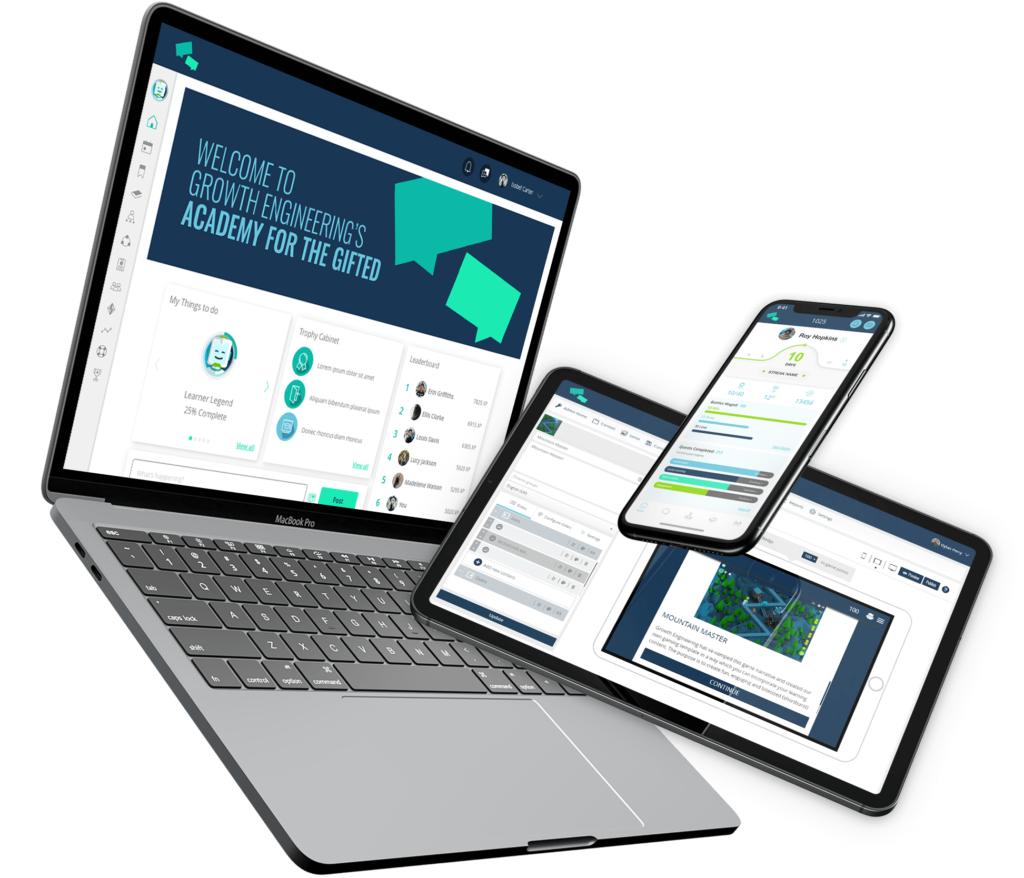
Sometimes, organisational success may require more than an LMS. You may also need an app, an authoring tool and other solutions.
A modern learning solution needs to be available on various devices. After all, the modern learner is seemingly surgically attached to their phone. In fact, there are more than 5.6bn smartphone users in the world today. That’s 70% of the world’s population.
As such, mobile learning (mLearning) is very much on the rise. This is where Growth Engineering Learning App comes in.
Our native app solution is easily downloadable onto your users’ devices and can be fully customised with your branding. We’ve also included a wealth of gamification and social functionality. As a result, your learners’ engagement levels are bound to soar.
If you want the best of all worlds, then the Growth Engineering Impact Suite is perfect for you.
The Impact Suite includes access to Growth Engineering LMS, Growth Engineering Learning App and Growth Engineering Authoring Tool. Three multi-award-winning solutions at an unbeatable price point. Please contact us for more details.
Building a Business Case for Learning Tech
Learning tech can be expensive to implement, but in the long term you’ll save money and experience a range of other benefits. When building your business case you need to focus on:
- Controlling costs: Identify what you need and focus your spending accordingly.
- Engaging learners: Look for an engaging solution that will increase your ROI.
- Talking in numbers: Calculate the financial benefits of investing in learning tech and highlight them wherever possible. For example, one of our Fortune 500 clients was able to link a 20% increase in sales revenue to our mobile app solution!
Head to this blog for a full explanation of how to build a business case for your new learning tech solution.
Final Words
Making an enterprise-level investment isn’t easy.
It’s important to make sure you know exactly what you’ll be getting out of your new LMS before purchasing. You should also be clear on all the different pricing models and options available to you, so you can make an informed decision.
You’ll also need to keep an eye out for any hidden costs that could arise at a later date. The more planning you do upfront, the fewer nasty surprises you’ll see down the line.
If the price is right, you’ll be ready to complete your purchase and kickstart your next learning journey.
Want to learn more about our pricing? Interested in exploring our multi-award-winning learning technology solutions? Then get in contact with the brain-friendly learning experts today.