
xAPI is the eLearning standard that lets you track learning wherever it happens, not just inside an LMS. This includes simulations, mobile apps, coaching conversations, tasks completed on the job, and so on. Each of these can send a simple record to a central store, ready for reporting.
That matters because most L&D teams still can’t see the full picture. In Watershed and GP Strategies’ 2025 survey, 98% of learning professionals said they want to measure learning’s business impact, yet only one in seven organisations has advanced analytics in place.
xAPI, short for the Experience API and once known as Tin Can, was built to close that gap. However, it can also feel complicated or difficult to parse. Statements, Learning Record Stores, profiles, cmi5. The jargon builds up fast. This guide cuts through it.
We’ll explain what xAPI is, how it compares with SCORM, and what changed when xAPI 2.0 became an IEEE standard. We’ll also help you decide whether your organisation needs it at all, because not every team does.
Ready? Then let’s get experienced!
What Is xAPI?
xAPI, short for the Experience API, is an eLearning specification that lets learning tools record what people do and send those records to a central store in a common format. It was originally developed under the name Tin Can API, which is why you’ll still (occasionally) see both names used.
Its big idea is that learning doesn’t only happen in an LMS. With older standards, a course had to be launched from a learning management system in a web browser before anything could be tracked. xAPI removes this restriction.
Now a mobile app, a simulation, a video platform, a coaching tool, or even a manager’s checklist can all report activity, as long as it can send a simple message over the internet.
xAPI is free to use, and it’s now formally recognised. In October 2023, xAPI 2.0 was published as IEEE 9274.1.1-2023. According to ADL, the US government initiative that sponsored it, it’s the first open-source specification in IEEE’s history to become a standard.
How xAPI Works
Put simply, xAPI is a way of writing and storing simple sentences about learning. Three parts make it work.
1. Statements
Every action is recorded as a statement made up of an actor, a verb, and an object. Each statement also gets a timestamp. If the tool sending it doesn’t say when the activity happened, the LRS stamps it with the time it arrives.
Statements can also carry a result, such as a score, and context, such as the team or programme the activity belonged to. Context can also hold category tags, which classify a statement so it’s easier to filter and compare later.
Behind the scenes, each statement is written in a structured format called JSON (as in the example below).
Actor Verb Object Result or context
- Sam completed the Product Launch Quiz.
- Priya passed the Fire Safety Assessment with a score of 92%.
- Maria demonstrated the customer handover process, observed by her line manager.
2. Activity Providers
These are the tools that create statements. For example: an eLearning course, an app, a simulation, a virtual classroom, or any system built to speak xAPI.

3. The Learning Record Store
Statements are sent to a Learning Record Store (LRS), which receives, stores, and returns them. Some LMSs include an LRS, while others connect to a standalone one.
Reporting and analytics tools then read from the LRS to turn thousands of statements into something people can act on.
xAPI vs SCORM
SCORM has been the workhorse of eLearning since the early 2000s, and it’s still how most courses are packaged and tracked. xAPI was designed to go further. Here’s how they compare:
| SCORM | xAPI | |
|---|---|---|
| What it tracks | Course completion, score, time spent, and pass or fail | Almost any activity, inside or outside a course |
| Where learning happens | A course launched from an LMS in a web browser | Anywhere: apps, simulations, video, classrooms, on the job |
| Offline learning | Usually needs a live connection to the LMS | Statements can be stored and sent once a connection returns |
| Data detail | A fixed, limited set of data points | Flexible statements with results and context |
| Where data lives | Inside the LMS | In a Learning Record Store (LRS) |
| Packaging | A ZIP file with a manifest | No required packaging (cmi5 adds rules for this) |
Despite xAPI’s flexibility, SCORM still dominates day-to-day use. Indeed, according to Rustici Software, which runs the widely used SCORM Cloud service, 92% of course launches on the platform in 2025 were SCORM courses, with SCORM 1.2 holding the majority.
Rustici also notes that xAPI and cmi5 have been its fastest-growing standards in recent years.
Interest in xAPI is high, but uptake is considerably slower. In a 2022 Learning Guild survey, 69% of learning professionals not yet using xAPI said they were interested but only 17% had experimented with it. Skills and infrastructure were the main barriers.
It remains to be seen whether xAPI will ever have its breakthrough moment. In the meantime, these two standards often work side by side. SCORM handles formal courses, while xAPI captures the learning that happens elsewhere.
Where cmi5 Fits
xAPI is deliberately flexible. It doesn’t set rules for how a course is launched, how the learner is identified, or when a course counts as complete. That suits apps, simulations, and informal learning experiences. On the other hand, it can make formal courses inside an LMS harder to manage.
cmi5 fills that gap. It’s a set of rules, built on top of xAPI, for packaging, launching, and tracking LMS courses. As such, every cmi5 course is also an xAPI course. This means you get the structure of SCORM with the richer data of xAPI.
cmi5 was developed by the AICC and the ADL Initiative. Its first full release, known as the “Quartz” edition, arrived in 2016. Adoption is still small compared with SCORM. However, development continues. cmi5 is now being updated to work with xAPI 2.0, and an IEEE working group is turning it into a formal standard.
A Short History of xAPI
xAPI grew out of the need for a successor to SCORM. Here’s the journey it’s been on:
- 2010: The US government’s ADL Initiative asked Rustici Software to research the next generation of SCORM. The project was called Tin Can.
- 2012: Version 0.9 of the Tin Can API was released.
- 2013: xAPI 1.0 launched in April, with ADL adopting the name Experience API.
- 2016: xAPI 1.0.3 arrived in September, and it became the version most tools were built on.
- 2023: xAPI 2.0 was approved in March and published by IEEE in October as IEEE 9274.1.1-2023. That’s a catchy name!
Today, IEEE working groups are developing standards for cmi5 and for xAPI profiles, which set shared vocabularies for specific uses.
What Changed in xAPI 2.0?
xAPI 2.0 is an update rather than a complete reinvention. According to Rustici Software, the changes focus on consistency. This includes:
- Stricter Rules: Several long-standing best practices are now requirements, so data from different tools should line up reliably.
- Clearer Language: Requirement wording moved from “must” to “shall”, in line with IEEE style, without changing what’s required.
- Authorisation Removed: How systems grant access to an LRS is no longer defined in the standard, as vendors had already settled on common approaches.
The bigger change is status. As a published IEEE standard, xAPI now has formal governance. SCORM may still lead on usage, but IEEE status signals that xAPI is here for the long term.
Versions 1.0.3 and 2.0 will run side by side for years, so check which versions any LRS or authoring tool supports before you buy. ADL has already updated its LRS conformance test suite for 2.0.
What Can You Track With xAPI?
Let’s tackle the big question.
If a tool can describe an activity as a statement (as with the examples above), xAPI can record it. Naturally, that opens up far more than course completions. Here are some common examples:
- Simulations and Games: The decisions a learner made and the paths they took, not just their final score.
- Mobile and Offline Learning: Activity in an app, even without a connection, sent to the LRS once the device is back online.
- Video: When people pressed play, when they paused, which sections they rewatched, and where they dropped off.
- Virtual Classrooms and Events: Attendance, contributions, resources used, and follow-up tasks.
- On-the-Job Performance: Observations, checklists, and sign-offs recorded by managers or assessors.
- Social Learning: Mentoring and coaching sessions, forum posts, SME interaction, and shared resources.
- AI Tutors: Every exchange with an AI tutor such as Zavmo can become a statement, from the skills a learner practised to the thinking level they reached.
The real value comes from joining these records up. With every activity in one LRS, you can start asking bigger questions. Did the people who finished the product training sell more? Which parts of onboarding predict who stays on past six months?
Note: those answers usually mean combining learning data with information from other business systems, such as your CRM or HR platform.
Do You Really Need xAPI?
Novelty bias is real. We all want the shiny new thing. So does that mean you should switch everything to xAPI tomorrow?
xAPI is powerful, but it isn’t essential for everyone. Many organisations get what they need from their LMS’s own reporting and well-built SCORM courses. Ultimately, there’s a reason why xAPI adoption has moved at a glacial pace.
xAPI earns its place when:
- Learning Happens Outside the LMS: You use apps, simulations, learning games, virtual reality, or on-the-job assessments and want them in one record.
- You Need to Prove Impact: You want to connect training with performance data, not just report completions.
- You Have the Resources: You have the skills, time, and budget to manage an LRS and make sense of the data it collects.
That last point matters more than you might think. In Watershed and GP Strategies’ 2025 survey, 98% of learning professionals wanted to measure business impact, but only 24% had a budget for it. Just 17% named a lack of data as their main barrier, while 40% named competing priorities.
More data won’t help unless someone has time to use it.
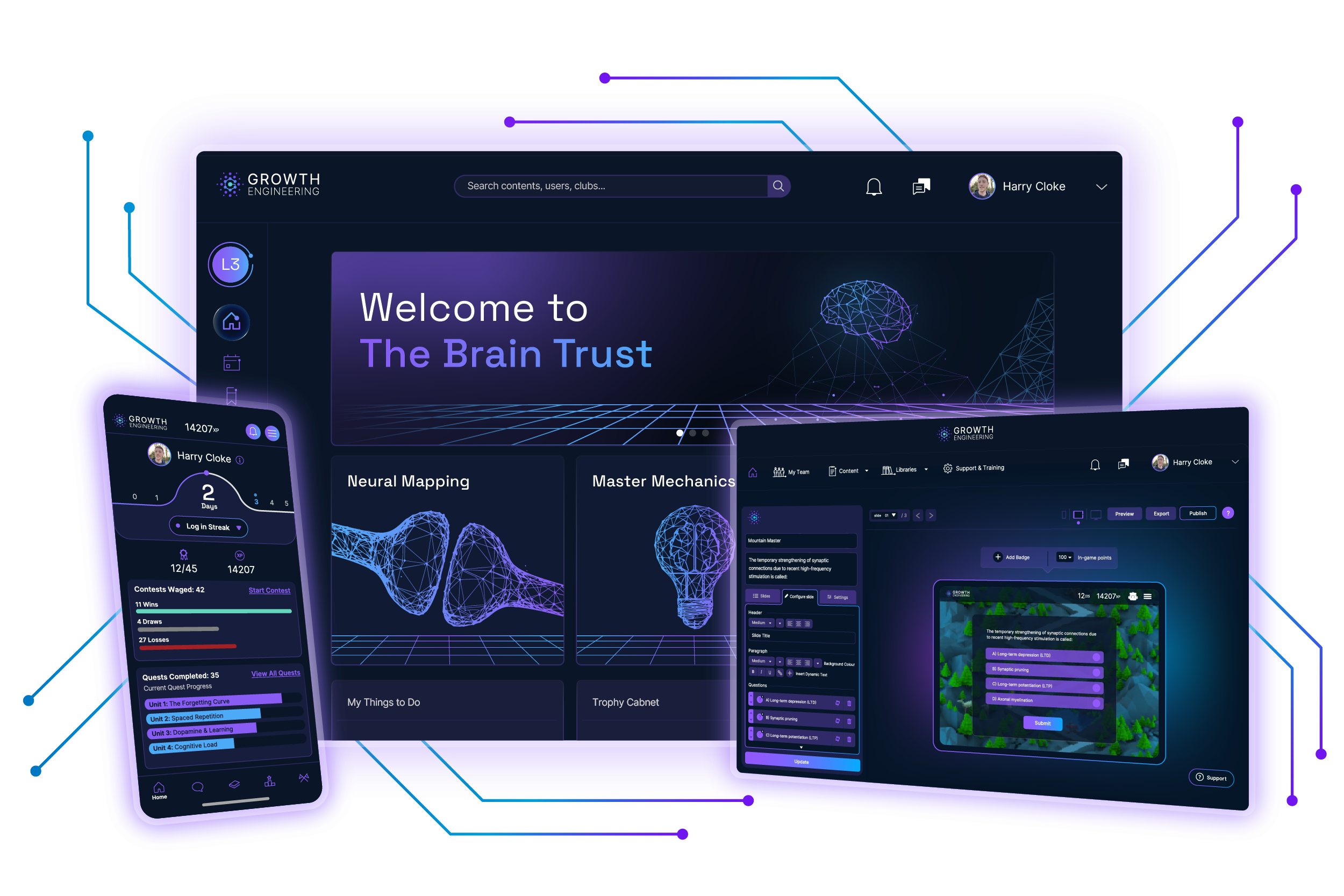
If your training lives mainly in one platform, rich built-in reporting may be all you need. Growth Engineering’s Impact Suite takes this approach. Courses run on SCORM 1.2, while everything learners do in the LMS and Learning App, from Knowledge Contests to daily streaks, feeds straight into the Report Builder and AI Insights.
What Is the Future of xAPI?
Don’t expect an explosion of xAPI usage over the coming years. That said, you are likely to see a period of steady growth. This moderate upswing will be shaped by three trends:
- More Standardisation: As mentioned, IEEE working groups are turning cmi5 and xAPI Profiles into formal standards. Profiles set shared vocabularies for specific uses, such as videos or assessments, so data from different tools lines up better.
- AI as a Data Source: AI tutors and coaching tools generate detailed records of what learners practise and how their thinking develops. xAPI gives that evidence a common format, so it can sit alongside all your other learning data.
- Skills Over Completions: As organisations shift towards skills-based hiring and development, they need proof of what their people can do, not just what courses they finished. As we’ve seen, that’s exactly the kind of evidence xAPI was designed to capture.
Despite this, SCORM isn’t going away any time soon. With 92% of SCORM Cloud launches still running on SCORM in 2025, most organisations will continue to use both standards for years to come.
xAPI FAQs
Yes. Tin Can was the project name used while the specification was being developed. It was renamed the Experience API, or xAPI, when version 1.0 launched in 2013. Some tools still use the old name.
Not yet, and perhaps not for a long time. SCORM still accounts for the vast majority of course launches, and most organisations use both. SCORM handles packaged courses, while xAPI tracks learning elsewhere. cmi5 is the bridge for teams that want to run LMS courses on xAPI.
The specification itself is free and open source. The costs come from the tools around it, such as an LRS, xAPI-ready authoring software, and the time needed to design what you’ll track and analyse.
Yes. xAPI statements need somewhere to go. That’s the job of a Learning Record Store. Some LMSs include one, while others connect to a standalone LRS.
Yes. Statements usually identify individual learners, so they count as personal data. Treat your LRS like any other system that holds employee information, with clear purposes, sensible retention periods, and the right security in place.
Final Words
xAPI changes the question L&D teams can ask. Instead of (the tried and tested classic) “did they finish the course?”, you can now ask “what did they do, and did it make a difference?”
That’s a big shift. But the standard itself is only half the story. The organisations that get real value from xAPI are the ones that decide what they want to learn from their data before they start collecting it, and then set aside time to act on it.
So here’s your next mission: track what matters, not everything that moves.
Want learning data you can act on without managing an LRS? See how the Report Builder and AI Insights turn everyday learning into clear answers in a live walkthrough of the Impact Suite.