What is Kaizen?
Kaizen is the Japanese principle of continuous improvement. Derived from the Japanese words for “change” and “good”, Kaizen encourages a culture of challenging how things are done. Any opportunity for progression, no matter how small, is embraced.
With an attitude like this, companies will always steadily improve. The pace of improvement doesn’t matter, it’s the fact that improvement never stops which makes Kaizen such a powerful philosophy for helping drive organisational change.
Where did Kaizen come from?
Kaizen took off in Japan in the 1950s after being introduced by Toyota to their factories. The success of this partnership was phenomenal, and the concept of Kaizen became interwoven with Toyota’s processes and culture.
In the Toyota factory, any worker is encouraged to stop the production line if they notice a defect or opportunity for improvement. Employing Kaizen in this way, the Toyota production line resulted in far fewer errors, and the rate of production was far faster.
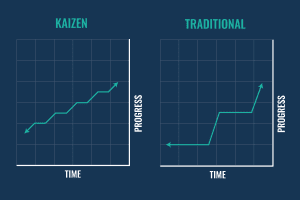
The effect of continuous changes made over time was far more effective than big changes made every now and then. This principle can be applied to all sorts of different situations, especially in learning and development.
The Status Quo
Most companies rely on a cycle of innovation and adoption to increase productivity. Making large changes to leap ahead, and then spending time getting used to the new methods.
This cycle is often a wild rollercoaster, taking employees through enormously high expectations, right down to the low of the ‘trough of disillusionment’ when their shiny new methods aren’t as life-changing as expected. Finally, they arrive at the productivity plateau, when the new methods have been fully integrated and new innovation is once again required. But by this point, everyone is too exhausted to go through it all again!
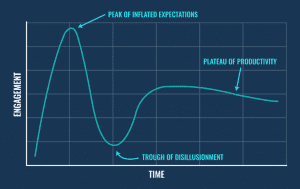
It’s no wonder that employees become resistant to change when this is their experience! Kaizen creates a change in company culture, where innovation is constant and happens in bite-size pieces. The whole company is on a journey together, continuously improving thanks to a shared attitude.
Looked at in terms of pure productivity, Kaizen looks like this:
L&D and Kaizen
Why should L&D be interested in Kaizen? Don’t we want learners to be receiving lots of information every time when they visit their LMS?
Not necessarily. The more information you receive at once, the more information you’ll lose due to the forgetting curve. This is the rate at which information is lost over time, and has some scary statistics:
- After one hour, people retain only half of the information presented to them.
- After one day, people forget more than 70% of everything they’ve learned.
- After a week, people forget 90% of the information in their training.
One of the best ways to combat the forgetting curve is to employ microlearning. Short, bite-sized bursts of information suit our rapidly shortening attention spans perfectly. With less than 1% of our working week available to dedicate to learning, those 4.8 minutes per day will be far more effective for retention than all 24 minutes taken in one big block per week.
This perfectly mirrors Kaizen, taking small steps every day towards a larger goal. It also taps into the psychology behind habit formation. Habits take a surprisingly long time to form – it can be as much as 66 days to form a new habit (possibly even more for complicated ones). The Kaizen approach of checking in daily, and learning and updating, will form the habit of learning far more easily than the traditional huge and sporadic information dump.
Looking at it from this perspective, Kaizen seems like a no-brainer for L&D professionals. An engaged workforce with a continuous commitment to improvement? What more could you want?
Enter: The Knowledge Arcade!
The Knowledge Arcade is the perfect tool for you to deliver microlearning in short, sharp doses. It’s the ideal learning solution for you to take what makes Kaizen so effective and apply it to your own learning and development strategy.
How does it work:
• Battles: peer vs peer quizzes that let your learners test their knowledge against each other.
• Streaks: Rewarding a pattern of behaviour with a badge or achievement.
• Scorecards: Where learners can see all their stats, such as battles won or streaks maintained
• Microlearning: Bite-sized pieces of learning that capture learners attention for exactly the right amount of time to keep them engaged and coming back for more.
• Social features: The Clubs and What’s Happening Wall encourage the social interaction and sharing of ideas that is central to Kaizen thinking.
The Knowledge Arcade emulates the apps that people choose to spend time on. This generates natural engagement with the app, meaning that your learners will log in each day to complete more training and interact with their team.