

 Do you use gamification in the classroom? If not perhaps it’s something you should think about.
The term ‘gamification’ has become inextricably linked to digital technology. But the practice has been around far longer than computers and online points!
Gamification has been doing wonders for offline engagement ever since the first scout badge was earned in 1908!
In this article, we’re going to look at how you can take the different elements which make games so much fun and apply them to a classroom setting.
How is Gamification Effective in the Classroom?
Imagine being able to snap your fingers and engage nine out of ten employees?
Gamification might be a bit more work than snapping your fingers – but it will definitely help you motivate your learners! In fact, 90% of employees are more productive when they use gamification.
It gets students engaged, more focused and more excited about the training they are undertaking, and it makes them more eager to apply it in their real-world jobs. If it can have these positive impacts online, then it will also boost engagement and enjoyment in the classroom, too.
Check out what Juliette has to say about gamification below!
Four Gamification Strategies to Use in the Classroom
Want some expert tips on applying gamification to a classroom setting? Here are four tried and tested strategies you can start using today!
1. Leaderboards
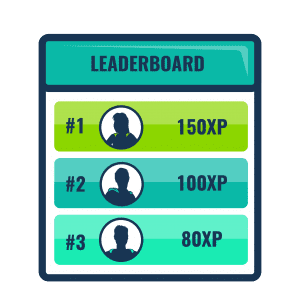
At the beginning of every session, we put up a leaderboard in the classroom with all the names of the students on it. As it’s visible to everyone, it allows learners to see where they are in relation to their peers as well as seeing how far they need to progress to overtake the nearest learner. It really drives a healthy sense of competition!
2. Badges
We’ve created a load of badges for learners to be awarded throughout the day’s learning. These badges are fun and should inspire learning by driving competition, forging a sense of pride and reinforcing positive behaviours.
We divided our badges into two genres:
-
- Badges for achievements. These badges focus on actions and behaviours that add to the learning environment but are not specifically aligned to the learning curriculum itself. Examples include the ‘On Time’ badge for arriving at the workshop/classroom on time, ‘Sunshine’ for being the most cheerful learner, ‘Sherlock’ for the most probing question, ‘Buddy’ for the best supportive comment, ‘Eye Opener’ for the most insightful comment, and many more – but you’ll have to take part in our classroom training to find out what they are!
- Specific learning outcomes. These badges take into account that people have different learning styles, so we make sure that everyone – whether they are quiet or outspoken, quick workers or more thorough – can receive badges. Examples of the learning badges include: ‘Best Application of XYZ Theory’, ‘Best Question’, ‘Best Presentation’, ‘Quickest Answer’ and ‘Longest Assignment’. Placing importance on not just behaviours (as the previous badges do) but on actual learning activities helps to cement knowledge and gets learners really enjoying the entire experience.
3. Teams
We divide the classroom into teams and ask each one to come up with a team name and slogan, which they are asked to share with the class. This way, we are inspiring them with a mission that is bigger than the learning itself. They’re not just there to learn new skills and further their knowledge (though that is obviously a huge part of it!) but they are also there to work together, have fun, improve their career prospects and get thoroughly invested in their training!
4. Competition
At the end of the training, the team at the top of the leaderboard will win the Learning Superhero badge. The leaderboards are updated each time a learner gets a badge, so throughout the day we’ll be able to let each team know whether they are catching up with the leader or storming ahead of the competition. This really gets individual students and teams enthused, engaged and eager to beat the competition.
Final Word
So there you have it, four top tips to take your classroom training to the next level. Add gamification to your classroom training and the session becomes more fun, more interactive and the participants will get much more out of the training.
If you want to take your gamified classroom a step further, always relate your classroom training back to your learning technologies. For example, after a classroom session why not set up a club for your learners to further share knowledge?
Perhaps make sure the gamification relates back to your platform as well. If learners win badges in the lesson, why not award them on the platform as well? The same is true of points – it only doubles the in-class value! The more cohesive you can make your gamification strategy, the more powerful it will be.
For more expert gamification tips, why not check out our Gamification tip sheet? In it you’ll find 34 hints and tips you can apply to your training today!