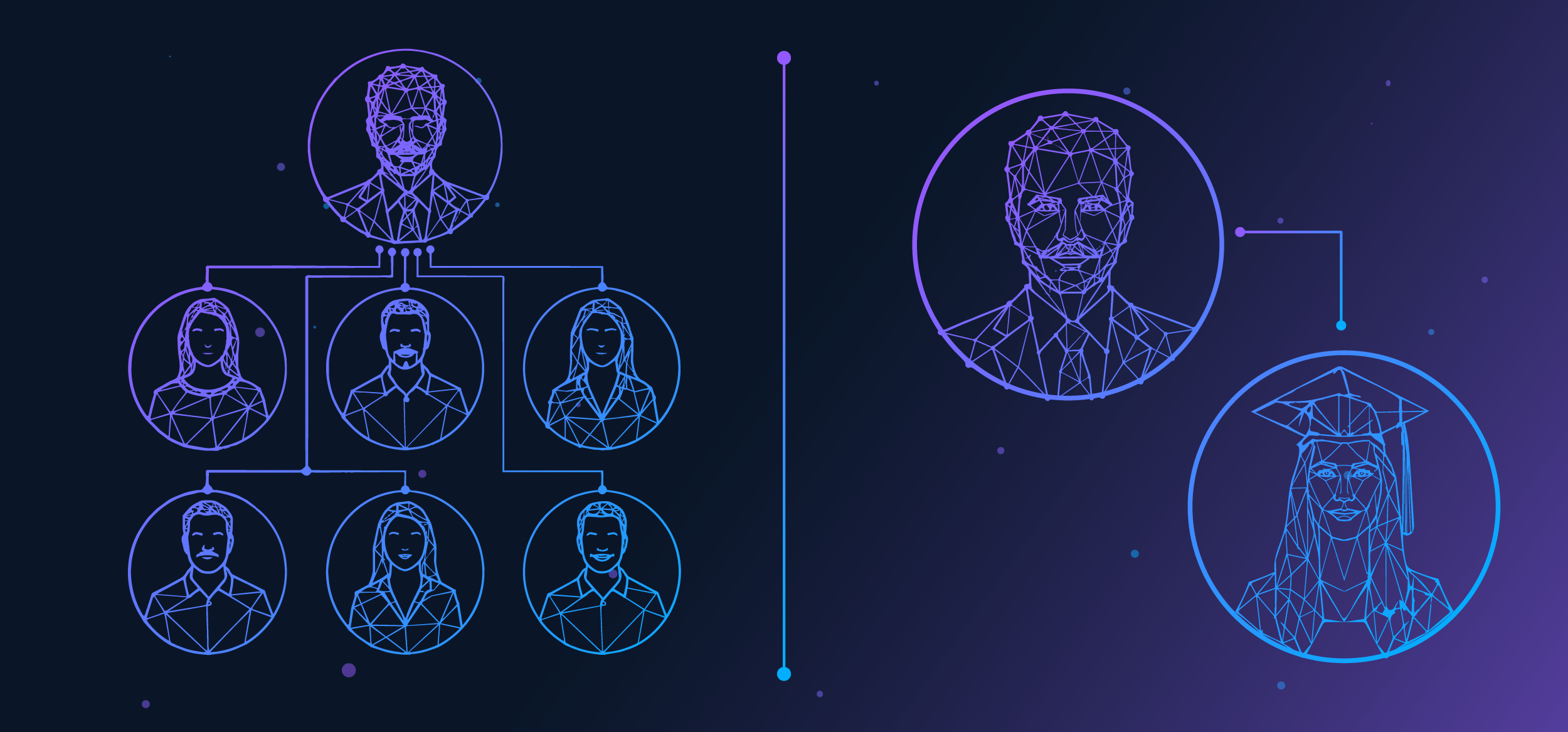
What if every learner in your organisation had their own personal tutor?
Not a training module. Not an eLearning course. A real tutor. Someone who adapts to their pace, identifies their gaps in real time, provides immediate feedback, and refuses to move on until mastery has been achieved.
You already know the answer. It would transform outcomes. The only question is: “by how much?”
In 1984, educational psychologist Benjamin Bloom put a number on it. And that number has haunted the learning industry ever since.
Bloom’s 2 Sigma Problem: The Finding
You may already know Bloom for his Taxonomy of Educational Objectives, a framework that shaped how we classify learning goals. But the 2 Sigma Problem may be his most provocative contribution to the world of learning and development.
Bloom’s paper, The 2 Sigma Problem: The Search for Methods of Group Instruction as Effective as One-to-One Tutoring, analysed the results of two controlled experiments conducted by his PhD students at the University of Chicago.
Both studies compared three conditions:
- Conventional classroom teaching
- Mastery learning in a group setting
- One-to-one tutoring combined with mastery learning
The results were striking. Students who received one-to-one tutoring combined with mastery learning performed two standard deviations above the conventionally taught group. In statistical terms, that’s the difference between the 50th percentile and the 98th. Bloom put it simply:
“The average tutored student was above 98% of the students in the control class.”
That wasn’t the only finding. Approximately 90% of the tutored students reached the achievement level of the top 20% of the conventional group. In other words, the gap didn’t just narrow at the top. It compressed the entire distribution upward.
But Bloom wasn’t celebrating. He was posing a challenge. The title of his paper contains the word “problem” for a reason. After all, one-to-one tutoring is, as Bloom wrote, “too costly for most societies to bear on a large scale.”
Of course, he was writing this in 1984. The world has changed significantly since then. But before we look to the future, let’s establish some definitions.
Bloom’s Key Concepts
Bloom’s research rests on two key concepts that are worth understanding clearly, because they are frequently referenced but rarely defined.
- One-to-One Tutoring: A single tutor working with a single learner. As a result, they can adapt in real time to their responses, correct errors as they happen, and carefully tailor their instruction. This isn’t mentoring or coaching in the broader sense. It’s direct, continuous, personalised instruction.
- Mastery Learning: An instructional approach where the learner must demonstrate mastery of a topic before progressing onwards. This typically amounts to achieving 90% on an assessment. In conventional training, everyone moves forward together regardless of understanding. Not so with mastery learning.
- 2 Sigma: Two standard deviations above the mean. This is a statistical measure of how far a result sits from average. One sigma puts you ahead of 84% of the group. Two sigma puts you ahead of 98%. This shows the scale of Bloom’s discovery.
Why One-to-One Tutoring is So Effective
What makes one-to-one tutoring so dramatically effective? Unfortunately, it’s not just one thing. That’d make the effect easy to replicate. Instead, it’s the combination of several conditions that conventional training typically strips out.
- Immediate Feedback: A tutor knows within seconds whether a learner has understood. There’s no waiting until the end-of-module quiz. Misunderstandings are corrected before they solidify into false knowledge. This is retrieval practice and error correction happening in real time.
- Adaptive Pacing: A tutor doesn’t move on because the schedule says to. They move on because they know the learner is ready. This means each concept receives exactly the time it needs. No more, no less. The result is perfect cognitive load management.
- Mastery-based Progression: In Bloom’s studies, tutored students couldn’t advance until they’d demonstrated mastery of the prerequisite material. This eliminates the compounding knowledge gaps that typically accumulate in conventional training.
- Continuous Diagnosis: A tutor constantly assesses what the learner knows, what they don’t, and where the gaps are forming. As a result, their instruction is shaped by the learner’s needs in the moment, rather than by a curriculum designed months earlier.
- Personalised Scaffolding: When a learner struggles, a tutor doesn’t just repeat the same explanation louder. They find a different angle. That could mean a new analogy, a simpler example, or a completely different entry point. The key is that each explanation is tailored to the specific learner.
In other words, one-to-one tutoring doesn’t work because of some mysterious quality. It works because it naturally creates the exact conditions that neuroscience says produce the strongest, most durable learning.
The 2 sigma effect isn’t magic. It’s applied neuroscience at its most concentrated.
Why the 2 Sigma Effect Can’t Scale
As we’ve seen, one-to-one tutoring combined with mastery learning produces extraordinary results. However, it also requires one qualified tutor for every single learner, for the full duration of the programme.
In a classroom of 30 students, that’s a 30x increase in teaching resource. In a corporate training programme serving 5,000 employees, it’s economically impossible.
Bloom knew this. He wrote that one-to-one tutoring is “too costly for most societies to bear on a large scale.” His paper wasn’t a recommendation. It was an open question: how do we get closer to the results despite the implausible economics?
Forty years later, the question is still open.
Has the 2 Sigma Effect Ever Been Replicated?
This is the point where most articles about Bloom’s 2 Sigma Problem stop. They present the finding as settled science and move on to the implications. But your time is worth more than that. Here’s the fuller picture.
The 2 sigma effect has never been replicated at that scale. A 2020 meta-analysis reviewed 96 tutoring studies. None produced a two-sigma effect. In fact, the average effect size across those studies was approximately 0.37 standard deviations.
That translates to moving the average learner from the 50th percentile to roughly the 66th. That’s substantial and practically significant, but it’s also less than a fifth of Bloom’s figure. There are a few reasons we can point to for this gap:
- The original studies were short-term experiments involving novel topics (probability and cartography) that students had no prior knowledge of.
- Specifically, students received eleven 40-minute lessons over 3 weeks and were then tested immediately.
- What’s more, they were tested on those specific topics, not on broader standardised assessments.
- And the tutoring condition included mastery learning. The evidence suggests it’s this combination that’s so potent, rather than tutoring alone.
Indeed, when researchers estimate the net tutoring effect by subtracting the mastery learning contribution, it drops to roughly 0.85 standard deviations. Again, that’s still significant, but it’s not 2.0.
Paul von Hippel, a professor at UT Austin, published a detailed critical analysis in Education Next (2025) that walks through these limitations carefully. It’s worth reading in full.
Does The 2 Sigma Problem Still Matter?
In short, yes.
The 2 Sigma Problem still matters because the direction of the evidence is unambiguous. Every meta-analysis confirms that the more personalised, adaptive, and mastery-based the instruction, the better the outcomes.
The debate isn’t over whether personalisation works. It’s about how large the effect is and how close we can get to Bloom’s ceiling under realistic conditions.
Think of the 2 sigma figure not as a guarantee, but as a boundary. It’s the upper limit of what’s been observed when learning conditions are optimised for an individual brain. While no one has replicated it exactly, closing even a fraction of that gap at scale would transform training outcomes for any organisation.
To put it in workplace terms: imagine your entire sales team, after training, performing at the level currently achieved by your top 2%. That’s the scale of improvement Bloom observed.
Closing The 2 Sigma Gap
Bloom’s challenge was to find methods of group instruction as effective as one-to-one tutoring. For forty years, nobody could. The economics were too stark, the technology too primitive, and the available methods too blunt.
Fortunately, that’s now changing. Not because any single technology replicates one-to-one tutoring — but because several approaches, used in combination, now address the specific conditions that made it so effective.
- Mastery-based Progression: This was the single most effective element in Bloom’s studies. One sigma through group instruction alone. Technology now makes this scalable. Learners can be held at a topic until they’ve demonstrated full understanding. No human gatekeepers are required.
- Retrieval-based Learning: An approach that engineers the testing effect into learners’ daily experience. Quizzes, knowledge contests, flashcard mechanics, and spaced retrieval schedules create the continuous diagnosis and correction that makes tutoring so effective.
- Adaptive Learning: Adjusting the difficulty, pacing, and content pathways solves the same problems a tutor solves. It ensures each learner works at the edge of their current ability (or their ‘zone of proximal development’) rather than following a fixed curriculum.
- Gamified Engagement: Game mechanics activate the brain’s dopamine reward system during the learning process itself. Leaderboards, XP, badges, and contests create the motivational conditions that keep learners returning. This replicates the sustained engagement that a human tutor can often provide.
Each of these closes part of the gap. But there’s one condition of effective tutoring that none of them fully replicate. That’s the ability to converse with the learner in natural language, diagnose their specific misconceptions, and guide them to understanding through personalised dialogue.
That’s the domain of AI.
AI-Powered Coaching: The Missing Piece
The most powerful thing a human tutor does isn’t delivering content. It’s responding to the learner — in the moment, in their own language, based on what they specifically don’t understand.
A tutor hears a confused answer and knows immediately whether the problem is a knowledge gap, a misconception, or a failure to connect two ideas. As a result, they’re well positioned to adapt, rephrase, or find a different angle. And they can do all this in real time.
For decades, that capability was exclusively human. No technology could hold a natural language dialogue, interpret the learner’s response, diagnose where understanding had broken down, and generate a tailored explanation. This is the reason why Bloom’s problem remained unsolved.
But that barrier has fallen.
AI-powered coaching tools can now engage learners in natural language dialogue, assess their understanding through conversation rather than multiple choice, identify gaps and misconceptions, and provide personalised guidance.
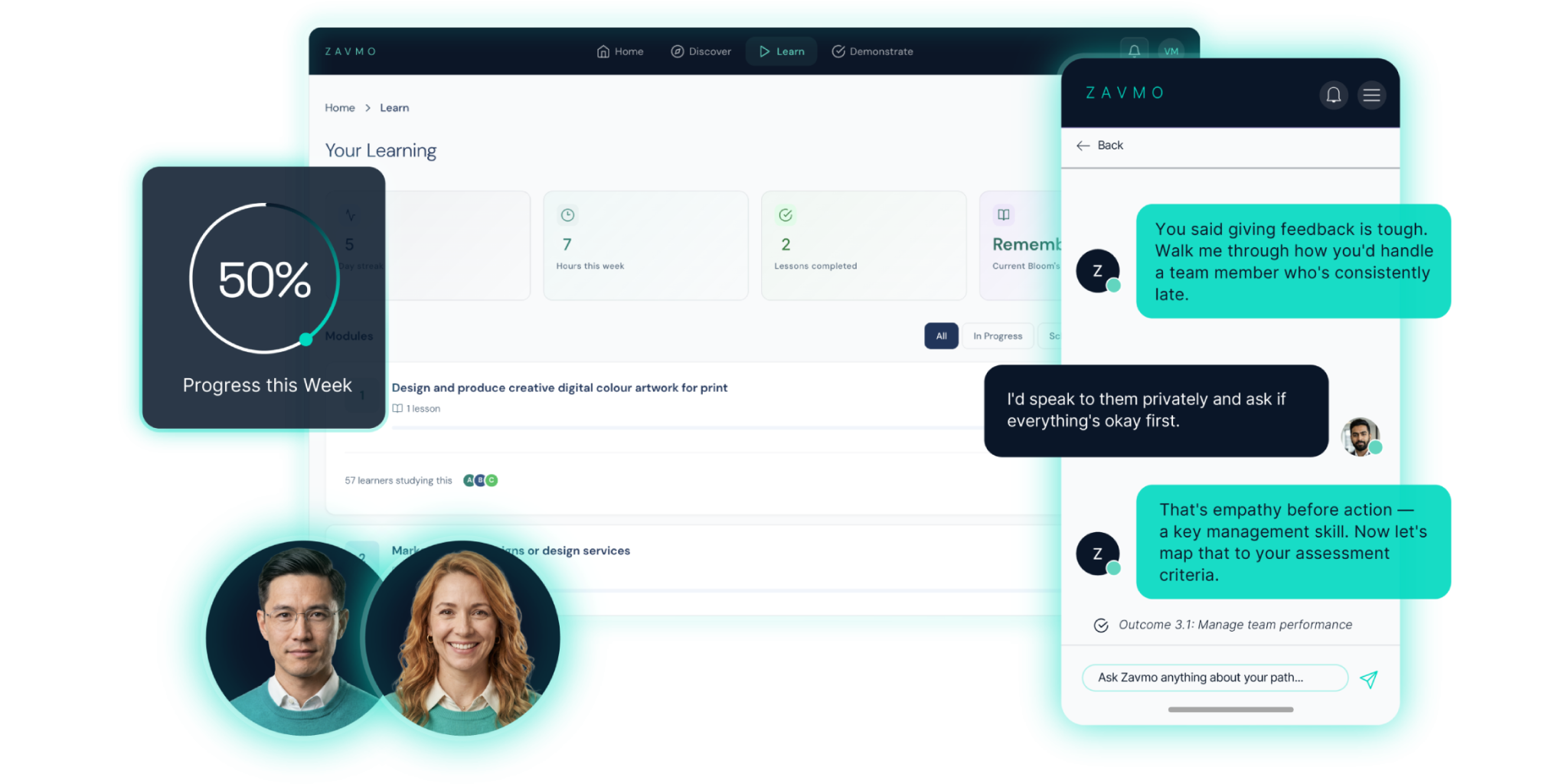
This isn’t a chatbot delivering scripted responses. It’s adaptive coaching that mirrors the conversational quality of human tutoring. And it’s happening at scale.
This is what Zavmo, Growth Engineering’s AI learning companion, is built to do. It coaches employees using natural language, identifies performance gaps, and guides learners towards mastery through conversation rather than content delivery.
As you might imagine, the implications for the 2 Sigma Problem are significant. Mastery-based progression, retrieval practice, and adaptive learning each close part of the gap. And the personalised, diagnostic, conversational element helps to deliver exactly what makes one-to-one tutoring work.
The gap between conventional training and Bloom’s ceiling is narrower than it’s ever been.
Final Words
In 1984, Benjamin Bloom proved that the average student, given the right conditions, could outperform 98% of conventionally taught students. Then he posed one of the hardest questions in learning: how do we deliver those conditions to everyone?
Forty years on, the question still hasn’t been fully answered. But it’s no longer outside the realms of possibility. The neuroscience is clearer. The technology is more capable. And the principles that make one-to-one tutoring effective can now be engineered into platforms that serve thousands of learners simultaneously.
Bloom’s finding wasn’t just about tutoring. It was a proof of concept for human potential. Most learners aren’t performing anywhere near their ceiling. As a result, the 2 Sigma Problem is both humbling and hopeful. The gap is real. And closing it is the most important work in learning.
Thanks for reading. If you’ve enjoyed this content, please connect with me here or find more articles here.
The Impact Suite is built to close the gap Bloom identified. Book a demo of our brain-friendly learning ecosystem now to see how, or download our Learning Theory guidebook to go deeper into the research.