
One of the most fundamental transformations in corporate people development has been the widespread acceptance that, for many subjects, teaching does not in fact promote learning. There is a limit to the number of facts that a person can absorb in a day, and not only that, absorbing facts does not necessarily equip the learner to take action in any new way.
For most of us, school consisted of being told things “Learn this, remember this, write this down”. It was often dull, and many pupils found themselves disengaged, unable to imagine how the things they were learning might be used in the real world, still less to actually apply them. It’s hardly surprising, then, that so many managers rely on the same approach when a team member needs to learn or improve at something; the default is to tell them what’s required “Do this, do this, do this”. Often, this gets results in the short term; probably the team member can return to his task, follow those instructions by rote and get the result that’s required. What he or she has not acquired is the investigative, analytical, decision making toolkit that the manager used to arrive at the instructions given. As a result, when a slightly different scenario arrives, they’re back at the manager’s desk, asking for assistance again.
In the workplace, the solution is a combination of mentoring; providing the team member with ideas of where he/she can go to find information on a subject, for instance, and coaching. Coaching is the process of asking questions which help the learner to think their own way through an issue, and identify their own solution. It’s effective because the coach, through asking the right questions, can help the learner discover structures and strategies of thinking which enable them to tackle other, different problems; it provides them with the toolkit to be more self-reliant, and more capable.
Coaching can work well in a workshop scenario too; facilitators can ask the group questions, ask them to share their ideas and knowledge, and the presence of others with different experiences in the room can mean the problem solving and knowledge acquisition happens even more quickly than in a 1-1 situation, but this approach relies on the interaction between learner and facilitator/coach, and the flexibility for the coach to respond and ask questions in ways which suit the particular needs of the group. This is much harder to replicate in the online learning space, where all of the “teaching” side of the interaction must be predicted and programmed in advance.
This has meant that all too often, e-learning has been linear, prescriptive, based on “telling”, and frankly, a bit boring. Worse than that, since people particularly don’t learn behavioural change very well through being “told”, it’s often been ineffective. The key to changing that dynamic is in finding ways for learners to explore concepts without the need for a responsive, human coach. Growth Engineering’s “Discovery Method” achieves just that through a range of means.
The first precept is that, wherever possible, we ask the learner to explore, reflect on, and capture what they know about the topic before we attempt to introduce a model or concept. When the academic thinking, be it a model of leadership styles or the structure of a buying decision making unit, is introduced, the learner is immediately able to see how it links with what they already know and understand, and how the models are often simply giving structure and order to thinking they have previously been doing. This might take the form of making decisions to guide a character through a business scenario, selecting words and phrases that describe situations or individuals they’ve worked with, or just reflecting and taking notes on experiences they’ve had.
After the model has been explained, another stage of reflection, exploration and understanding gives the learner the opportunity to apply the thinking they’ve been doing, in practical ways, to work they are already engaged with. In a piece of sales training, that might mean looking forward to a sales meeting they’ll be having, and capturing some of the questions they are now aware they need to answer. In a leadership scenario, it might involve planning an appraisal meeting, or preparing to try to influence a more senior manager’s decision. Through immediately using the knowledge they have gained, learners embed it much more effectively than through simple memory, and further, they discover the gaps in their understanding whilst it’s still easy to click the “back” button and refresh themselves on the topic.
A final piece of insight into behavioural change came from the realisation that when people are trying to improve interactions, be they sales presentations or operational team meetings, having a strategy of things to try was only part of the battle. What learners really need is the self awareness and emotional intelligence to appreciate the impact of what they are doing on the other parties. Increasing this understanding allows them to make good decisions and get better results far beyond the scope of the specific situations explored in the e-learning. In order to promote this awareness, we turned a common e-learning paradigm on its head. Typically, learners will view a scenario, and then be asked to reflect on what happened, and the results for the protagonist, who represents them. The breakthrough in the Discovery Method was to take the focus off “what were the results for you” and to place it onto “what was the impact on the buyer/colleague/employee”. This ability to consider the impact of behaviour on others, combined with the self-reflective ability to apply tools which the learner has thoroughly made their own, and to make sensible decisions, makes for far more empowered, capable, self reliant and effective employees. And after all, isn’t that exactly what you want?
Based on The Bartle Test, a well-known game player classification system we can divide eLearners into 4 types.The types relate to the Gamification of real world activities because they help to make sure you are making things interesting for as wide a demographic as you can. In the case of making engaging eLearning it also helps to understand the value of recognition, rewards and visibility.
The Bartle Test is based on a 1996 paper by Richard Bartle, is a series of questions and an accompanying scoring formula that classifies players into categories based on their preferences.
The test has been taken by a large number of computer game players. As of September 2009, the test had been taken over 500,000 times.
The Types by name:

Achievers like to feel that the task can be "beaten" in some way, shape or form, cater to the Achiever style by giving them something to accomplish.
One of the appeals of visibility to the Achiever is that he or she has the opportunity to show off their skill, and hold elite status to others.

Explorers will retain rich memories about what they experienced about their learning and will often enrich themselves in anything they can find about the subject.
One appeal of the visibility is that they are surrounded by people who will benefit from their wisdom.
It is notable that they often feel restricted when expected to move on within a certain time, as that does not allow them to look around at their own pace.

Socialisers their objective is not so much to win or explore as it is to be social, there are few activities that the Socialiser enjoys based on their merits. Instead, they take part so that they can use their experience to socialize with others.
One appeal of visibility is that it allows them to welcome others, help and share information, and have near limitless potential for new relationships. They are compatible with everyone.

Killers thrive on competition with other players, and prefer fighting them. The majority are in it for the sport, trying to read their opponent's moves and generally acting with honor.
One appeal of visibility is the ability be a guild, clan, or community leader. ‘Market control’ appeals strongly to Killers, many of whom have a natural talent for reading ‘markets’.
It is notable that Killers are a very small percentage of the overall population.
But how we do this in a way that makes us stand out from the crowd and gives you results that last?
We adopt the Discovery Method of Instructional Design, which allows the learner to make the learning process their own, reflectively applying new ideas and concepts to their real-world experiences.
![]()
“My first impression was "Wow!". What a great job!”
Jaqueline Moyse, Mandarin Hotels.
Your e-learning solutions will be built around you, and around the needs of your users. Only when we understand what counts as success for you and the people you train do we build the appropriate platform.
The learner’s journey, and your needs are at the heart of everything we do. That’s why it works.
![]()
“Excelent work, very very pleased”
Laurent Fantino
Western Europe Market Strategy & Planning
Duracell Professional
If you have a limited staff training budget, tailored e-Learning solutions can be an expensive option, so we've made all the e-Learning materials available to you. The courses have been written in conjunction with the British Standards Institute and are endorsed by City & Guilds, the Institute of Leadership and Management (ILM), the Institute of Sales & Marketing Management (ISMM), and by specialist trade organisations. So you can be sure they meet the highest standards.
![]()
“Our business has seen a 30% uplift in conversion from sales leads to close. The sales training elearning on the Spicers academy was the catalsyst for this. Since doing the training we have made significant changes to sales processes and the business is growing well above industry average.”
Thank you. Mark Rostock, MD, Just Office
Need to top up your CPD points? Completing one of the courses in our library counts towards your CPD (Continuous Professional Development) points, so visit our library and find out how we can help you keep your knowledge up to date.
The learner’s journey is at the heart of what we do – we're focussed on making the online learning experience as compelling and engaging as possible.
The following elements also need to be built into the eLearning:
Interactivity keeps the learner interested in, and participating with the content. Interactions available include process flows, labelled graphics, tabs, “circle diagram”, timelines, media tours, FAQs, “pyramid” diagrammes, Guided Image and Glossary.
**NOTE – Interactions are typically created using slide content, and replace several slides. They are useful when clarifying, for example, options available (circle diagram), features of a new product (labelled graphics), or when explaining the constituent parts of a process (FAQ).
Discussion, design and agreement – on a course-by-course basis when initial content provided.
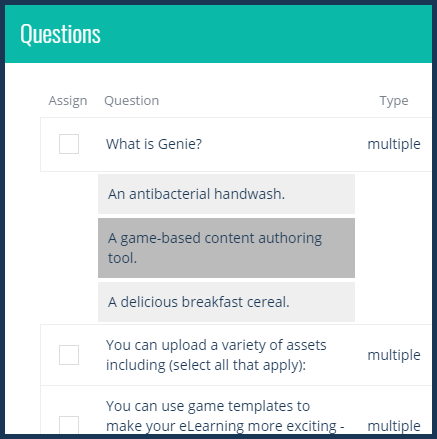
A good way to keep learners interacting with the content is to include short knowledge checks towards the end of the eLearning module. Types include yes/no, true or false, multiple choice, multiple answer, free text etc. When consumers get an answer right, learning should be reinforced/confirmed. When an answer is incorrect, explanation needs to be provided.
It's standard practice to have a corporate music track, loop” or “stinger” on the first and last slide, with a fade-in-fade-out effect. A 30-second selection is all that is required; the first slide will have a 5-second edit created, and the entire track will be used on the last slide.
The process
Project set up and scheduling
Storyboarding, learner's journey, creation of .ppt template. Meetings with stakeholders to discuss and sign-off PowerPoint template and user interface.
Stage 3Co-ordination and telephone discussion with subject matter experts. To include research of subject matter areas prior to calls and assimilation of PowerPoint materials provided
Voiceover per language (all courses will be produced in English first, these will then be signed off in full before being translated into other languages.
Creation of flash eLearning
QA stage – Amendments as necessary, full testing of all elements and interactions by customer on server/LMS, finalization, launch and post-production file handover.