
If you’ve worked in L&D for any length of time, you’ve probably seen the Learning Pyramid. The one that claims we remember 10% of what we read, 20% of what we hear, and 90% of what we do.
It’s shared on LinkedIn daily. It’s referenced in training decks worldwide. And it’s attributed to Edgar Dale’s Cone of Experience.
There’s just one problem. Dale never wrote those numbers. They have no research behind them. And the model they’re attached to has been so thoroughly corrupted that most people have never seen the original.
This article sets the record straight. Let’s start with an introduction.
Who Is Edgar Dale?
Edgar Dale was born in 1900, and he grew up on a family farm in North Dakota, United States. He earned both his Bachelor’s and Master’s degrees from the University of North Dakota and made his way as a teacher in a small rural school.
After this, Dale enjoyed a long career as a professor at Ohio State University (1929-1970). He also served as President of the Division of Visual Instruction of the National Education Association (NEA), now known as the Association for Educational Communication and Technology.
In addition to mentoring doctoral students and working as a professor, Dale made significant contributions in many areas of research. To name a few, his work includes:
- How to Appreciate Motion Pictures (1933)
- Teaching with Motion Pictures (1937)
- Audiovisual Methods in Teaching (1946, 1954, 1969)
- Building a Learning Environment (1972)
- The Living Word Vocabulary: The Words We Know (1976)
- The Educator’s Quotebook (1984)
According to Wagner (1970), Dale used his position to fight relentlessly for a better school system, academic freedom and civil rights.
Dale’s Cone of Experience
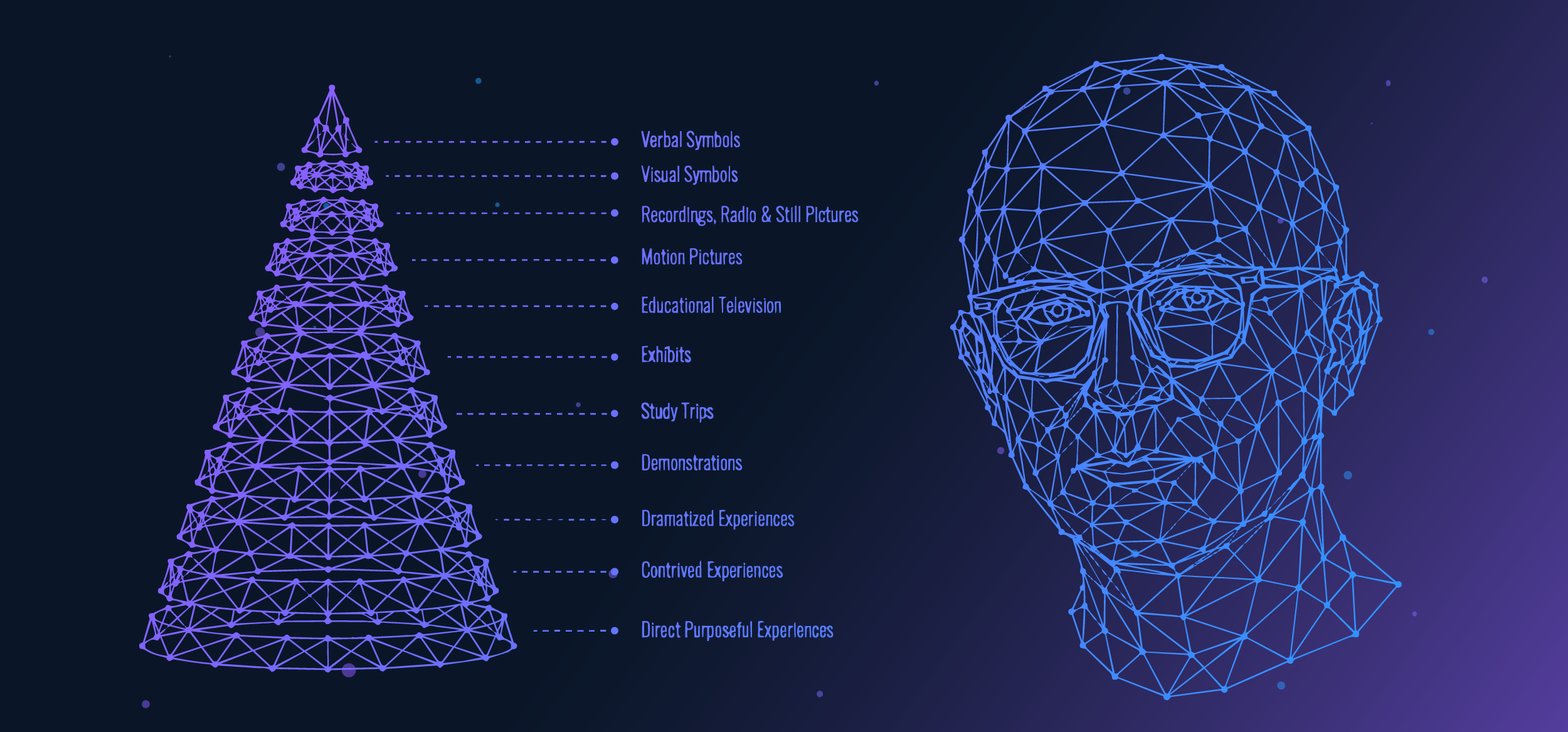
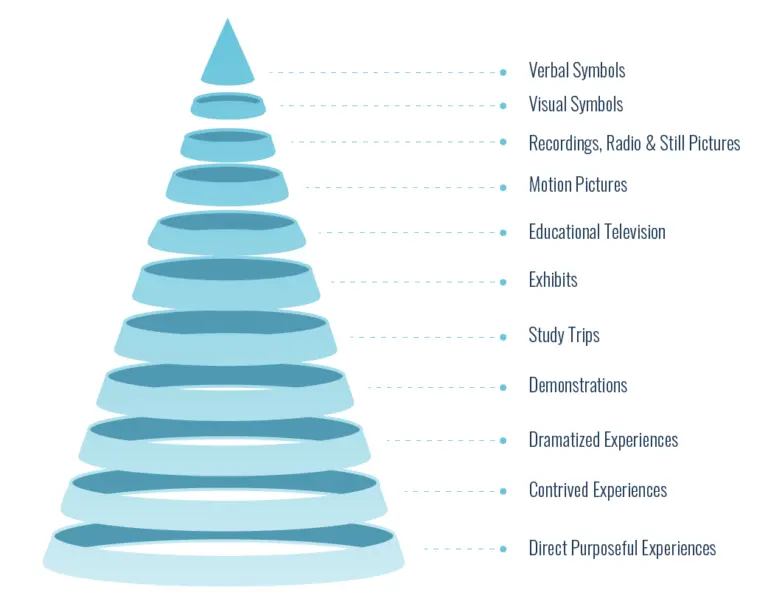
In his first edition of Audiovisual Methods in Teaching (1946), Dale introduced the ‘Cone of Experience’. The Cone placed different educational media and methods in a continuum from the most concrete experiences at the bottom to the most abstract at the top.
When a learner moves from direct and purposeful experiences to verbal symbols, the degree of abstraction gradually grows. And as a result, learners become spectators rather than active participants.
Learners can see, handle, taste, touch, feel, and smell the most purposeful experiences. By contrast, verbal symbols, such as use of words, speech or auditory language, at the peak of the Cone are highly abstract. This means they do not have a physical resemblance to the objects or ideas in question.
As such, the Cone of Experience explains the interrelationships of the various types of media and their individual ‘positions’ in the learning process. This makes it a valuable tool that helps instructional designers and L&D professionals incorporate the right audiovisual materials into their classroom or online training interventions.
However, Dale’s Cone of Experience has been widely misrepresented. Let’s have a look at the common misconceptions.
The Learning Pyramid Myth: How Dale’s Cone Was Corrupted
Dale’s intention was to produce an intuitive model of the concreteness of various kinds of audiovisual media. However, as we’ve seen, his model has been widely and frequently misunderstood and misused.
Over the decades, Dale’s original model has been corrupted almost beyond recognition. The version most people encounter (often labelled the ‘Learning Pyramid’ or ‘Remembering Cone’) bears little resemblance to Dale’s actual work. It includes fabricated retention percentages that Dale never wrote.
Unfortunately, it’s also been shared so widely that the corrupted version has effectively replaced the original. As Subramony and Molenda (2014) put it, the corrupted version has become ‘a virtual 21st century plague’ — spreading and mutating across the web despite over fifty years of attempts to correct it.
Let’s play a game of spot the difference. The illustration directly below is what most share as the ‘Cone of Experience’. You’ve probably seen it before, on social media, or in an article about effective learning approaches.
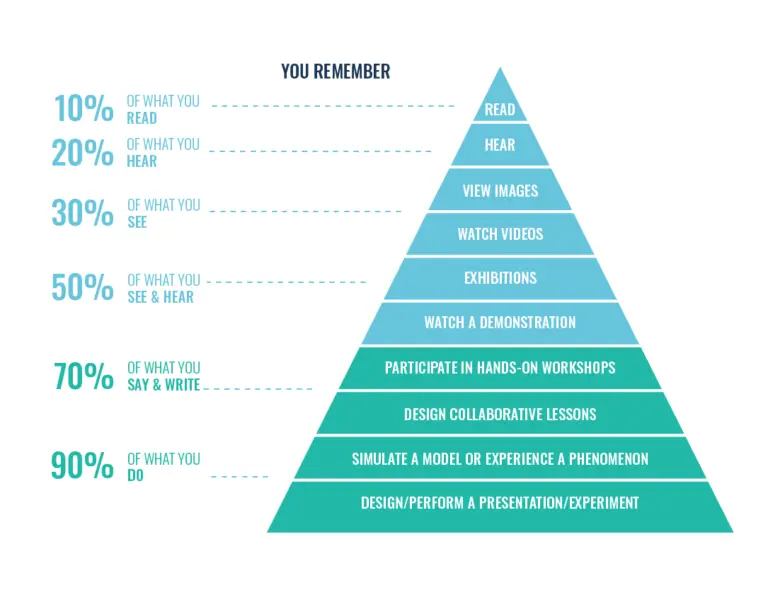
We’ll come to discover that this cone is completely bogus. Instead, it’s the cone below that accurately represents the levels Edgar Dale introduced in his original model. We’ll dig into the detail in the next section.
Do We Really Only Remember 10% of What We Read?
As we can see from the illustrations, the corrupted model purports to inform learners of how much people remember based on how they receive information. According to it, learners generally remember:
- 10% of what they read.
- 20% of what they hear.
- 30% of what they see.
- 50% of what they hear and see.
- 70% of what they say and write.
- And 90% of what they do.
Suspiciously round numbers, no?
In fact, Dale never mentioned the relationship between the level of the Cone and the learners’ level of recall. Instead, he simply used the shape to convey the gradual loss of sensory information in learning interventions.
After seeing how widely the corrupted cone was spreading, Subramony, Molenda, Betrus and Thalheimer combined their powers in an attempt to debunk the myth. They have since published various articles (2014a, 2014b, 2014c) on the topic, and they even have a website focusing on the corrupted cone.
According to their research, the retention data, referring to the percentages seen in the corrupted cone, dates back to ‘folkloric maxims’ from the early 1900s. Multiple authors and publications have cited these percentages over the decades. Not one has ever provided a primary source.
Is The Cone of Experience a Hierarchy of Learning?
On top of these mystical retention percentages, Dale’s Cone of Experience has been misapplied for decades. For instance, some interpret the model as suggesting that direct learning experiences are inherently better than the more abstract audiovisual experiences offered at the top of the cone.
But this is far from how Dale intended his Cone to be used. In his 1969 edition of Audiovisual Methods in Teaching, Dale notes that the Cone is merely a visual analogy. It shows the progression of learning experiences from the concrete to the abstract.
The shape had nothing to do with deciding that one kind of experience is better than another. It is not a hierarchy of learning efficiency. In fact, Dale even explained that too much reliance on concrete experience may actually obstruct the process of meaningful generalisation.
And on top of all that, Dale advised his readers not to take the cone too literally in the first place. He intended the Cone to be a descriptive model, instead of a roadmap for lesson or training planning.

Edgar Dale’s Original Cone of Experience: All 11 Levels
Now that we have overcome some of the misconceptions, let’s have a look at the eleven levels of Dale’s authentic Cone of Experience.
The base of the model is characterised by more concrete experiences. These include direct experiences, contrived experiences, and dramatic participation.
The middle of the Cone is slightly more abstract, where learners observe without action. These experiences are less concrete than the lower levels, as learners do not interact directly with the phenomenon.
The peak of the Cone displays the most abstract experiences, which are represented with limited degrees of realism by symbols. These include visual and verbal symbols, like listening to the spoken word.
As such, the arrangement of the levels in the Cone is not based on its difficulty. Instead, it focuses on abstraction and the number of senses involved. Instructional designers can mix and interrelate these experiences to foster more meaningful learning.
Let’s have a look at each level individually, working our way down the Cone
11. Verbal Symbols

The most abstract level. Words (written or spoken) bear no physical resemblance to the things they represent. As Dale pointed out, the letters H-O-R-S-E don’t look, sound, smell, taste, or feel anything like the actual animal.
10. Visual Symbols

Charts, maps, graphs, and diagrams used for conceptual representation. Like verbal symbols, they convey shared meaning, but through visual abstraction rather than language. Think traffic signs, team logos, or a pie chart summarising quarterly results.
9. Recordings, Radio, and Still Pictures

Edgar Dale was writing in 1946. So let’s think in modern terms: photos, podcasts, and audio files. Dale placed visual and auditory media on the same level of abstraction. This is an important detail, given that the corrupted cone wrongly treats “seeing” as more effective than “hearing”.
In both cases, the learner is observing passively.
8. Motion Pictures and 7. Educational Television

Most publications combine these levels. Videos, animations, and recorded presentations provide a window into real-life processes, but the learner remains a spectator.
The advantage is editorial control. You can edit, zoom, slow down, and replay. The limitation is that only sight and hearing are engaged.
6. Exhibits

Meaningful displays with limited handling. Most exhibits are eyes-only, though some are designed for interaction. Museums and trade shows are common examples. The learner sees the meaning and relevance of concepts through curated representations.
5. Study Trips

Field trips offer the sights and sounds of real-world settings. The learner is primarily observing, with occasional opportunities to participate. The value is context. Learners see connections between training content and real-world application in a way the classroom simply can’t replicate.
4. Demonstrations

A visualised explanation of facts, ideas, or processes. Demonstrations sit in the middle of the Cone because they may or may not include participation. Seeing how a task is done is useful, but it’s rarely as effective as attempting it yourself.
3. Dramatised Experiences

Role-play and simulation. Here learners shift from observers to participants, reconstructing situations in a safe environment where failure carries no real-world consequences.
This enables experimentation. And the opportunity to learn from peers by observing how others approach the same scenario differently.
2. Contrived Experiences

Representative models, mock-ups, and simulations that edit reality to make it easier to grasp. Some realities are too complex to take in all at once. Contrived experiences simplify them without losing the essential structure.
They teach through imitation, and sometimes the imitation teaches better than the original.
1. Direct Purposeful Experiences

The least abstract level and the base of the Cone. These are hands-on activities where the learner is an active agent, responsible for driving a specific outcome. All senses are engaged. Learners can see, handle, taste, touch, and feel the experience.
These are the richest form of learning, though as Dale himself cautioned, too much reliance on concrete experience can obstruct the ability to generalise.
Is the Cone of Experience Still Relevant Today?
Even decades after his passing, Dale’s work continues to influence the educational technologies field. Its utility in selecting instructional resources and activities is just as practical today as when Dale first created the Cone.
The Cone has also inspired the birth of other models. For instance, Baukal et al. (2013) built upon Dale’s ideas and created the Multimedia Cone of Abstraction.
Even though Dale himself recommended not to take the model too seriously, it does guide us in creating effective learning environments. Let’s take a closer look.
The Cone in Learning & Development
In his 1969 version of Audiovisual Methods in Teaching, Dale introduced the concept of ‘rich experiences’. According to Dale, effective learning environments should offer memorable and rich experiences where learners can use multiple senses. He characterised these experiences as follows:
- Students use their eyes, ears, noses, mouths and hands to explore the experience.
- Learners have the chance to discover something new.
- Training events are emotionally rewarding and will motivate participants to continue learning.
- Students have the opportunity to reflect on their past experiences to create new experiences.
- And students can create their own dynamic experiences.
It’s clear that no one level of Dale’s Cone of Experience is sufficient to generate a ‘rich’ learning experience. With this in mind, instructional designers should focus on combining Cone categories to create memorable learning experiences where learners can see, hear, taste, touch, and try.
What Edgar Dale Got Right About Multimedia Learning
Edgar Dale, like John Dewey before him, believed that the school system forced students to memorise information instead of actually learning how to think or solve real problems. Unfortunately, the current school system has been criticised for adopting the same approach.
For this reason, Dale argued that we should use revolutionary approaches to improve the quality of educational learning environments. One way to do this is to introduce a range of audiovisual materials to create vivid and memorable learning experiences. As Dale (1969, p. 23) describes:
“Thus, through the skillful use of radio, audio recording, television, video recording, painting, line drawing, motion picture, photograph, model, exhibit, poster, we can bring the world to the classroom. We can make the past come alive either by reconstructing it or by using records of the past.”
In other words, instructional designers must implement learning strategies fuelled by interaction. They can do so by introducing multimedia design principles and modern learning techniques like dual coding, where verbal and visual information are presented together to strengthen encoding.
A growing body of modern research backs Dale up. Noetel et al. (2022), in a meta-meta-analysis of 29 reviews covering 1,189 studies and 78,177 participants, found “robust evidence” for multimedia design principles including modality, animation, coherence, segmentation, and personalisation.
What’s Next for Edgar Dale’s Cone?

Dale was ahead of his time. He argued that no single level of the Cone is sufficient. That effective learning requires “revolutionary new combinations” of media that are multi-sensory, emotionally rewarding, and designed to give learners a sense of personal achievement.
The challenge, in Dale’s era, was delivery. Rich experiences were possible in a classroom with a skilled teacher, a field trip budget, and a small group. But they were not possible at scale, across geographies, or within the time and cost constraints that most organisations face.
Technology has changed that equation.
- Mobile Apps: A mobile learning app can deliver microlearning content daily. It combines video, text, and imagery to engage multiple senses in a single five-minute session. That’s Dale’s multi-sensory principle, scaled to thousands of learners simultaneously.
- Game Mechanics: Gamification (points, badges, leaderboards, and competitive challenges) creates the emotionally rewarding experiences Dale argued for. Learners aren’t just consuming content. They’re competing, earning, and progressing in ways that activate the brain’s reward system and sustain motivation over time.
- Retrieval Practice: Through quizzes, knowledge contests, and flashcard mechanics, learners have the opportunity to actively reconstruct knowledge. This moves them from the passive observation of Dale’s upper levels toward the active participation of his lower levels, without leaving their desk.
None of this contradicts Dale’s model. It fulfils it. Technology doesn’t replace rich experiences. It makes them scalable. What Dale described as the ideal conditions for learning can now be engineered into a platform and delivered to every learner in an organisation, every day.
Final Words
Edgar Dale’s Cone is one of the most cited models in L&D and one of the most misunderstood. The fabricated retention percentages have no research behind them and never did.
The hierarchy most people associate with the Cone was never Dale’s intention. And the corrupted version has effectively replaced the original.
But Dale’s core insight still holds up. Learners benefit from rich, multi-sensory, emotionally rewarding experiences that combine multiple forms of media. So stop sharing the corrupted cone. And start taking the original seriously.
The Impact Suite is where those principles become technology. Book a demo to see Dale’s rich experiences at scale, or download our Learning Theories guidebook to explore the research.