
 From online shopping to social media posts, to streams of quick-fire videos; content today is consumed at a rapid pace.
The L&D industry has kept up with this need for speed with their very own way of delivering short learning units, namely with microlearning.
Microlearning is more than just a buzzword within corporate and commercial training. It’s a movement which has transformed the way we learn. Day-long PowerPoint sessions are starting to become a thing of the past.
Admins can now produce microunits quickly and deliver them directly to the learner in an instant. Similarly, as 94% of learners prefer to learn in short bursts, you can see why microlearning has made such an impact.
Microlearning has been around for a long time. But it’s fair to say that it’s become more of a focus in recent times as L&D departments find themselves adapting content to meet the mindsets and attention spans of their changing audiences.
What makes this style of training so appealing? Why does it work so well? Join us as we delve into the brain science behind L&D’s (relatively) new sensation.
Microlearning – The Ultimate Definition
Microlearning is a form of training delivered in purposefully small units.
There’s no official time limitation, but on average, microlearning content lasts between 2-5 minutes. If your content is longer than this you may want to consider splitting it into smaller sections.
Whilst microlearning places limitations on the amount of information you’re able to present learners within one sitting, it does create a number of advantages.
Amongst many other benefits, it’s more engaging, it gives the user flexibility and the content itself is easier to digest, which results in higher knowledge retention among your learners. What’s more, as the content is naturally more lightweight, it’s quicker and easier to produce than your standard training fare.
What Are The Benefits of Microlearning?
Here are just some of the benefits of microlearning:
1. It’s Mobile Friendly
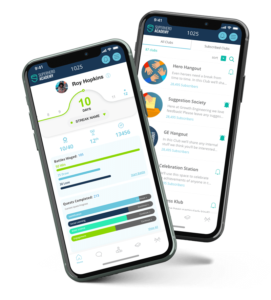
As the learning units are compressed, they lend themselves to the portable nature of mobile devices. Take the commute to work, for example. These journey’s are perfect to fit in some nifty microlearning via a mobile learning app such as Growth Engineering Learning App.
Additionally, as we touch our mobiles (on average) 2,617 times a day, they are already habitual. Mobile learning therefore becomes second nature to us.
2. It’s Engaging
The modern learner learns most effectively in short bursts. Why? The digital age comes with a heap of distractions (social media, anyone?). With bite-size learning averaging in at around 2-5 minutes, it means we don’t get distracted by the undeniable lure of cat videos.
3. It Helps With Knowledge Retention
Learners are more inclined to absorb content repeatedly if it’s contained in short bursts. This culture of casual, quick-fire learning means that it becomes easier to retain knowledge (more about this later!).
What’s the Neuroscience Behind Microlearning?
The fact that admins and learners alike prefer microlearning to more traditional training techniques isn’t just coincidence.
Research into brain science tells us that there are neuroscientific reasons to back up the power of microlearning. Here are a smattering of neuroscience-focused facts and theories that endorse learning in bite-sized chunks.
1. The Forgetting Curve
In the late 19th century, German psychologist Hermann Ebbinghaus was one of the first scientists to study quantitative memory research. He tested his memory periodically by memorising nonsense syllables and recorded the results.
Ebbinghaus collated his findings into a theory called The Forgetting Curve. It argues that we forget 50% of what we learn within a day and 90% of what we learn within a month!
It’s not all bad news, however. Every time you revisit training material, the rate of forgetfulness decreases. The condensed nature of microlearning entices us to revisit units more frequently. This is why microlearning is a welcome antidote in the fight against The Forgetting Curve.
With mobile learning apps, we’re even more inclined to rehash learning modules as they permit us to learn at our own pace, when it suits us. Learning is now a tailored experience. This is what L&D call ATAWAD (Anytime, Anywhere, Any Device).
2. Neural Pathways
Whenever you learn something new, a neural pathway is created in the brain. Every time we revisit this new piece of information, the neural pathway becomes stronger and easier to access when we go to recall. Whether it’s riding a bike or learning the piano, this is why practice makes perfect.
Due to the easy-to-digest nature of microlearning content, it’s easier for us to revisit modules over and over, forming stronger neural pathways. Ultimately, this helps knowledge to stick over time.
3. Why Smaller is Better
Like Mini Coopers, espressos and Tom Cruise, microlearning is flying the flag for small but cool! The British person’s attention span lasts (on average) for just 14 minutes.
Acknowledging that we, therefore, absorb more in shorter bursts, L&D professionals are adapting to suit our ability to focus by providing us with microlearning content. This boosts our overall comprehension rates. Who says size doesn’t matter?
4. Spaced Learning and Long Term Memory
If something is taught once it will be stored in the short-term memory and promptly forgotten. Therefore when it comes to learning, we need to create long-term memories for the information to be properly remembered.
Spaced learning is a learning method whereby highly compact content is taught and then repeated over measured intervals. By reinforcing the knowledge, the learner begins to develop long-term memories in the hippocampus. Microlearning is the perfect tool by which to create long-term memories as reinforcement can be achieved so quickly.
Final Words
Neuroscience plays a big part in why microlearning appeals to the majority of learners. Its compact quality gives us the opportunity to learn in short bursts. This will help in the fight against the almighty Forgetting Curve!
Again, with microlearning units being so short, we can revisit it over and over. Hopefully, the content will have an impact on your learner’s lives without it taking up too much time. This way of learning will strengthen neural pathways and safely place knowledge in long-term memory.
Learning apps and microlearning are a match made in Heaven. But what’s the difference between a learning app and a responsive LMS?
Click here to download our whitepaper ‘Mobile Learning Apps Vs Responsive LMSs’ and get the lowdown!