

Ever walked out of a long presentation feeling like a genius, only to draw a blank when a colleague asks you to explain the main point? You’re not alone. This frustrating gap between perception and reality is what the Feynman Technique was built to destroy.
It turns out the Roman philosopher Seneca nailed it two millennia ago: “While we teach, we learn”. The Feynman Technique takes this timeless insight and turns it into a ruthlessly practical four-step cognitive hack.
Consider it your operating manual for achieving mastery through simplification and the ultimate argument for the power of explanation.
In this article, we’ll break down each of the four steps, the cognitive principles that drive them, and share suggestions for implementing this approach within your learning and development programme. But first, let’s explore the gap between confidence and competence.
The Illusion of Competence
We’ve all seen it. The training completion rates are stellar. The quiz scores are glowing. There are smiling faces in the course feedback survey. Yet, when it’s time to apply that new knowledge in a high-stakes meeting or critical project, nothing changes and competency falls apart.
So, why do your learners consistently fail to apply their knowledge when it counts?
The truth is, there’s a big gap between ‘feeling ready’ and actually ‘being ready’. This illusion of competence is driven, in part, by the Dunning-Kruger effect. This psychological bias tells us that we tend to overestimate our ability because we lack the expertise to judge ourselves accurately.
- The original study found that participants ranking in the bottom 12% of a skill test rated their own ability, on average, at the 62nd percentile!
- In learning, this plays out predictably. Koriat and Bjork found learners can overshoot their own recall by as much as 15 percentage points in some study conditions.
This confidence-performance mismatch can lead to a sort of L&D Peter Principle, where employees are promoted or advanced based on assumed competency, only to struggle in roles requiring the deep mastery they never acquired. Yet, this illusion persists due to:
- Passive Consumption: Reviewing notes or highlighting text tricks the brain into mistaking familiarity for mastery.
- Jargon Acceptance: Learners often accept complex professional jargon without demanding a simple explanation of the key terms.
- Low-Stakes Testing: Multiple-choice or true/false quizzes often test for basic recognition, rather than deep comprehension.
But the moment a learner is asked to explain, teach, or apply the ‘learned’ concept in a high-stakes, real-world context, the illusion shatters. And this is precisely the misalignment the Feynman Technique is designed to brutally and efficiently expose.
What is The Feynman Technique?

The Nobel Prize-winning physicist Richard Feynman (1918-1988) was once challenged to explain a complex concept — why certain particles obey Fermi-Dirac statistics — in simple terms. He famously failed.
“I couldn’t do it,” Feynman admitted. “I couldn’t reduce it to the freshman level. That means we don’t really understand it”.
The idea that true understanding demands the ability to simplify became his signature. It earned him the nickname, ‘The Great Explainer’, and his relentless approach to demystifying complexity was later distilled into a powerful four-step model.
This is the Feynman Technique, a diagnostic tool for intellectual honesty, designed to systematically convert surface-level knowledge into deep, applicable understanding.
At its core, the technique operationalises a powerful cognitive principle known as the Protégé Effect. This intellectual phenomenon tells us that teaching a concept to others is the most effective way to learn it yourself. After all, teaching forces you to:
- Organise scattered information into a coherent narrative.
- Simplify complex ideas and ruthlessly eliminate ambiguity.
- Own the material and sharpen your focus.
While the Protégé Effect explains the why, the Feynman Technique provides a structured, repeatable method for achieving that cognitive boost. In doing so, it transforms a general idea (learning by teaching) into a rigorous cycle of self-correction.
In a sense, the Feynman Technique offers learners the ultimate metacognitive workout. It doesn’t just build knowledge, it tests your ability to monitor your own understanding — the very skill missing in the Dunning-Kruger effect.
Now, let’s break down the four steps that make this transformation possible.
The Feynman Technique: 4 Stages
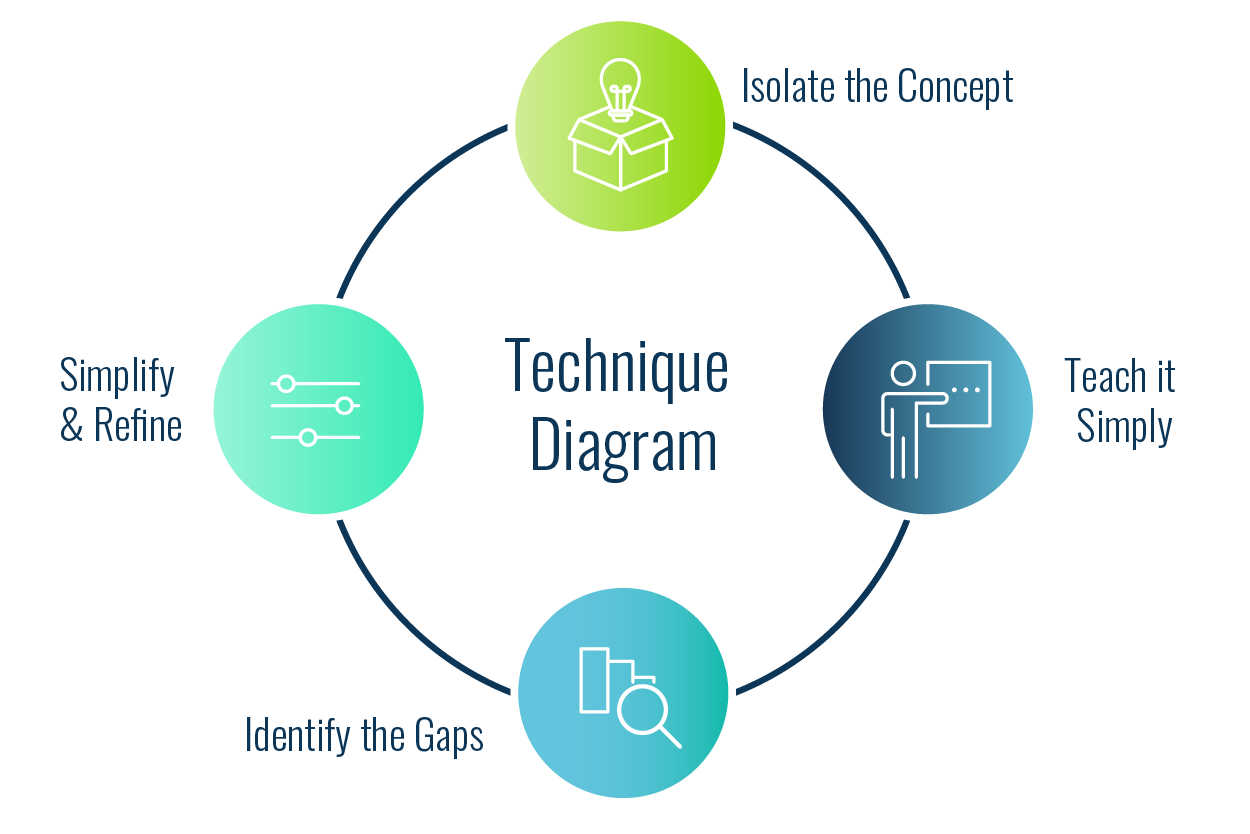
The Feynman Technique works because it’s a learning loop, not a to-do list. Each stage is a deliberate cognitive intervention designed to dismantle the illusion of competence. Here’s what happens in learners’ minds during each step.
1. Isolate the Concept
- The Action: Start by defining your target. Write down the specific idea, process, or term that you want to master at the top of a blank page. Remember to be precise. This will focus your effort and create a defined space for learning.
- The Principle: Research into goal-directed learning tells us that our brain filters information more effectively when given a clear target. By isolating one concept, you switch from passive browsing to focused, active engagement.
2. Teach it Simply
- The Action: Next, explain the concept aloud or in writing as if to a complete novice. “Speak as you might to a young child or a golden retriever,” as Jeremy Irons once memorably put it. Use plain language. The goal is to create a clear, logical narrative from scratch.
- The Principle: Retrieval practice, the act of pulling information from memory without cues, is one of the most powerful drivers of long-term retention. Articulation forces semantic encoding, shifting passive intake to integrated knowledge.
3. Identify the Gaps
- The Action: Now it’s time to review your explanation. Where did you get vague, resort to jargon, or feel a flicker of doubt? Note these points: they are the specific gaps where your understanding is incomplete or fragile.
- The Principle: At this stage, you’re applying metacognitive monitoring. This is the ability to ‘think about your own thinking’. In doing so, you’re assessing your comprehension and forging a specific, actionable diagnosis.
4. Simplify & Refine
- The Action: Finally, return back to your original learning materials and address the specific gaps you’ve identified. Attempt to create a simpler explanation, a stronger analogy, or a clearer diagram for those tricky parts. Then incorporate those refinements into your teaching.
- The Principle: Filling gaps by connecting new information to existing knowledge is called elaboration. This process integrates the new concept into your existing knowledge network, making it more meaningful and memorable.
The real power emerges when you repeat the cycle.
Each pass through these stages refines your mental model, strengthens neural connections, and replaces the illusion of competence with stress-tested understanding. It means that learning is no longer a one-off event. It’s a process of continuous clarification and mastery.
The Research
Now that we understand the technique, let’s look at its impact on learning outcomes.
Brain imaging (fMRI) studies reveal that the technique switches on the brain regions responsible for deep comprehension and long-term memory retrieval, making learning significantly more effective. And there’s plenty of research to support this.
For example, a 2023 study on science education found that using the Feynman framework doubled average performance, with pre-test scores rising from 34 to 66. Learners also reported marked improvements in engagement and communication skills. Promising, though it was exploratory, with no comparison group.
Similarly, In a 2025 quasi-experiment with 60 Indonesian high-school English learners, the Feynman group’s reading scores rose from 58 to 74, against 56 to 67 in the control group. In the accompanying survey:
- 90% said it helped their comprehension.
- And 80% felt more confident explaining ideas.
Learners are famously bad at judging what they have actually understood. Across 115 studies and 15,889 participants, the correlation between people’s confidence and their real comprehension was just 0.18. Explaining the material to yourself roughly doubled it.
And it improves the learning itself, not just your read on it. A meta-analysis of 69 effect sizes found prompting learners to explain material to themselves produced a moderate-to-large gain, g = 0.55. A separate 2025 meta-analysis of 204 effects landed in the same range at g = 0.46.
The evidence is clear: structuring learning around explanation and simplification doesn’t just transfer information — it transforms the learner. Next, let’s look at applying the technique within the world of learning & development.
Applying the Feynman Technique in Learning Design
We know the Feynman Technique delivers results, but how do we move it beyond an individual study habit and scale the principle into an organisational training strategy? Our recommendation? Apply it consistently to the following three pillars: your content, your platform, and your team.
1. Your Content

Traditionally, training content is designed to deliver information (passive consumption), not facilitate reflection (or active creation). To leverage the Feynman Technique, you need to deliberately ‘bake in’ retrieval and reconstruction into the content design itself.
Here’s how you can pull this off.
- The ‘Teach Back’ Prompt: After a key concept, include an activity prompt like: “In the space below, explain [Concept X] to a new team member using only 2-3 sentences and one real-world analogy.” Alternatively, offer workbooks after a learning experience that encourage further reflection.
- Concept Mapping Tools: Provide digital whiteboards where learners can visually map a process or system in their own words. Ask them to connect ideas without using any jargon-heavy terms from the source material.
- Peer Teaching Sprints: Take things further by structuring breakout sessions or forum prompts where learners are randomly assigned to teach a micro-concept to a partner in three minutes or less.
- ‘Simplify This’ Challenges: Present a complex, jargon-laden policy document or technical update relevant to your industry. Then challenge learners to collaboratively rewrite it for a non-expert customer or a new hire.
2. Your Platforms

Use your learning management system (or a similar learning platform) to streamline the act of explanation, turning social learning features into a mandatory, measurable step that reinforces cognitive mastery across your team.
- Get Social: Use your learning platform’s collaboration features (like discussion forums or integrated chat) to share Feynman friendly prompts. For instance, challenge your learners to “Post a one-paragraph ‘explainer’ of Topic Y as if to a new hire. The best explanations will be awarded a ‘The Great Explainer’ badge.”
- Peer Review: Once learners have posted their simplified explanations, encourage their peers to offer useful (and friendly) feedback. For example, challenge reviewers to identify unnecessary complexity, lingering jargon, or frivolous details.
- Gamified Rewards: Reward the right behaviors! Use digital badges and experience points (XP) for every instance of effective simplification and insightful peer diagnosis. Ensure this recognition is visible on a platform leaderboard, so your learners can track their progress.
3. Your Team

To scale mastery, you’ll need to look beyond your LMS. Your managers, coaches, and mentors are the ultimate force multipliers. Equip them to embed the Feynman principle in every coaching conversation and team huddle. Here’s some ideas to get you started.
- Check-in Challenge: Train your leaders to ask team members to explain a concept or process (verbally or via a quick sketch) during 1:1s. They should listen for clarity and use probing questions whenever an explanation starts to get fuzzy.
- Project Progress: Before a project kickoff, ask team members to prepare a simple, two-minute explanation of the core challenge for a non-expert audience. Use their notes as a discussion starter to ensure shared, foundational understanding.
- Goal-Setting: Give your leaders a specific, teaching goal. For instance, ‘By the end of Q4, be prepared to teach the core components of our data privacy policy in a 10-minute, jargon-free briefing’. This shifts their development focus from passive consumption to active, measurable mastery.
Not sure where to start? In your next training programme, replace one traditional review quiz with a ‘Teach it Back’ activity or reflection prompt. This will reveal more about your learners’ true readiness than any assessment analytics currently can.
Is The Feynman Technique Practical?
Implementing the Feynman Technique means flipping the script on how learning is ‘supposed’ to work. After all, we’re asking people to trade comfort for true mastery and greater cognitive effort. This won’t work for everybody. So, let’s address these concerns head on.
- Exposure & Anxiety: It’s true that asking a learner to expose their knowledge gaps can feel vulnerable. Psychological safety is key. With this in mind, we’d recommend a phased introduction. Start with low-stakes, private exercises (e.g. “explain it in your notebook”) before moving onto social or recorded formats.
- Time & Value: While applying the Feynman Technique can be time consuming, it does represent a shift from quantity to quality. Ten minutes of ‘teaching’ is more valuable for long-term retention than an hour of passive video. If the average employee really does have just 24 minutes a week for formal learning, we have to make every second count.
- Complexity & Expertise: How does this technique fare with highly complex or tacit knowledge? How do you simplify something so complex? Here, we’d recommend reducing the topic at hand to its underlying principles, frameworks, or first concepts. You can’t oversimplify expertise, but you can ensure the foundational mental models are rock solid.
Final Words
While many see the Feynman Technique as a simple ‘study hack’, it’s so much more than this. It’s a fundamental principle that can be used to build a culture of genuine, applied competence across your organisation.
After all, by designing for explanation, you create a self-correcting system. All of a sudden, learners aren’t just consuming content. They’re also testing their understanding against the real-world standard of clear communication.
This is how you build a bridge from “certificate of completion” to “promotion-worthy performance” and make sure it doesn’t collapse under pressure.
Now, for the ultimate test of simplicity and mastery: Can you explain the Feynman Technique in 2-3 minutes, as if talking to a 12-year-old?
Thanks for reading. If you’ve enjoyed this content, please connect with me here or find more articles here.
Love this technique? It’s just chapter one. Unlock your ‘Learning Theories Guidebook’ now. It’s your manual for building a culture that doesn’t just learn, but masters.