
 Making sure your eLearning actually engages your learners is vital to the success of the project. Without learner engagement, the eLearning won’t be effective. If learners aren’t paying attention to what they’re doing, going through the eLearning unit won’t lead to any real learning.
It’s an issue that we come across time and again when talking to business owners, L&D professionals and training managers. They have the eLearning units, they have the Learning Management System, they have the desire to roll out their training programme: but their learner engagement is set to a big fat zero!
Not to worry; here are 7 things you can do to quickly and easily to improve your eLearning and get learners more engaged with what they’re being taught.
 Make the eLearning units shorter
Our attention spans are mostly pretty rubbish these days (read more on that here). That’s why shorter, bite-sized eLearning is much more effective at securing learner engagement and therefore improving learning.
But more than that, when eLearning units are short, we’re not only more likely to squeeze studying into our busy day, but we feel that sense of accomplishment at having finished a unit more often. And as we’ve said before, a feeling of accomplishment is important to motivate and engage learners in their activities.
Improve the Imagery in the eLearning
How many times do we have to say it? Stock images are, by and large, pretty awful. They’re obviously posed, cheesy and often jar with your content. It’s far more effective to take the time to commission a set of photos or images that are relevant to your organisation, on-brand and not eye-wateringly cheesy! It’s also worth saying that images should complement the text – not try to distract from boring reams of content or overly-complicated language.
 Make Text Easier to Read
As we said above, images shouldn’t be used to distract from confusing language or huge paragraphs. How should it be done, then? Well, the answer is not to have overly long or complicated text in the first place!
Break up paragraphs with bullet points, split text over a few screens, use diagrams where possible, put information into tables, use voice-overs or videos instead… there are numerous ways to make on-screen text easier to read.
Add Assessments
As the article says, you need inbuilt tests or assessments to check that learners have actually been, you know, learning! We do this with a variety of tests and quizzes, in numerous formats – from scenario-based questions with free text answer boxes and multiple choice questions, to sudden death pop-up quizzes and experience-specific data entry to prove learners can apply the content to their own situation.
Ask for Feedback
You won’t really know what your learners thought about the eLearning unit unless you ask them, or allow them the opportunity to tell you how fantastic they found the module (or not…). You can use in-depth surveys to do this, or a simple ‘rate this piece of content out of 5’ selection may be enough to give you an idea of what your learners thought.
Beat the forgetting curve
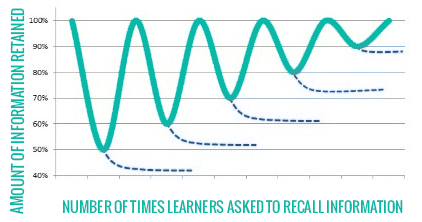 We know from the ‘forgetting curve’ theory that we forget about half of what we learn after just a few days if we don’t work to recall it.
That’s why it’s important to follow up with extra questions, assessments, projects or real-life applications to thoroughly cement the training content in learners’ minds.
One way to beat the forgetting curve is to encourage social learning. So once a learner has finished their eLearning, they’ll be able to join relevant groups and forums where they can discuss the things they learnt. By going over the content again, focusing on different aspects, asking and answering questions, and recommending further reading, learners remember what they’ve been taught – which results in much better return on investment on the training programme.
 Review your learning objectives
It’s important that each eLearning unit has an associated learning objective as it guides the training and helps to categorise failure and success. If the objective is to increase employees’ sales knowledge and you find that post-training they are selling 40% more, you can be assured that the eLearning unit is a success. If, on the other hand, the number of sales doesn’t change at all, you won’t have achieved the learning objective – a worrying situation to be in!
Make eLearning fun
When things are fun, we enjoy them more, and if we enjoy something we will pay attention to it and be motivated to do said activity more. In the case of eLearning, this means that the more fun we find the unit, the more we’ll learn, and we’ll approach further eLearning units with a positive attitude.
Securing learner engagement can sometimes seem like an impossible task. But as you’ve seen, there are a few tricks that can boost engagement and get learners to enjoy their eLearning. Click the following link to download our free white paper on learner engagement and see for yourself how easy it is to make learners happy and get them motivated!