 By our very nature, we humans are all different. What motivates one person might rub the other up the wrong way, bore them to tears or deter them from ever making any progress.
It’s important to gain everyone’s attention and engage them in their learning, but how can this be done when we are all so different?
Competition in the Workplace: Where’s the Proof?
The office is not full of athletes. We’re not all obsessed with completing a task faster than the person next to us. So what’s the point in even trying to apply it to your workforce?
Here’s a few links to back-up the power of competition in the workplace:
- The Academy of Management suggest that competition can motivate employees, make them put in more effort and overall, help achieve results.
- The New York Times called competition the ‘defining feature of the upper-echelon workplace.
- The American Psychological Association say that competition increases effort and enables higher performance.
What Motivates Employees?
There’s two types of motivation when it comes to team members:
Intrinsically Motivated
Intrinsically motivated people are powered by themselves. They don’t need the promise of a bonus to be driven to accomplish a task. Examples of intrinsic motivation may include;
- A sense of achievement
- Self-actualisation
- Task accomplishment
Externally Motivated
Extrinsically motivated people are driven by external rewards such as money. An example of external motivation could be sales staff receiving commission. External motivation may include:
- Money
- Praise
- Promotion
- Rewards and prizes.
Want to know more? Take a look at what Juliette has to say about the issue?
The Mechanics of Gamification
Learning and Development professionals need to make sure all their learners are engaged, motivated and happy to learn – and they can ensure this is the case by utilising gamification in learning.
We talk a lot about gamification and how badges, experience points and leaderboards help to encourage learners to try harder, log on more often and push their development forward. We’ve found time and again that gamification is the answer to the issue of securing learner engagement.
Now, for learners that are naturally competitive, tough competition will be very motivating, rather than disheartening. They’ll be more likely to complete their assigned eLearning modules, explore their Learning Management System and do everything they can to gain extra points and badges because they want to climb up the leaderboard. The difficulty makes it worth it!
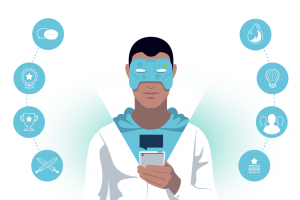
Of course, we’re not saying that learners are never demotivated by leaderboards. After all, as we said above, everyone is different.
But one of the great things about leaderboards in learning – and particularly the leaderboards on our Growth Engineering LMS – is that there are many different leaderboards which learners can top for doing different things.
How This Works
1. Company-wide Leaderboard
Company-wide leaderboard means that you involve all your learners in it. The more eLearning modules/tests/assessments they do and the more they interact with their LMS (by searching, exploring and sharing on social media) the higher they climb up the leaderboard.
2. Group Insights Leaderboards
Admins in each Academy can create special ‘groups’ dedicated to specific topics.
So, for instance, there could be a gamification group, a technology group and a sales group. Learners can join whichever group they are most interested in (or all of them!) and each group has its own leaderboard.
The more a learner contributes to his or her group, the higher up that leaderboard they climb, until they are crowned the Gamification Group’s Top Contributor!
So even if they think they have no chance of reaching the top spot on the company-wide leaderboard, there’s still a chance that they can be named an expert in their own topic of interest. And doesn’t everyone want to be called an expert sometimes?
Final Words
More and more L&D departments are investing in gamified solutions to train their teams. Why? Because it’s been proven that competition in the workplace drives productivity. From leaderboards to experience points, from levels to virtual badges; there’s plenty of ways to implement this on your learning solution!
To find out more about gamification in learning, and the science behind it, download our free whitepaper: ‘Guide to The Science of Gamification.’