
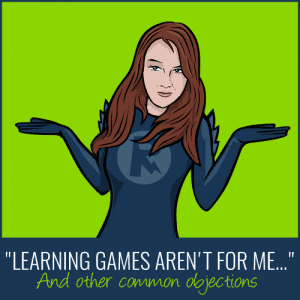
Objections to game-based learning and gamification abound. We’d wager that anyone who spent any decent amount of time looking into gamification has come across a tonne of them.
It’s only natural. Game-based online learning is taking the training world by storm and changing the way L&D professionals approach their training programmes. Big changes can be scary, especially with learners around the world finding a brave new world, free of the dullness of traditional online learning.
Everything is getting better, looking up and moving forward.
Despite this quantum leap in learning technology, there’s still a hardcore of learning professionals who are reluctant to take the plunge and discover the possibilities that game-based learning offers. Every step into the unknown comes with a degree of risk, but one shouldn’t confuse risk with failure.
If you’re someone who’s still on the fence about learning games, you probably have a few concerns. In this article, we’ll answer the most popular challenges and by the end, you’ll see that game-based learning isn’t as terrifying as your thought it was.
I Don’t Know How to Make Games
-
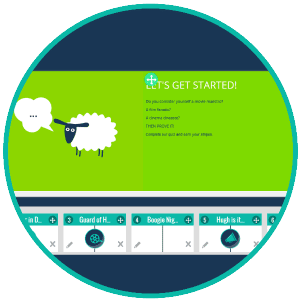
Building a learning game in Genie
As a learning manager, you probably don’t have a background in game development, so it’s understandable that this area feels like uncharted territory. On the contrary, though, the worlds of game development and instructional design are fundamentally similar.
In both cases, the structure is essentially the same. A game will usually involve a goal at the end and a series of obstacles to overcome on the journey. A good eLearning unit is much the same. To generate any kind of engagement or meaningful change in the learner, the learning content needs to challenge them.
If you’re an instructional designer, this won’t come as a huge revelation. You might, however, be surprised to learn that the exact same principle is the driving force behind the most successful games. The bottom line here is that anyone who can create a meaningful learning asset can also adapt their approach to create an awesome learning game!
Games Are For Kids
One of the most persistent myths about games (video games in particular) is that they appeal chiefly to teenage boys and children. This might have been true in the 80s and early 90s, but the world has come a long way since the days of Sonic and Mario.
It might then come as a shock to some people that the average game player is 35 years old and that 27% of gamers are over 50 years old – a larger percentage than those under the age of 18 (26%).* The main reason that video games have overtaken all other forms of entertainment is that they are more interactive and more engaging.
If you want to boost engagement in your learning programmes, you can’t afford to ignore this trend.
*The Entertainment Software Association 2015
Normal eLearning Works Fine For Me
It never ceases to amaze us when we hear that some learning managers aren’t interested in engagement within their online learning. Instead, they focus on creating functional content and delivering it on a very basic learning platform.
Their confidence in their current methods masks their fear of the unknown and unwillingness to change. The fact of the matter is that learning programmes that focus on engaging learners have more success than those that don’t. Clients using our gamified LMS have seen engaged learners outperform disengaged learners by 75% in terms of sales.
If you don’t at least try something new, you’ll never know if it works or not.
I Don’t Want My Employees Wasting Time On Games
 When you’re paying employees for their time, you naturally want to get the best return possible. Many managers (and even learners) see time spent on training as time that isn’t spent making that return. It’s understandable that they might want to reduce training time as much as possible.
For these people, the idea that employees might be so engaged with their training that they can’t tear themselves away from it seems counter-productive. However, focusing on the short term denies the possibility of the real, long term gains that can come from an engaging training programme.
Learning games are, by their nature, even more engaging than traditional training methods and employees are likely to spend more time learning what they need. This isn’t a bad thing – since learners are more engaged, the rate of retention is much higher and the training is more effective. Better trained employees are more capable of doing their jobs and helping the business thrive.
Here’s what our good friend Karl Kapp says about serious games:
Gamification Objection Case Study:
Grumpy Greta says: “Online sucks! It’s boring! I hate it!”
Oh Greta. We’re sorry that you’ve had such bad experiences of online learning in the past. It’s truly sad that you’ve had to put up with dull eLearning modules, faulty technology and lonely learning. But don’t worry – that is now a thing of the past!
We use a nifty thing called ‘gamification’ to make online learning much more fun and enjoyable. Here’s what this involves: we add gaming mechanics and metaphors to our Academy LMS to encourage certain behaviours. So when a learner opens an eLearning module, they get some points and a badge; when they finish it with flying colours, they get even more points! If learners share their knowledge and ideas with fellow learners, they’ll receive Achievement badges and a smattering of points. And sharing their progress on Twitter and Facebook? That’ll gain them a special badge!
See? By gamifying the learning process, we make learning fun again. Forget what you think you know about online learning. The ‘Next Generation’ of online learning technologies has arrived to eradicate dull eLearning, and we’re leading the strike force!
Grumpy Greta asks: “I heard that gamification doesn’t work with my employee demographics! Is that true?”
Don’t panic, Greta! Research shows that 70% of senior executives play games (during work hours, no less!), 53% of gamers are aged between 18 and 49 and 20% are over 50. So where’s the evidence that gamification doesn’t appeal to your employees?
When we gamify Academies we see a significant uplift (over 50%!) in learner activity and engagement. It’s impossible to prejudge who will be motivated by gamification – there are no barriers when it comes to age, gender, role or experience.
If you’ve heard that gamification doesn’t work, it’s probably from companies that were using it incorrectly. Gamification for gamification’s sake – showering learners with badges for doing nothing much at all – won’t work.
But aligning the gamification to the kinds of behaviours you want to see most certainly will result in more of those behaviours. If you want employees to work through eLearning modules more quickly, a ‘Speedy Reader’ or ‘Fast Learner’ badge might help. Or what about telling learners that they start the module with 1,000 points, and the longer they take to progress through it, the more points disappear from the total? That might help to get them motivated!
So don’t be scared of change. Embrace these new technologies and find out for yourself how they can change your learners’ lives! Luckily, it’s easier than you might think to kick off game-based learning. If you want to take it for a spin, visit unleashthegenie.com now and sign up for a free 30-day demo of Genie, our content authoring tool, and create some learning games of your own!