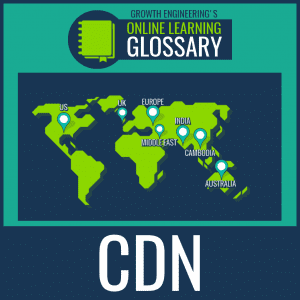
 What is a CDN? Or given its full name, a content delivery network.
If you’re rolling out an international training programme, or perhaps even working with a vendor based in another country, then you could run the risk of facing technical issues…
We think of the internet as offering us instantaneous communication, but unfortunately, we’re still constrained by those pesky laws of physics.
An optical fibre cable will carry signals at roughly 60-70% of the speed of light. Though this is very fast, it still means that when transferring data across a 16,000-kilometer distance (say, from the UK to Australia), there will be a minimum delay of 80 milliseconds.
This might not sound like much, but it adds up. Sending something simple like text will be quick and the delay will be subtle. But sending something data-rich, such as an eLearning unit or video, will take a long time to load. And this is without considering the time it takes servers and computers to process all of this data!
So what’s the solution to keep things moving quickly? A CDN.
What is a Content Delivery Network (CDN)?
 A Content Delivery Network, or CDN, will allow you to offer a smooth, fast, and seamless experience to your learners, no matter where they might be in the world!
A CDN consists of a number of servers distributed geographically. So, for a global training programme, you might have one server placed within each continent or even each country involved.
These servers will copy the content of a website, or a learning management system so that a cached version is readily available. As new content is added, it will get pushed out to these servers, so that they can stay up to date.
When a user tries to access the website, their request will be automatically redirected to the closest server, which will send the cached content to them.
Because the physical distance between the user and this server is much shorter than the distance to the original one, the data can be transferred far more quickly!
Benefits of CDNs in online learning
 The obvious benefit of a CDN is that it means that your learners don’t have to wait until the next ice age to access their training content. Given that an estimated 40% of people will abandon a website if it takes more than three seconds to load, this is a massive help in maintaining engagement!
Speed is becoming even more of an issue as mobile device usage continues to blossom. Mobile devices don’t always have as much processing power as desktops or laptops, and sometimes have to rely on mobile signals rather than Wi-Fi, so any efforts to reduce load times will make a big difference.
A CDN will also have a big impact on reducing the strain on servers. This is good news because it will improve the overall performance of your system, and will lessen the risk of outages, so you can rest easy without worrying about a Code Red situation!
Finally, one of the CDN’s most noble attributes is that it’s happy to run quietly as an unsung hero, going largely unnoticed by the user. Most major websites will redirect visitors to the correct CDN, even taking them to a new URL, but it happens so quickly that the average user isn’t even aware. This means that everyone can continue enjoying superfast online learning in peace.
Keep an eye out for plenty more entries into our Online Learning Glossary over the coming weeks!
And if you’re looking to put together a massively successful online training programme, then you’ve come to the right place! Download your free Engagement Engine Workbook to map out a strategy which uses gamification, social and personalised learning: