

 In order to compete in a global and ever changing economy, companies are increasingly beginning to recognise the importance of individual employee contributions. Now, L&D departments are seeking ways to capture informal learning and encourage a culture of knowledge sharing.
But before they can promote informal learning, they need to understand what it means.
Formal learning is anything that has been pre-arranged and prescribed as part of the training programme. Informal learning is everything else that happens outside of that framework. As it’s so often overlooked by L&D departments, you might think that informal learning is negligible but you’d be dead wrong.
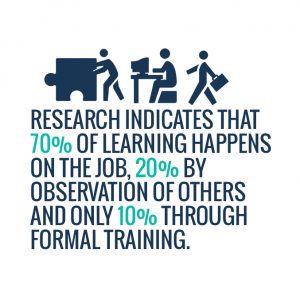 Research indicates that 70% of learning happens on the job, 20% by observing others and only 10% through formal training. In fact, most business leaders now rate informal approaches (such as on-the-job experience, mentoring and coaching) as having more impact than formal training initiatives.
Informal learning happens all the time in every organization, but it’s something that tends to disappear under the radar.
Recognising the knowledge that exists within workforce is key to capturing it. Rather than the traditional, top-down model of training, managers should view learning as a continuous cycle that captures both formal and informal experiences.
Most learning platforms only focus on delivering training content. They seldom do anything to promote informal learning and certainly don’t provide a means of capturing it. This means that formal and informal training are not delivered concurrently. Moreover, an enormous percentage of workplace learning goes ignored, reducing the impact of the learning programme as a whole.
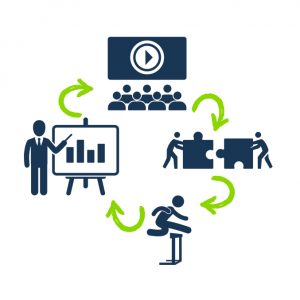 L&D need to have a clear engagement strategy, as well as the processes and systems in place to ensure that learners participate in informal learning.
Reward and recognition gives employees an incentive to share their knowledge. We’ve added game mechanics to our learning platform, encouraging learners to contribute to the knowledge pool. Every time a learner shares their knowledge, they earn badges and experience points.
Aggregate Industries reinforce their formal sales training content with user-generated content. As part of their programme, employees upload case studies demonstrating how they have applied the knowledge.
Managers and their colleagues are then rewarded for commenting and praising their colleagues for their contribution to the knowledge pool. The process helps to:
- Reinforce the knowledge of the learner.
- Create a culture that rewards knowledge sharing and promotes informal learning.
The right technology can unlock more opportunities for sharing knowledge. The more knowledge is shared and disseminated, the quicker the organisation can react and respond to change.
If L&D departments want to deliver a return on investment, social features can help them get the most out of informal learning within the organisation. It’s only by promoting knowledge sharing across the board, that they can start making a meaningful impact on company culture.